


Related on Lably
Through Omnivore, Carnivore and North America
Taxonomy
Classification
Mesonychidae was named by Cope (1875), with its type genus, Mesonyx, being assigned to Carnivora. However, in a later paper, mesonychids would be moved to Creodonta by Cope (1880). In their 1966 paper, Van Valen recovered mesonychids from as Condylarthra. In their following paper, Van Valen would rank up mesonychids to an order known as Mesonychia, a consensus supported by all recent studies.
Relationship with Cetacea
Because skulls and teeth of mesonychids have similar features to early whales, and the family was long thought to be the ancestors of cetaceans. However, fossil discoveries have overturned this idea; the consensus is that whales are highly derived artiodactyls. Some researchers now consider the family a sister group either to whales or to artiodactyls, close relatives rather than direct ancestors. Other studies define Mesonychia as basal to all ungulates, occupying a position between Perissodactyla and Ferae. In this case, the resemblances to early whales would be due to convergent evolution among ungulate-like herbivores that developed adaptations related to hunting or eating meat.
Sign in to keep reading
2 more chapters are free with a Lably account.
Description
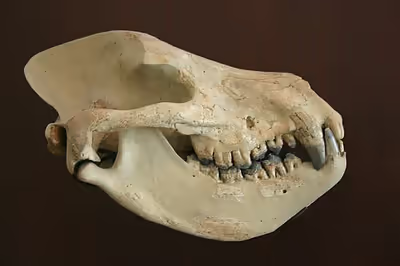
The mesonychids were an unusual group of condylarths with a specialized dentition featuring tri-cuspid upper molars and high-crowned lower molars with shearing surfaces.Like the Paleocene family Arctocyonidae, mesonychids were once viewed as primitive carnivorans. Various genera and species coexisted in some localities, such as the Lushi Formation. In contrast to arctocyonids, the mesonychids had only four digits furnished with hooves supported by narrow fissured end phalanges. Mesonychids varied in diet from the carnivorous to bone-crushing carrion specialists.
Evolutionary history
Mesonychids probably originated in Asia, where the oldest mesonychids, Yantanglestes, Dissacus rotundus, Hukoutherium, and Dissaccussium , are known from the Early Paleocene. Throughout the Paleocene and Eocene, several genera, including Dissacus, Pachyaena, and Mesonyx would radiate out from their ancestral home in Asia and disperse into North America via the Bering land bridge. From North America, mesonychids would disperse into Europe. Mesonychids fared very poorly at the close of the Eocene epoch. Originally, it was thought that only one genus, Mongolestes, survived into the Early Oligocene epoch, going extinct 33 million years ago. However, recent analysis found the supposed Early Oligocene biochronogical units have been revised to the Late Eocene age, suggesting the family went extinct just before the end of the Eocene.