

Messier object
Astronomical objects catalogued by Charles Messier
- 3 min read
- 4 chapters

Related on Lably
Through Astronomical object, Comet and Nebula
A preliminary version of the catalogue first appeared in 1774 in the Memoirs of the French Academy of Sciences for the year 1771. The first version of Messier's catalogue contained 45 objects, which were not numbered. Eighteen of the objects were discovered by Messier; the rest had been previously observed by other astronomers. By 1780 the catalogue had increased to 70 objects. The final version of the catalogue containing 103 objects was published in 1781 in the Connaissance des Temps for the year 1784. However, due to what was thought for a long time to be the incorrect addition of Messier 102, the total number remained 102. Other astronomers, using side notes in Messier's texts, eventually expanded the list to 110 objects.
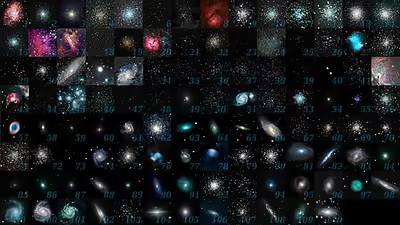
The catalogue consists of a diverse range of astronomical objects, from star clusters and nebulae to galaxies. For example, Messier 1 is a supernova remnant, known as the Crab Nebula, and the great spiral Andromeda Galaxy is M31. Further inclusions followed.
Lists and editions
The first edition of 1774 covered 45 objects (M1 to M45). The total list published by Messier in 1781 contained 103 objects, but the list was expanded through successive additions by other astronomers, motivated by notes in Messier's and Méchain's texts indicating that at least one of them knew of the additional objects. The first such addition came from Nicolas Camille Flammarion in 1921, who added Messier 104 after finding a note Messier made in a copy of the 1781 edition of the catalogue. M105 to M107 were added by Helen Sawyer Hogg in 1947, M108 and M109 by Owen Gingerich in 1960, and M110 by Kenneth Glyn Jones in 1967. M102 was observed by Méchain, who communicated his notes to Messier. Méchain later concluded that this object was simply a re-observation of M101, though some sources suggest that the object Méchain observed was the galaxy NGC 5866 and identify that as M102.
Messier's final catalogue was included in the Connaissance des Temps pour l'Année 1784 [Knowledge of the Times for the Year 1784], the French official yearly publication of astronomical ephemerides.
Messier lived and conducted his astronomical work at the Hôtel de Cluny (now the Musée national du Moyen Âge), in Paris, France. The list he compiled contains only objects found in the sky area he could observe from the north celestial pole to a celestial latitude of about −35.7°. He did not observe or list objects visible only from farther south, such as the Large and Small Magellanic Clouds.
Sign in to keep reading
3 more chapters are free with a Lably account.
Observations
The Messier catalogue comprises nearly all of the most spectacular examples of the five types of deep-sky object – diffuse nebulae, planetary nebulae, open clusters, globular clusters, and galaxies – visible from European latitudes. Furthermore, almost all of the Messier objects are among the closest to Earth in their respective classes, which makes them heavily studied with professional class instruments that today can resolve small and visually significant details in them. A summary of the astrophysics of each Messier object can be found in the Concise Catalog of Deep-sky Objects.
Since these objects could be observed visually with the relatively small-aperture refracting telescope (approximately 100 mm ≈ 4 inches) used by Messier to study the sky from downtown Paris, they are among the brightest and thus most attractive astronomical objects (of the class popularly called deep-sky objects) observable from Earth, and are popular targets for visual study and astrophotography available to modern amateur astronomers using larger aperture equipment. In early spring, astronomers sometimes gather for "Messier marathons", when all of the objects can be viewed over a single night.
Messier objects
Open clusterGlobular clusterDiffuse nebulaPlanetary nebulaSupernova remnantGalaxy Other