

Microcline
Igneous rock-forming feldspar mineral
- 1 min read
- 2 chapters

Related on Lably
Through Igneous rock, Mineral and Potassium
The chemical compound name is potassium aluminium silicate, and it is known as E number reference E555.
Geology
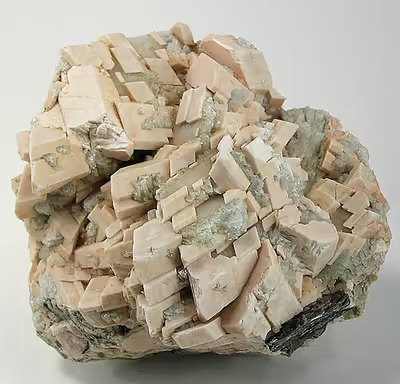
Microcline may be chemically the same as monoclinic orthoclase, but because it belongs to the triclinic crystal system, the prism angle is slightly less than right angles; hence the name "microcline" from the Greek "small slope". Microcline is identical to orthoclase in many physical properties, and can be distinguished by x-ray or optical examination. When viewed under a polarizing microscope, microcline exhibits a minute multiple twinning which forms a grating-like structure that is unmistakable.
Perthite is either microcline or orthoclase with thin lamellae of exsolved albite.
Amazon stone, or amazonite, is a green variety of microcline. It is not found anywhere in the Amazon Basin, however. The Spanish explorers who named it apparently confused it with another green mineral from that region.
The largest documented single crystals of microcline were found in Devil's Hole Beryl Mine, Colorado, US and measured ~50 × 36 × 14 m. This could be one of the largest crystals of any material found so far.
Microcline is exceptionally active ice-nucleating agent in the atmosphere. Recently it has been possible to understand how water binds to the microcline surface.
Sign in to keep reading
One more chapter is free with a Lably account.
As food additive
The chemical compound name is potassium aluminium silicate, and it is known as E number reference E555. It was the subject in 2018 of a Call for technical and toxicological data from the EFSA.
In 2008, it (along with other aluminium compounds) was the subject of a Scientific Opinion of the Panel on Food Additives, Flavourings, Processing Aids and Food Contact Materials from the EFSA.