

Mole salamander
Genus of amphibians
- 6 min read
- 6 chapters

Related on Lably
Through Burrow and Invertebrate
General description
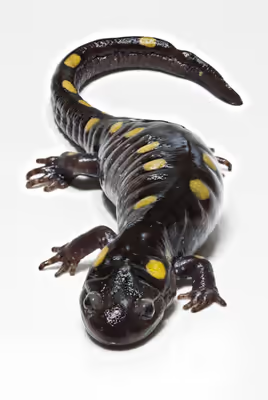
Terrestrial mole salamanders are identified by having wide, protruding eyes, prominent costal grooves, and thick arms. Most have vivid patterning on dark backgrounds, with marks ranging from deep blue spots to large yellow bars depending on the species. Terrestrial adults spend most of their lives underground in burrows, either of their own making or abandoned by other animals. Some northern species may hibernate in these burrows throughout the winter. They live alone and feed on any available invertebrate. Adults spend little time in the water, only returning to the ponds of their birth to breed.
All mole salamanders are oviparous and lay large eggs in clumps in the water. Their fully aquatic larvae are branchiate, with three pairs of external gills behind their heads and above their gill slits. Larvae have large caudal fins, which extend from the back of their heads to their tails and to their cloacae. Larvae grow limbs soon after hatching, with four toes on the fore arms, and five toes on the hind legs. Their eyes are wide-set and lack true eyelids.
The larvae of some species (especially those in the south, and tiger salamanders) can reach their adult size before undergoing metamorphosis. During metamorphosis, the gills of the larvae disappear, as do the fins. Their tails, skin, and limbs become thicker, and the eyes develop lids. Their lungs become fully developed, allowing for a fully terrestrial existence.
Some species of mole salamanders (as well as populations of normally terrestrial species) are neotenic (retaining their larval form into adulthood). The most famous example is the axolotl. They cannot produce thyroxine, so their only means of metamorphosis is mainly through the outside injection of it. This usually shortens the lifespan of the salamander.
Sign in to keep reading
5 more chapters are free with a Lably account.
Tiger salamander complex
Morphologically, tiger salamanders (Ambystoma tigrinum complex) have large heads, small eyes, and thick bodies. This basic morphology is similar across most mole salamanders (genus Ambystoma), though tiger salamanders are among the largest of the mole salamanders, and have relatively large larvae.
Tiger salamanders inhabit a wide variety of ecosystems across North America. Given this geographic diversity, subpopulations of tiger salamanders exhibit morphological and behavioral diversity. Whether subpopulations constitute independent species or subspecies within the Ambystoma tigrinum complex, as well as the driving forces behind diversification, remains an active area of research as of 2024. Several subspecies within the Ambystoma tigrinum complex have been reclassified as an independent species. For example:
- Ambystoma mavortium (barred tiger salamander) comprises former subspecies A. t. diaboli, A. t. mavortium, A. t. melanostictum, A. t. nebulosum, and A. t. stebbinsi.
- Ambystoma californiense (California tiger salamander)
- Ambystoma velasci (Plateau tiger salamander), which may be paraphyletic and shares habitats with axolotl (A. mexicanum)
Hybrid all-female populations
Unisexual (all-female) populations of ambystomatid salamanders are widely distributed across the Great Lakes region and northeastern North America. The females require sperm from a co‑occurring, related species to fertilize their eggs and initiate development. Usually the eggs then discard the sperm genome and develop asexually (i.e., gynogenesis, with premeiotic doubling); however, they may incorporate the genome from the sperm into the resulting offspring. Sperm incorporation commonly takes the form of genome addition (resulting in ploidy elevation in the offspring), or genome replacement, wherein one of the maternal genomes is discarded. This unique mode of reproduction has been termed kleptogenesis by Bogart and colleagues. This is in contrast to hybridogenesis, where the maternal genomes are passed hemiclonally and the paternal genome is discarded every generation before the egg matures and reacquired from the sperm of another species.
The nuclear DNA of the unisexuals generally comprises genomes from up to five species: the blue-spotted salamander (A. laterale), Jefferson salamander (A. jeffersonianum), small-mouthed salamander (A. texanum), streamside salamander (A. barbouri), and tiger salamander (A. tigrinum), denoted respectively as L, J, Tx, B, and Ti. This flexibility results in a large number of possible nuclear biotypes (genome combinations) in the unisexuals. For example, an LJJ individual would be a triploid with one A. laterale genome and two A. jeffersonianum genomes, while an LTxJTi individual would be a tetraploid with genomes from four species. Because they have hybrid genomes, unisexual salamanders are a cryptic species with morphology similar to coexisting species. For example, LLJs look like blue-spotted salamanders and LJJs look like Jefferson salamanders. Silvery salamanders LJJ (A. platineum), Tremblay's salamanders LLJ (A. tremblayi), and Kelly's Island salamanders LTxTx and LTxTi (A. nothagenes) were initially described as species. Species names were later dropped for all unisexual salamanders because of the complexity of their genomes. The offspring of a single mother may have different genome complements; for example, a single egg mass may have both LLJJ and LJJ larvae.
Despite the complexity of the nuclear genome, all unisexuals form a monophyletic group based on their mitochondrial DNA. The maternal ancestor of the unisexual ambystomatids was most closely related to the streamside salamander, with the original hybridization likely occurring 2.4~3.9 million years ago, making it the oldest known lineage of all-female vertebrates. The hybridization was most probably with an A. laterale. All known unisexuals have at least one A. laterale genome and this is thought to be essential for unisexuality. However, the A. laterale genome has been replaced several times, independently, in each of the lineages by matings with A. laterale.
Limb regeneration
Ambystoma mexicanum, a neotenic salamander with exceptional regenerative capabilities is one of the principal models for studying limb regeneration. Limb regeneration involves the propagation of a mass of low differentiated and highly proliferative cells termed the blastema. During limb regeneration, blastema cells experience DNA double-strand breaks and thus require homologous recombination, a form of DNA repair that deals with double-strand breaks.
Taxonomy
Rhyacosiredon was previously considered a separate genus within the family Ambystomatidae. However, cladistic analysis of the mole salamanders found the existence of Rhyacosiredon makes Ambystoma paraphyletic, since the species are more closely related to some Ambystoma species than those species are to others in Ambystoma. The stream-type morphology of these salamanders (which includes larvae and neotenes with short gills and thicker gular folds) may have led to their misclassification as a different genus.
The genus name Ambystoma was given by Johann Jakob von Tschudi in 1839. Tschudi did not provide a derivation for the name, and many thought that he intended the name Amblystoma, "blunt-mouth". Occasionally, old specimens and documents use the name Amblystoma. Writing in 1907, Leonhard Stejneger offered a derivation of Ambystoma based on a contraction of a Greek phrase meaning "to cram into the mouth", but others have not found this explanation convincing. In the absence of clear evidence that Tschudi committed a lapsus, the name given in 1839 stands.
Species
The genus Ambystoma contains 32 extant species, listed below, the most recently-named being A. bishopi. Some species are terrestrial, others are neotenic, and some species have established populations of both neotenic and terrestrial forms.
In addition, two groups of unisexual hybrid populations are sometimes named under their own species:
- Silvery salamander (A. platineum)
- Tremblay's salamander (A. tremblayi)
Fossil species
Several extinct species of Ambystoma are known from fossils found throughout North America. These include: