


Related on Lably
Through India, Economy of India and Investor
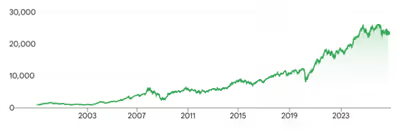
The NIFTY 50 is widely regarded as the benchmark index of the Indian equity market and is commonly used to measure the overall performance of large-cap Indian stocks. Because its constituents represent companies from 13 sectors of the Indian economy, the index serves as a reference for investors, fund managers, and financial analysts when evaluating market trends and portfolio performance.
The NIFTY 50 index ecosystem consists of index funds (both onshore and offshore mutual funds and ETFs), and futures and options at NSE and NSE International Exchange (through GIFT Nifty). In 2016, NIFTY 50 was reported by the WFE and FIA as the world's most actively traded index options contract, but it was later overtaken by Nifty Bank. In 2024, NIFTY 50 overtook Nifty Bank after the latter's weekly expiry contracts were discontinued.
As of August 2026, NIFTY 50 gives a weightage of 36.47% to financial services including banking, 9.52% to oil and gas, 8.48% to information technology, 7.06% to automotive, and 5.41% to fast moving consumer goods.
Methodology
The NIFTY 50 index is a free float market capitalisation-weighted index.
Stocks are added to the index based on the following criteria:
- Must have traded at an average impact cost of 0.50% or less during the last six months for 90% of the observations, for the basket size of Rs. 100 million.
- The company should have a listing history of 6 months.
- Companies that are allowed to trade in F&O segment are only eligible to be constituent of the index.
- The company should have a minimum listing history of 1 month as on the cutoff date
The index was initially calculated on a full market capitalization methodology. On 26 June 2009, the computation was changed to a free-float methodology. The base period for the NIFTY 50 index is 3 November 1995, which marked the completion of one year of operations of the equity market segment on NSE. The base value of the index has been set at 1,000 and a base capital of ₹2.06 trillion.
The index is re-balanced on semi-annual basis. The cut-off date is 31 January and 31 July every year; further, average data for the previous six months from the cut-off date is considered to filter stocks. A notice of 4 weeks from the date of change is given to market participants so that they can prepare for any changes.
Sign in to keep reading
5 more chapters are free with a Lably account.
Constituents
The Nifty 50 has the following constituents, as of 8 December 2025.
Index changes
Changes in index constituents since Nifty 50 since 2005:
Statistics
Record values
Milestones
Major single day falls
The following table lists some of the notable single-day falls of the NIFTY 50 index.
Major single day gains
The following table lists some of the notable single-day gains of the NIFTY 50 index.
Annual returns
The following table shows the annual development of the NIFTY 50 since 2000. The historical daily returns data can be accessed from the NSE website.
Derivatives
Trading in futures and options on the NIFTY 50 is offered by the NSE and NSE International Exchange (NSEIX). NSE offers weekly as well as monthly expiry options.
NSE allows international traders to trade on the NIFTY 50 by GIFT NIFTY. The same index had previously operated under the name SGX Nifty, and was traded on the Singapore Exchange. It was rebranded to GIFT Nifty on 3 July 2023; trading was then moved to the NSE International Exchange (NSEIX), situated in GIFT City, Gandhinagar. The CEO of NSEIX called it a watershed moment since it was the first time India got back an international contract which had previously been exported.
NIFTY Next 50
NIFTY Next 50, also called NIFTY Junior, is an index of 50 companies whose free float market capitalisation comes after that of the companies in NIFTY 50. NIFTY Next 50 constituents are thus potential candidates for future inclusion in NIFTY 50.