

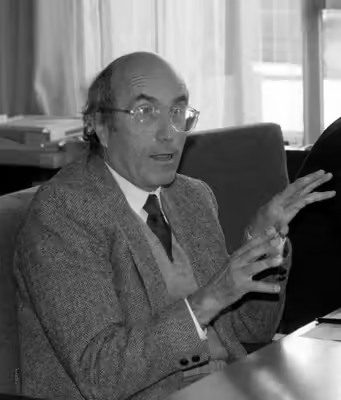
Niklas Luhmann
German sociologist (1927–1998)
- 2 min read
- 1 chapter

Related on Lably
Through Sociology, Systems theory and Globalization
Niklas Luhmann is one of the most influential German sociologists of the 20th century. His thinking was based on the philosophical tradition and at the same time the reception of a wide variety of concepts from modern science. From this foundation he developed a functionalist-oriented systems theory, which claims to be able to describe all social phenomena in a theoretically consistent language.
Social systems are understood as communication contexts that have autonomy from the actors involved in them. On this basis, three types of social systems can be distinguished: interaction, organization and society.
On his general theory he developed a social theory, which describes modern society as a global society that is characterized by an internal differentiation into various autonomously working functional areas such as politics, law, economics, science, religion and art. According to Luhmann, their operations can not be coordinated centrally.
Biography
Luhmann was born in Lüneburg, Free State of Prussia, where his father's family had been running a brewery for several generations. He entered the Gymnasium Johanneum at Lüneburg in 1937. In 1943, he was conscripted as a Luftwaffenhelfer in World War II and served for two years until, at the age of 17, he was taken prisoner of war by American troops in 1945. After the war Luhmann studied law at the University of Freiburg from 1946 to 1949, where he obtained a law degree, and then began a career in Lüneburg's public administration. During a sabbatical in 1961, he went to Harvard, where he met and studied under Talcott Parsons, then the world's most influential social systems theorist.
In later days, Luhmann dismissed Parsons' theory, developing a rival approach of his own. Leaving the civil service in 1962, he lectured at the national Deutsche Hochschule für Verwaltungswissenschaften (University for Administrative Sciences) in Speyer, Germany. In 1965, he was offered a position at the Sozialforschungsstelle an der Universität Münster (Social Research Centre of the University of Münster), led by Helmut Schelsky. From 1965/66 he studied one semester of sociology at the University of Münster.
Two earlier books were retroactively accepted as a PhD thesis and habilitation at the University of Münster in 1966, qualifying him for a university professorship. In 1968/1969, he briefly served as a lecturer at Theodor Adorno's former chair at the University of Frankfurt and then was appointed full professor of sociology at the newly founded Bielefeld University, Germany (until 1993). When asked about his research plan, he said, "The theory of modern society. Duration 30 years. No costs."
He continued to publish after his retirement, when he finally found the time to complete his magnum opus, Die Gesellschaft der Gesellschaft (literally, "The Society of Society"), which was published in 1997, and has been translated into English as Theory of Society (volume I in 2012 and volume II in 2013). This work describes segmented societies divided into specialized functional subsystems.