


Related on Lably
Through Phylogenetic tree, Fossil and South America
Description
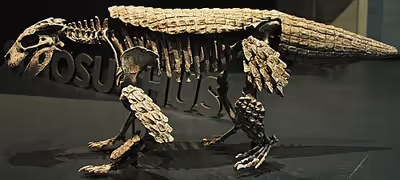
Notosuchians were generally small, with slender bodies and erect limbs. The most distinctive characteristics are usually seen in the skull. Notosuchian skulls are generally short and deep. While most are relatively narrow, some are very broad. Simosuchus has a broadened skull and jaw that resembles a pug, while Anatosuchus has a broad, flat snout like that of a duck.
The teeth vary greatly between different genera. Many have heterodont dentitions that vary in shape across the jaw. Often, there are large canine-like teeth protruding from the front of the mouth and broader molar-like teeth in the back. Some genera, such as Yacarerani and Pakasuchus, have extremely mammal-like teeth. Their molars are complex and multicuspid, and are able to occlude or fit with one another. Some forms such as Malawisuchus had jaw joints that enabled them to move the jaw back and forth in a shearing motion rather than just up and down.
A derived group of notosuchians, the baurusuchids differ considerably from other forms. They are very large in comparison to other notosuchians and are exclusively carnivorous. Baurusuchids have deep skulls and prominent canine-like teeth.
Recent research found Araripesuchus wegeneri, Armadillosuchus arrudai, Baurusuchus, Iberosuchus macrodon, and Stratiotosuchus maxhechti were ectothermic organisms
Sign in to keep reading
2 more chapters are free with a Lably account.
Classification
Taxonomy
Genera
The evolutionary interrelationships of Notosuchia are in flux, but the following genera are generally considered notosuchians:
Phylogeny
The clade Notosuchia has undergone many recent phylogenetic revisions. In 2000, Notosuchia was proposed to be one of two groups within the clade Ziphosuchia, the other being Sebecosuchia, which included deep snouted forms such as baurusuchids and sebecids. The definition of Notosuchia by Sereno et al. (2001) is similar to that of Ziphosuchia as it includes within it Sebecosuchia. Pol (2003) also includes Sebecosuchia within Notosuchia. More recently, a phylogenetic analysis by Larsson and Sues (2007) resulted in the naming of a new clade, Sebecia, to include sebecids and peirosaurids. Baurusuchidae was considered to be polyphyletic in this study, with Pabwehshi being a basal member of Sebecia and Baurusuchus being the sister taxon to the clade containing Neosuchia and Sebecia. Thus, Sebecosuchia was no longer within Notosuchia and not considered to be a true clade, while Notosuchia was found to be a basal clade of Metasuchia.
The following cladogram simplified after the most comprehensive analysis of notosuchians as of 2014, presented by Pol et al. in 2014. It is based mainly on the data matrix published by Pol et al. (2012) which is itself a modified version of previous analyses. Thirty-one additional characters were added from other comprehensive analyses of notosuchians, e.g. Turner and Sertich (2010), Andrade et al. (2011), Montefeltro et al. (2011), Larsson and Sues (2007), and Novas et al. (2009), and 34 characters were noval, resulting in a matrix that includes 109 crocodyliforms and outgroup taxa which are scored based on 412 morphological traits.
This cladogram represents the results of the most comprehensive analysis of notosuchian relationships to date, performed in the description of Antaeusuchus taouzensis by Nicholl et al. 2021. It is largely based on the matrix from the above Pol et al. 2014 study, but also adding character scores from Leardi et al. 2015, Fiorelli et al. 2016, Leardi et al. 2018, and Martinez et al. 2018. The final matrix consisted of 121 taxa scored for 443 morphological traits.
Subclades
There is uncertainty on the precise interrelationships between different notosuchian families. This is a summary on the phylogenetic definitions of higher-level notosuchian clades from Leardi et al. 2024.