


Related on Lably
Through Friction, Tension (physics) and Compression (physics)
In applications where vibration or rotation may work a nut loose, various locking mechanisms may be employed: lock washers, jam nuts, eccentric double nuts, specialist adhesive thread-locking fluid such as Loctite, safety pins (split pins) or lockwire in conjunction with castellated nuts, nylon inserts (nyloc nut), or slightly oval-shaped threads.
Square nuts, as well as bolt heads, were the first shape made and used to be the most common largely because they were much easier to manufacture, especially by hand. While rare today due to the reasons stated below for the preference of hexagonal nuts, they are occasionally used in some situations when a maximum amount of torque and grip is needed for a given size: the greater length of each side allows a spanner to be applied with a larger surface area and more leverage at the nut.
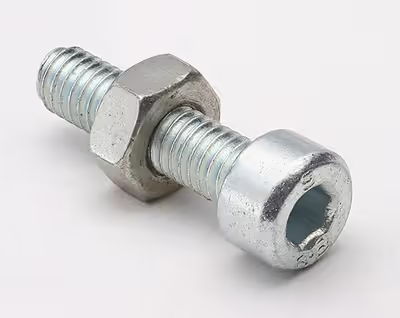
The most common shape today is hexagonal, for similar reasons as the bolt head: six sides give a good granularity of angles for a tool to approach from (good in tight spots), but more (and smaller) corners would be vulnerable to being rounded off. It takes only one sixth of a rotation to obtain the next side of the hexagon and grip is optimal. However, polygons with more than six sides do not give the requisite grip and polygons with fewer than six sides require greater space to manoeuvre a spanner between engagements, or the use of a ratchet. Other specialized shapes exist for certain needs, such as wingnuts for finger adjustment and captive nuts (e.g. cage nuts) for inaccessible areas.
History
Nuts and bolts were originally hand-crafted together, so that each nut matched its own bolt, but they were not interchangeable. This made it virtually impossible to replace lost or damaged fasteners, as they were all different. Joseph Whitworth in 1841 proposed that a standard should be set, but it did not happen immediately.
In 1851, the Great Exhibition of the Works of Industry of All Nations was to be held in Hyde Park, London, England, and it was decided to build the Crystal Palace as part; this had to be done in 190 days, and at reasonable cost. Research into the remains of the destroyed building in 2024 revealed a major innovation that made this possible. The construction firm responsible, Fox Henderson, decided to use nuts and bolts, but to use standardised sizes, a revolutionary method at the time. This enabled the building to be completed in time. The use of interchangeable nuts and bolts was so successful that the Whitworth standard was widely adopted. A British standard was not formally adopted until 1905.
Sign in to keep reading
4 more chapters are free with a Lably account.
Types
There is a wide variety of nuts, from household hardware versions to specialized industry-specific designs that are engineered to meet various technical standards. Fasteners used in automotive, engineering, and industrial applications usually need to be tightened to a specific torque setting, using a torque wrench. Nuts are graded with strength ratings compatible with their respective bolts; for example, an ISO property class 10 nut will be able to support the bolt proof strength load of an ISO property class 10.9 bolt without stripping.
Locknuts
Many specialised types of nut exist to resist loosening of bolted joints, either by providing a prevailing torque against the male fastener or by gripping against the bolted components. These are generally referred to as locknuts.
- Castellated nut
- Distorted thread locknut
- Centerlock nut
- Elliptical offset locknut
- Toplock nut
- Interfering thread nut
- Tapered thread nut
- Jam nut
- Jet nut (K-nut)
- Keps nut (K-nut or washer nut) with a star-type lock washer
- Nyloc plate nut
- Polymer insert nut (Nyloc)
- Security locknut
- Serrated face nut
- Serrated flange nut
- Speed nut (Sheet metal nut or Tinnerman nut)
- Split beam nut
- BINX nut
Standard nut sizes
Metric hex nuts
Note that flat (spanner or wrench) sizes differ between industry standards. For example, wrench sizes of fastener used in Japanese built cars comply with JIS automotive standard.
SAE hex nuts
Classifications
Hex nuts, recognized by their six-sided shape, and square nuts, with a square form, are commonly used. Steel nuts are strong and great for construction, while stainless steel ones resist rust, perfect for outdoor use. Brass nuts, corrosion-resistant, find their place in electrical and plumbing work. Lock nuts, like nylon-insert or prevailing torque types, prevent loosening due to vibration or torque, catering to specific needs across industries.
Manufacture
The manufacturing process of nuts involves several steps. It begins with the selection of raw materials like steel, stainless steel, or brass, depending on the desired type of nut. The chosen material undergoes cold forming, hot forming, or machining processes to create the basic shape of the nut. Threads are then cut or formed onto the nut using specialized machinery. After threading, nuts may undergo additional treatments such as heat treatment or surface finishing to enhance their strength, durability, or appearance. Some nuts are manufactured according to international standards such as ISO, DIN, or ANSI, to ensure compatibility with bolts worldwide. Quality control checks are performed throughout the manufacturing process to ensure that the nuts meet industry standards and specifications.