

Outrigger
Projecting structure on a boat
- 2 min read
- 3 chapters

Related on Lably
Powered vessels and sailboats
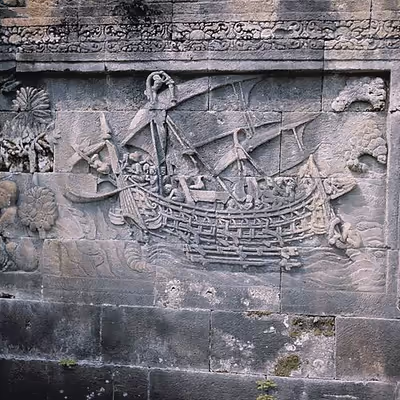
An outrigger describes any contraposing float rigging beyond the side (gunwale) of a boat to improve the vessel's stability. If a single outrigger is used it is usually but not always windward. The technology was originally developed by the Austronesian people. There are two main types of boats with outriggers: double outriggers (prevalent in maritime Southeast Asia) and single outriggers (prevalent in Madagascar, Melanesia, Micronesia and Polynesia). Multihull ships are also derived from outrigger boats.
In an outrigger canoe and in sailboats such as the proa, an outrigger is a thin, long, solid, hull used to stabilise an inherently unstable main hull. The outrigger is positioned rigidly and parallel to the main hull so that the main hull is less likely to capsize. If only one outrigger is used on a vessel, its weight reduces the tendency to capsize in one direction and its buoyancy reduces the tendency in the other direction.
On a keelboat, "outrigger" refers to a variety of structures by which the running rigging (such as a sheet) may be attached outboard (outside the lateral limits) of the boat's hull. The Racing Rules of Sailing generally prohibit such outriggers, though they are explicitly permitted on specific classes, such as the IMOCA Open 60 used in several major offshore races.
Sign in to keep reading
2 more chapters are free with a Lably account.
Fishing
In fishing from vessels, an outrigger is a pole or series of adjustable poles that allow boats to trawl more lines in the water without tangling and simulates a school of fish. It is attached to the fishing boat's sides in front of the hull. They are typically made from metal or plastic and provide stability for the fishing boat and fishing platform.
Rowing
In a rowing boat or galley, an outrigger (or rigger) is a triangular frame that holds the rowlock (into which the oar is slotted) away from the saxboard (or gunwale in gig rowing) to optimize leverage. Wooden outriggers appear on the new trireme around the 7th or 6th centuries BC and later on Italian galleys around AD 1300, while Harry Clasper (1812–1870), a British professional rower, popularised the use of the modern tubular-metal version and the top rowing events accepted the physiological and ergonomic advantages so acceded to its use in competitions . In recent decades, some manufacturers of racing shells have developed wing-riggers which are reinforced arcs or flattened tubular projections akin to aircraft wings, instead of conventional triangular structures.