


Related on Lably
Through Chemical formula, VSEPR theory and Molecular geometry
Preparation
Oxygen difluoride was first reported in 1929; it was obtained by the electrolysis of molten potassium fluoride and hydrofluoric acid containing small quantities of water. The modern preparation entails the reaction of fluorine with a dilute aqueous solution of sodium hydroxide, with sodium fluoride as a side-product:
- 2 F2 + 2 NaOH → OF2 + 2 NaF + H2O
Sign in to keep reading
4 more chapters are free with a Lably account.
Structure and bonding
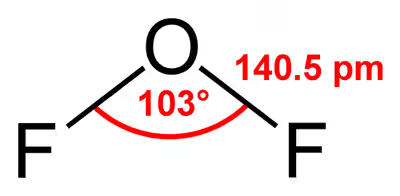
It is a covalently bonded molecule with a bent molecular geometry and a F-O-F bond angle of 103 degrees. Its powerful oxidizing properties are suggested by the oxidation number of +2 for the oxygen atom instead of its normal −2.
Reactions
Above 200 °C, OF2 decomposes to oxygen and fluorine by a radical mechanism.
- 2 OF2 → O2 + 2 F2
OF2 reacts with many metals to yield oxides and fluorides. Nonmetals also react: phosphorus reacts with OF2 to form PF5 and POF3; sulfur gives SO2 and SF4; and unusually for a noble gas, xenon reacts (at elevated temperatures) yielding XeF4 and xenon oxyfluorides.
Reactions of oxygen difluoride and hydrogen halides or halide salts produce the free halogen. For example:
4 HCl + OF2 → 2 HF + H2O + 2 Cl2
Oxygen difluoride reacts with water to form hydrofluoric acid:
- OF2 + H2O → 2 HF + O2
It can oxidize sulfur dioxide to sulfur trioxide and elemental fluorine:
- OF2 + SO2 → SO3 + F2
However, in the presence of UV radiation, the products are sulfuryl fluoride (SO2F2) and pyrosulfuryl fluoride (S2O5F2):
- OF2 + 2 SO2 → S2O5F2
Safety
Oxygen difluoride is considered an unsafe gas due to its oxidizing properties. It reacts explosively with water, hydrogen sulfide, sulfur tetrafluoride, diborane, nitrogen oxides, nitrosyl fluoride, and charcoal. It also reacts with halogens, reducing agents, adsorbent materials, combustibles, platinum, hydrocarbons, metal oxides, red phosphorus, boron powder, steam, and moist air. The gas is heavier than air, and upon escape from containment, the concentration of OF2 in the air quickly becomes hazardous. Hydrofluoric acid, produced by the hydrolysis of OF2 with water, is highly corrosive and toxic, capable of causing necrosis, leaching calcium from the bones and causing cardiovascular damage, among a host of other highly toxic effects. Acute poisoning effects from OF2 include: pulmonary edema, bleeding lungs, headaches, and skin and eye irritation or burns. Short-term exposure can cause lachrymation (secretion of tears, especially in abnormal abundance). and irritation of the respiratory tract. Chronic exposure to oxygen difluoride, like that of other chemicals that release fluoride ions, can lead to fluorosis and other symptoms of chronic fluoride poisoning. Oxygen difluoride may be associated with kidney damage. The maximum workplace exposure limit is 0.05 ppm.
Fresh air, rest, and immediate medical attention are needed upon inhalation of OF2 as the symptoms of lung edema often are not present until a few hours have passed, and they are aggravated by physical effort.
Popular culture
In Robert L. Forward's science fiction novel Camelot 30K, oxygen difluoride was used as a biochemical solvent by fictional life forms living in the solar system's Kuiper belt. While OF2 would be a solid at 30 K, the fictional alien lifeforms were described as endothermic, maintaining elevated body temperatures and liquid OF2 blood by radiothermal heating.