

Pioneer 11
First spacecraft to visit Saturn (1973–1995)
- 9 min read
- 6 chapters

Related on Lably
Through Solar wind, Escape velocity and Solar System
Mission background
History
Approved in February 1969, Pioneer 11 and its twin spacecraft, Pioneer 10, were the first probes designed to explore the outer Solar System. Early mission objectives, developed from proposals made throughout the 1960s, were to:
- Explore the interplanetary medium beyond the orbit of Mars.
- Investigate the asteroid belt and assess its potential hazard to missions to the outer planets.
- Explore Jupiter and its environment.
After a Saturn encounter was added to the mission plan, additional objectives included:
- Map Saturn's magnetic field and determine its strength, direction, and structure.
- Measure the distribution of electrons and protons of different energies along the spacecraft's trajectory through the Saturnian system.
- Study the interaction between Saturn's magnetosphere and the solar wind.
- Measure the temperatures of Saturn's atmosphere and of Titan, Saturn's largest moon.
- Investigate the structure of Saturn's upper atmosphere, including its ionosphere.
- Map the thermal structure of Saturn's atmosphere using infrared observations and radio occultation measurements.
- Obtain two-color spin-scan images of the Saturnian system and polarimetric measurements of Saturn.
- Study Saturn's rings and atmosphere using S-band radio occultation.
- Improve estimates of the masses of Saturn and its larger moons by measuring their gravitational effects on the spacecraft's trajectory.
- Characterize the environment of Saturn's ring plane in preparation for the planned Voyager program, helping determine whether it could be crossed safely without serious damage to a spacecraft.
Pioneer 11 was built by TRW Inc. and managed by NASA Ames Research Center as part of the Pioneer program. A backup spacecraft, Pioneer H, is on display in the "Milestones of Flight" exhibit at the National Air and Space Museum. Many aspects of the mission informed the planning and design of the Voyager program.
Spacecraft design
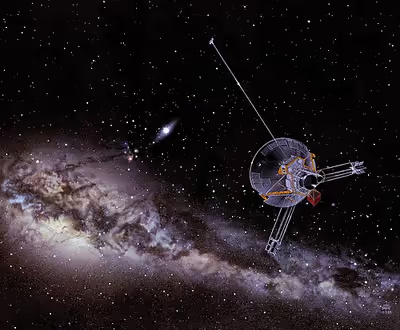
The Pioneer 11 bus is 36 cm (14 in) deep and consists of six 76 cm (30 in) panels forming a hexagonal structure. The bus houses the propellant used to control the spacecraft’s orientation and eight of its 12 scientific instruments. The spacecraft has a mass of 259 kg (571 lb).
The spacecraft's orientation was maintained by six 4.5 N hydrazine monopropellant thrusters. The thrusters were arranged in three pairs: one pair maintained a constant spin rate of 4.8 rpm, another controlled forward thrust, and the third controlled attitude. Orientation information was provided by conical scanning maneuvers used to track Earth as it orbited the Sun, a star tracker capable of tracking Canopus, and two Sun sensors.
Communication system
Pioneer 11 had a redundant communications system with two transceivers: one connected to the high-gain antenna and the other to the omnidirectional and medium-gain antennas. Each transceiver had a power output of 8 W and operated in the S band, receiving commands from Earth at 2110 MHz and transmitting data at 2292 MHz. The Deep Space Network tracked the spacecraft's signal. Before transmission, the probe used convolutional coding to allow errors in the received data to be detected and corrected on Earth.
Power
Pioneer 11 used four SNAP-19 radioisotope thermoelectric generators (RTGs). The RTGs were mounted on two three-rod trusses, each 3 m (9 ft 10 in) long and positioned 120 degrees apart. This arrangement was intended to keep the RTGs a safe distance from the spacecraft's sensitive scientific instruments. Together, the RTGs provided 155 W of power at launch, decreasing to 140 W during the spacecraft's journey to Jupiter. The spacecraft required 100 W to operate all systems.
Computers
Much of the computation for Pioneer 11 was performed on Earth, with commands transmitted to the spacecraft. Pioneer 11 could store up to five commands at a time from a library of 222 commands prepared by ground controllers. Its command system consisted of two command decoders and a command distribution unit, which provided limited onboard processing for directing spacecraft operations. This system required mission operators to prepare commands well in advance of transmission.
A data storage unit could record up to 6,144 bytes of data collected by the scientific instruments. A digital telemetry unit then organized the data into one of 13 possible formats before transmitting them to Earth.
Scientific instruments
Pioneer 11 had one more instrument than Pioneer 10, a fluxgate magnetometer.
Sign in to keep reading
5 more chapters are free with a Lably account.
Mission profile
Launch and trajectory
Pioneer 11 was launched on April 6, 1973, at 02:11:00 UTC from Cape Canaveral Launch Complex 36A in Florida aboard an Atlas-Centaur launch vehicle with a Star-37E upper stage. Its twin spacecraft, Pioneer 10, had been launched on March 3, 1972.
Pioneer 11 was initially launched on a direct trajectory to Jupiter without any gravity assists. In May 1974, mission controllers adjusted its trajectory to pass Jupiter on a north-to-south path, enabling a flyby of Saturn in 1979. The maneuver used 17 lb (7.7 kg) of propellant, lasted 42 minutes and 36 seconds, and increased the spacecraft's speed by 230 km/h (140 mph). Pioneer 11 also performed two mid-course correction maneuvers, on April 11, 1973, and November 7, 1974.
Encounter with Jupiter
Pioneer 11 encountered Jupiter in November and December 1974. At closest approach on December 2, it passed 42,828 km (26,612 mi) above the planet's cloud tops. The spacecraft returned detailed images of the Great Red Spot, transmitted the first close-up views of Jupiter's polar regions, and refined estimates of the mass of the moon Callisto. Jupiter's gravity was also used for a gravity-assist maneuver that redirected the spacecraft toward Saturn and increased its velocity. On April 16, 1975, after the Jupiter encounter, the micrometeoroid detector was switched off.
Media related to Pioneer 11 Jupiter encounter at Wikimedia Commons
Encounter with Saturn
Pioneer 11 flew past Saturn on September 1, 1979, passing about 21,000 km (13,000 mi) above the planet's cloud tops. During the encounter, it returned 440 images and collected data on Saturn, its rings, and its moons.
By then, Voyager 1 and Voyager 2 had already flown past Jupiter and were en route to Saturn. Mission planners directed Pioneer 11 to cross Saturn's ring plane along the same path later planned for Voyager 2 on its way to Uranus and Neptune. If hazardous ring particles were present, Pioneer 11 would detect them first, allowing Voyager 2's trajectory to be changed if necessary, although doing so would have prevented its later encounters with the ice giants.
During the flyby, Pioneer 11 passed within about 4,000 km (2,500 mi) of one of Saturn's small moons. The object was initially identified as Epimetheus, which had been discovered only the previous day from images returned by Pioneer 11 and had also been suspected from earlier Earth-based observations. After the Voyager missions, astronomers determined that two similarly sized moons, Epimetheus and Janus, share nearly the same orbit, leaving some uncertainty over which moon Pioneer 11 actually passed. The spacecraft encountered Janus on September 1, 1979, at 14:52 UTC, passing within 2,500 km (1,600 mi), and later flew past Mimas at 16:20 UTC the same day at a distance of 103,000 km (64,000 mi).
In addition to observing Epimetheus, Pioneer 11 detected another previously unknown small moon and a previously unknown ring, mapped Saturn's magnetosphere and magnetic field, and found Titan's surface temperature to be about −193 °C (−315 °F), indicating that the moon was too cold to support life as it was understood at the time. Passing beneath the ring plane, the spacecraft returned images of Saturn's rings from a unique viewing angle. Rings that appear bright when viewed from Earth appeared dark in Pioneer 11's images, while the dark gaps visible from Earth appeared bright.
Media related to Pioneer 11 Saturn encounter at Wikimedia Commons
Interstellar mission
On February 25, 1990, Pioneer 11 became the fourth human-made object to pass beyond the orbits of the planets.
By 1995, Pioneer 11 could no longer power any of its scientific instruments, so NASA decided to end routine operations. On 29 September 1995, NASA's Ames Research Center, which managed the mission, announced that the mission would soon end after nearly 22 years of exploration. NASA planned to use its Deep Space Network antennas to listen for the spacecraft's signal once or twice a month until late 1996, when its transmitter was expected to fall silent.
NASA terminated routine contact with Pioneer 11 on 30 September 1995 but continued to contact the spacecraft for about two hours every two to four weeks. Scientists received several minutes of usable engineering data on 24 November 1995, but then lost contact permanently after Earth moved out of the spacecraft's antenna field of view.
Timeline
Current status
Due to limited power and the spacecraft's great distance from Earth, the last routine contact with Pioneer 11 was on September 30, 1995, and the last usable engineering data were received on November 24, 1995.
As of June 24, 2024, Pioneer 11 was estimated to be 113.121 AU (16.9227×10⁹ km; 10.5153×10⁹ mi) from Earth and 114.089 AU (17.0675 billion km; 10.6052 billion mi) from the Sun. It was traveling at 11.155 km/s (40,160 km/h; 24,950 mph) relative to the Sun and receding from the Sun at about 2.35 AU per year. The spacecraft is traveling toward the constellation Scutum, near right ascension 18h 54m and declination -8° 46' (J2000.0), close to Messier 26. In about 928,000 years, it is expected to pass within 0.25 parsecs (0.82 light-years) of the K-type star TYC 992-192-1. It is also expected to pass near Lambda Aquilae in about four million years.
Pioneer 11 has been overtaken by the two Voyager spacecraft launched in 1977. Voyager 1 is now the most distant human-made object and is expected to remain so for the foreseeable future, as no spacecraft launched since Voyager 1 has sufficient speed to overtake it.
Pioneer anomaly
Analysis of the radio tracking data from the Pioneer 10 and 11 spacecraft at distances between 20 and 70 AU from the Sun had consistently indicated the presence of a small but anomalous Doppler frequency drift. The drift can be interpreted as due to a constant acceleration of (8.74 ± 1.33) × 10−10 m/s2 directed towards the Sun. Although it was suspected that there was a systematic origin to the effect, none was found. As a result, there has been sustained interest in the nature of this so-called "Pioneer anomaly". Extended analysis of mission data by Slava Turyshev and colleagues determined the source of the anomaly to be asymmetric thermal radiation and the resulting thermal recoil force acting on the face of the Pioneers away from the Sun.
Pioneer plaque
Pioneer 10 and 11 both carry a gold-anodized aluminum plaque in the event that either spacecraft is ever found by intelligent lifeforms from other planetary systems. The plaques feature the nude figures of a human male and female along with several symbols that are designed to provide information about the origin of the spacecraft.
Commemoration
In 1991, Pioneer 11 was honored on one of 10 United States Postage Service stamps commemorating uncrewed spacecraft exploring each of the then nine planets and the Moon. Pioneer 11 was the spacecraft featured with Jupiter. Pluto was listed as "Not yet explored".