


Related on Lably
Through Asia, Americas and Central Asia
These snakes range in size from the diminutive hump-nosed viper (Hypnale hypnale), which grows to a typical total length (including tail) of only 30–45 cm (12–18 in); to the bushmaster (Lachesis muta), a species known to reach a maximum total length of 3.65 m (12.0 ft) in length.
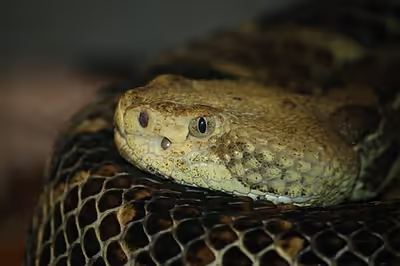
This viper subfamily is unique in that all member species share a common characteristic – a deep pit, or fossa, in the loreal area between the eye and the nostril on either side of the head. These loreal pits are the external openings to a pair of extremely sensitive infrared-detecting organs, which in effect give the snakes a "sixth sense" to help them find and perhaps even judge the size of the small, warm-blooded prey on which they feed upon.
Among vipers, these snakes are also unique in that they have a specialized muscle, called the muscularis pterigoidius glandulae, between the venom gland and the head of the ectopterygoid. Contraction of this muscle, together with that of the muscularis compressor glandulae, forces venom out of the gland.
Evolution
The earliest known fossil pit viper remains are from the Early Miocene of Nebraska. As pit vipers are thought to have had an Asian origin before eventually colonizing the Americas, this suggests that they must have originated and diversified even earlier. During the Late Miocene, they reached as far west as eastern Europe, where they are no longer found; it is thought that they did not expand further into Europe.
Sign in to keep reading
6 more chapters are free with a Lably account.
Geographic range
The subfamily Crotalinae is found from Central Asia eastward and southward to Japan, China, Indonesia, peninsular India, Nepal, Bangladesh and Sri Lanka. In the Americas, they range from southern Canada southward to Central America to southern South America.
Habitat
Crotalines are a versatile subfamily, with members found in habitats ranging from parched desert (e.g., the sidewinder, Crotalus cerastes) to rainforests (e.g., the bushmaster, Lachesis muta). They may be either arboreal or terrestrial, and at least one species (the cottonmouth, Agkistrodon piscivorus) is semiaquatic. The altitude record is held jointly by Crotalus triseriatus in Mexico and Gloydius strauchi in China, both of which have been found above the treeline at over 4,000 m above sea level.
Behavior
Although a few species of crotalines are highly active by day, such as Trimeresurus trigonocephalus, a bright green pit viper endemic to Sri Lanka, most are nocturnal, preferring to avoid high daytime temperatures and to hunt when their favored prey are also active. The snakes' heat-sensitive pits are also thought to aid in locating cooler areas in which to rest.
As ambush predators, crotalines typically wait patiently somewhere for unsuspecting prey to wander by. At least one species, the arboreal Gloydius shedaoensis of China, is known to select a specific ambush site and return to it every year in time for the spring migration of birds. Studies have indicated these snakes learn to improve their strike accuracy over time.
Many temperate species of pit vipers (e.g. most rattlesnakes) congregate in sheltered areas or "dens" to overwinter (brumate, see hibernation), the snakes benefiting from the combined heat. In cool temperatures and while pregnant, pit vipers also bask on sunny ledges. Some species do not mass together in this way, for example the copperhead, Agkistrodon contortrix, or the Mojave rattlesnake, Crotalus scutulatus.
Like most snakes, crotalines keep to themselves and strike only if cornered or threatened. Smaller snakes are less likely to stand their ground than larger specimens. Pollution and the destruction of rainforests have caused many pit viper populations to decline. Humans also threaten pit vipers, as many are hunted for their skins or killed by cars when they wander onto roads.
Reproduction
With few exceptions, crotalines are ovoviviparous, meaning that the embryos develop within eggs that remain inside the mother's body until the offspring are ready to hatch, when the hatchlings emerge as functionally free-living young. In such species, the eggshells are reduced to soft membranes that the young shed, either within the reproductive tract, or immediately after emerging.
Among the oviparous (egg-laying) pit vipers are Lachesis, Calloselasma, and some Trimeresurus species. All egg-laying crotalines are believed to guard their eggs.
Brood sizes range from two for very small species, to as many as 86 for the fer-de-lance, Bothrops atrox, which is among the most prolific of all live-bearing snakes.
Many young crotalines have brightly coloured tails that contrast dramatically with the rest of their bodies. These tails are known to be used by a number of species in a behavior known as caudal luring; the young snakes make worm-like movements with their tails to lure unsuspecting prey within striking distance.
Taxonomy
In the past, the pit vipers were usually classed as a separate family: the Crotalidae. Today, however, the monophyly of the viperines and the crotalines as a whole is undisputed, which is why they are treated here as a subfamily of the Viperidae.
Genera
*) Not including the nominate subspecies.
T) Type genus.