

Planckian locus
Locus of colors of incandescent black bodies within a color space
- 5 min read
- 2 chapters

Related on Lably
Through Physics, Black-body radiation and Temperature
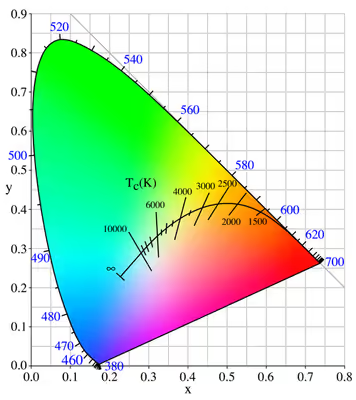
A color space is a three-dimensional space; that is, a color is specified by a set of three numbers (the CIE coordinates X, Y, and Z, for example, or other values such as hue, colorfulness, and luminance) which specify the perceived attributes of a particular homogeneous visual stimulus. A chromaticity is a color projected into a two-dimensional space that ignores brightness. For example, the standard CIE XYZ color space projects directly to the corresponding chromaticity space specified by the two chromaticity coordinates known as x and y, making the familiar chromaticity diagram shown in the figure. The Planckian locus, the path that the color of a black body takes as the blackbody temperature changes, is often shown in this standard chromaticity space.
Planckian locus in the XYZ color space
In the CIE XYZ color space, the three coordinates defining a color are given by X, Y, and Z:
where M(λ,T) is the spectral radiant exitance of the light being viewed, and X(λ), Y(λ) and Z(λ) are the color matching functions of the CIE standard colorimetric observer, shown in the diagram on the right, and λ is the wavelength. The Planckian locus is determined by substituting into the above equations the black body spectral radiant exitance, which is given by Planck's law:
where:
- c1 = is the first radiation constant
- c2 = is the second radiation constant
and
- M is the black body spectral radiant exitance (power per unit area per unit wavelength: watt per square meter per meter (W/m3))
- T is the temperature of the black body
- h is the Planck constant
- c is the speed of light
- k is the Boltzmann constant
This will give the Planckian locus in CIE XYZ color space. If these coordinates are XT, YT, ZT where T is the temperature, then the CIE chromaticity coordinates will be
Note that in the above formula for Planck's Law, you might as well use c1L = 2hc2 (the first radiation constant for spectral radiance) instead of c1 (the "regular" first radiation constant), in which case the formula would give the spectral radiance L(λ,T) of the black body instead of the spectral radiant exitance M(λ,T). However, this change only affects the absolute values of XT, YT and ZT, not the values relative to each other. Since XT, YT and ZT are usually normalized to YT = 1 (or YT = 100) and are normalized when xT and yT are calculated, the absolute values of XT, YT and ZT do not matter. For practical reasons, c1 might therefore simply be replaced by 1.
Approximation
The Planckian locus in xy space is depicted as a curve in the chromaticity diagram above. While it is possible to compute the CIE xy co-ordinates exactly given the above formulas, it is faster to use approximations. Since the mired scale changes more evenly along the locus than the temperature itself, it is common for such approximations to be functions of the reciprocal temperature. Kim et al. use a cubic spline:
The Planckian locus can also be approximated in the CIE 1960 color space, which is used to compute CCT and CRI, using the following expressions:
This approximation is accurate to within and for . Alternatively, one can use the chromaticity (x, y) coordinates estimated from above to derive the corresponding (u, v), if a larger range of temperatures is required.
The inverse calculation, from chromaticity co-ordinates (x, y) on or near the Planckian locus to correlated color temperature, is discussed in Correlated color temperature § Approximation.
The color of an infinitely hot blackbody.
#94b1ff
Infinite temperature
The Planckian locus terminates at CIE xy coordinates (0.2399, 0.2340), or an sRGB value of (148, 177, 255) or #94b1ff, a light blue color known as perano. This is because of the Rayleigh-Jeans law, which states that at frequencies much lower than the peak frequency of a black-body radiator, spectral power is inversely proportional to the fourth power of the wavelength. As a black-body's temperature approaches infinity, its color converges to the aforementioned shade of blue.
Sign in to keep reading
One more chapter is free with a Lably account.
Correlated color temperature
The correlated color temperature (Tcp) is the temperature of the Planckian radiator whose perceived colour most closely resembles that of a given stimulus at the same brightness and under specified viewing conditions
— CIE/IEC 17.4:1987, International Lighting Vocabulary (ISBN 3900734070)
The mathematical procedure for determining the correlated color temperature involves finding the closest point to the light source's white point on the Planckian locus. Since the CIE's 1959 meeting in Brussels, the Planckian locus has been computed using the CIE 1960 color space, also known as MacAdam's (u,v) diagram. Today, the CIE 1960 color space is deprecated for other purposes:
The 1960 UCS diagram and 1964 Uniform Space are declared obsolete recommendation in CIE 15.2 (1986), but have been retained for the time being for calculating colour rendering indices and correlated colour temperature.
— CIE 13.3 (1995), Method of Measuring and Specifying Colour Rendering Properties of Light Sources
Owing to the perceptual inaccuracy inherent to the concept, it suffices to calculate to within 2 K at lower CCTs and 10 K at higher CCTs to reach the threshold of imperceptibility.
International Temperature Scale
The Planckian locus is derived by the determining the chromaticity values of a Planckian radiator using the standard colorimetric observer. The relative spectral power distribution (SPD) of a Planckian radiator follows Planck's law, and depends on the second radiation constant, . As measuring techniques have improved, the General Conference on Weights and Measures has revised its estimate of this constant, with the International Temperature Scale (and briefly, the International Practical Temperature Scale). These successive revisions caused a shift in the Planckian locus and, as a result, the correlated color temperature scale. Before ceasing publication of standard illuminants, the CIE worked around this problem by explicitly specifying the form of the SPD, rather than making references to black bodies and a color temperature. Nevertheless, it is useful to be aware of previous revisions in order to be able to verify calculations made in older texts:
- = 1.432×10⁻² m·K (ITS-27). Note: Was in effect during the standardization of Illuminants A, B, C (1931), however the CIE used the value recommended by the U.S. National Bureau of Standards, 1.435 × 10⁻²
- = 1.4380×10⁻² m·K (IPTS-48). In effect for Illuminant series D (formalized in 1967).
- = 1.4388×10⁻² m·K (ITS-68), (ITS-90). Often used in recent papers.
- = 1.4387770(13)×10−2 m·K (CODATA 2010)
- = 1.43877736(83)×10−2 m·K (CODATA 2014)
- = 1.438776877...×10−2 m·K (CODATA 2018). Current value, as of 2020. The 2019 revision of the SI fixed the Boltzmann constant to an exact value. Since the Planck constant and the speed of light were already fixed to exact values, that means that c2 is now an exact value as well. Note that ... doesn't indicate a repeating fraction; it merely means that of this exact value only the first ten digits are shown.