


Related on Lably
Through Species, North America and Atlantic Ocean
Distribution
Pollicipes pollicipes is chiefly distributed from 48°N to 28°N, along the coasts of France, Spain (including the Canary Islands), Portugal, Morocco, and south to Senegal. The periphery of the species' range also extends as far north as Ireland, with outlying populations on the south coast of England and possibly in southwestern Ireland, although there are no recent records there. The species is present, but rare, in the Mediterranean Sea. It is possible that the outlying populations are not self-sustaining, being instead maintained by immigration of larvae from self-sustaining core populations.
A population disjunctly located around the tropical Cape Verde Islands at about 16°N was described in 2010 as a new species, Pollicipes caboverdensis.
Sign in to keep reading
One more chapter is free with a Lably account.
Ecology
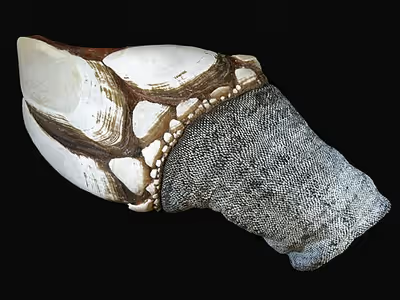
Pollicipes pollicipes grows in groups on rocks, as well as on the hulls of shipwrecks and on driftwood. It is a filter feeder, living on particles that it can glean from the water passing over its extended cirri; these possess a complex assortment of setae, enabling P. pollicipes to have a varied diet, including diatoms, detritus, large crustaceans, copepods, shrimp and molluscs.
The larvae pass through seven free-swimming stages (six nauplii and one cypris) over the course of at least a month. After this time, they settle into the adult, sessile form.
Pollicipes pollicipes is harvested for consumption in many parts of its range, mostly for the Spanish market, where (marketed as percebe gallego) it may sell for as much as €90 per kilogram. As a result, the species is thought to be in decline. It is harvested manually, and archaeological evidence suggests that the species has been harvested in this way for over 10,000 years.