

Polykarp Kusch
German–American physicist (1911–1993)
- 2 min read
- 3 chapters

Explore on Lably
ToursExplore Lably’s 3D toursBiography
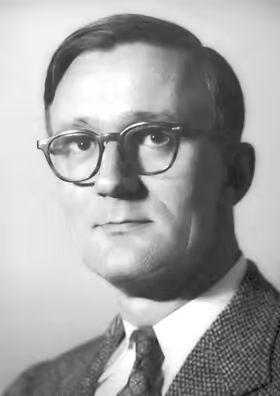
Polykarp Kusch was born on January 26, 1911, in Blankenburg, Germany, the son of John Mathias Kusch, a Lutheran missionary, and Henrietta van der Haas. In 1912, Kusch and his family emigrated to the United States, where he naturalized as a U.S. citizen in 1922.
After graduating from grade school in the Midwest, Kusch attended Case Institute of Technology (CIT) in Cleveland, Ohio (now Case Western Reserve University), where he majored in physics. After graduating from CIT with a B.S. in 1931, Kusch entered the University of Illinois, from which he received his M.S. in 1933. He continued his education at the same alma mater, studying under Francis Wheeler Loomis. For his work in the field of optical molecular spectroscopy, he received his Ph.D. in 1936.
In 1937, Kusch moved to Columbia University, where he spent much of his career as a professor and served as its provost for one year in 1970–1971. He worked on molecular beam resonance studies under I. I. Rabi, then discovered the electron anomalous magnetic moment. Many measurements of magnetic moments and hyperfine structure followed. He expanded into chemical physics and continued to publish research on molecular beams. In 1972, he left Columbia to become a professor at the University of Texas at Dallas, remaining there until his retirement in 1982.
Sign in to keep reading
2 more chapters are free with a Lably account.
Personal life
In 1935, Kusch married Edith Starr McRoberts, with whom he had three daughters. Edith died in 1959, and the following year he married Betty Pezzoni. They had two daughters. Kusch House, a residential dormitory for undergraduate students at Case Western Reserve University in Cleveland, Ohio on the South Campus, is named after Kusch. It is located on Carlton Road in Cleveland Heights. The University of Texas at Dallas has a Polykarp Kusch Auditorium with a plaque.
Kusch died on March 20, 1993, in Dallas at the age of 82.