

R136
Super star cluster in the constellation Dorado, in the Large Magellanic Cloud
- 2 min read
- 2 chapters

Related on Lably
Through Parsec
Properties
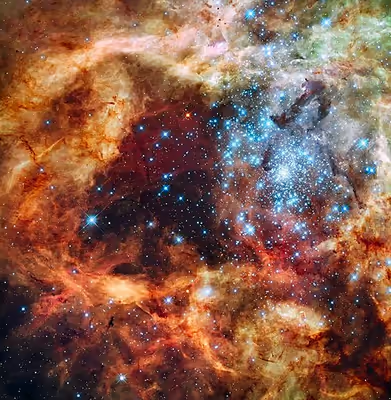
R136 produces most of the energy that makes the Tarantula Nebula visible. The estimated mass of the cluster is 450,000 solar masses, suggesting it may become a globular cluster in the future. R136 has around 200 times the stellar density of a typical OB association such as Cygnus OB2. The central R136 concentration of the cluster is about 2 parsecs across, although the whole NGC 2070 cluster is much larger.
R136 is thought to be less than 2 million years old. None of the member stars are significantly evolved, and none are thought to have exploded as supernova. Because of this, the cluster contains no red supergiants, blue hypergiants, or luminous blue variables. The brightest stars are WNh, O supergiants, and OIf/WN slash stars, all extremely massive fully convective stars. A small number of B-type main sequence stars have been detected in the outskirts of the cluster, but less massive and less luminous stars cannot be resolved from the dense cluster core at the large distance of the LMC.
R136a
R136a is the bright knot at the centre of R136. It consists of eight extremely massive stars, three of them Wolf–Rayet stars and the rest early O-class stars.
Sign in to keep reading
One more chapter is free with a Lably account.
Components
The cluster contains many of the most massive and luminous stars known, including R136a1. Within the central 5 parsecs there are 32 of the hottest type O stars (O2.0–3.5), 40 other O stars, and 12 Wolf–Rayet stars, mostly of the extremely luminous WNh type. Within 150 parsecs there are a further 325 O stars and 19 Wolf–Rayet stars. Several runaway stars have been associated with R136, including VFTS 682. R136 was first resolved into three components R136a, R136b, and R136c. R136a was resolved using speckle interferometry and eventually space-based observations into as many as 24 components, dominated by R136a1, R136a2, and R136a3, all three being extremely massive WNh stars several million times more luminous than the sun.