


Related on Lably
Through Radiant energy, Frequency and Wavelength
Mathematical definitions
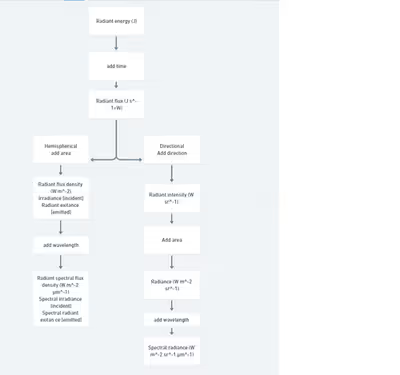
Radiant flux
Radiant flux, denoted Φe ('e' for "energetic", to avoid confusion with photometric quantities), is defined as where
- Qe is the radiant energy passing out of a closed surface Σ in time interval T;
- t is time;
- A is the area of the surface Σ;
- S is the Poynting vector, representing the directional flow of energy per unit time, per unit area;
- n is the unit normal vector to the differential area element dA.
The rate of energy flow through the surface fluctuates at the frequency of the radiation, but radiation detectors only respond to the average rate of flow. This is represented by replacing the Poynting vector with the time average of its norm, giving where ⟨-⟩ is the time average, and α is the angle between n and S.
Spectral flux
Spectral flux in frequency, denoted Φe,ν, is defined as where ν is the frequency.
Spectral flux in wavelength, denoted Φe,λ, is defined as where λ is the wavelength.
Sign in to keep reading
One more chapter is free with a Lably account.
SI radiometry units
More in Physics
PhysicsScientific field of studyUltravioletForm of electromagnetic radiationIonParticle, atom or molecule with a net electrical chargeElectronElementary particle with negative chargeQuantum mechanicsDescription of physical properties at the atomic and subatomic scaleDigital object identifierISO standard unique string identifier for a digital object