


Related on Lably
Through Predation
These brown insects are primarily found in stagnant or slow-moving water like ponds, marshes and canals, but can also be seen in streams. Exceptionally they have been recorded from hypersaline lakes and brackish lagoons.
Biology
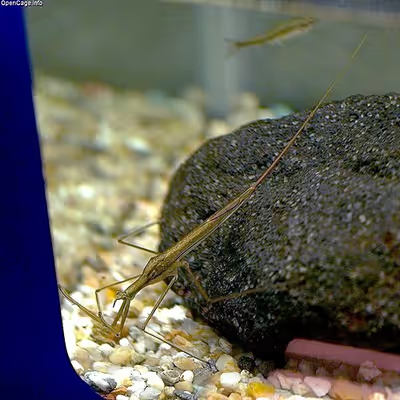
The front legs of bugs in Ranatra are strong and used to grasp prey. They typically eat other insects, tadpoles and small fish, which they pierce with their proboscis and inject a saliva which both sedates and begins to digest their prey. They are sit-and-wait predators that reside among water plants and position themselves head-down with their grasping legs extended out to surprise passing prey. At least one species will also swim in open water at night to catch zooplanktonic organisms. Like other members in the family they have a long tail-like siphon, or breathing tube, on the rear end of their body. The adult body length is generally 2–6 cm (0.8–2.4 in) depending on the exact species, and females average larger than males of the same species. The siphon is typically almost the same size, but varies from less than half the body length to somewhat longer. Two of the largest species are the East Asian R. chinensis and South American R. magna. Ranatra do have wings and they can fly.
The adults are active year-round, except in extreme cold. Their eggs are positioned on plants just below the water surface, but in some species they can be placed in mud. The eggs typically take two to four weeks to hatch and the young take about two months to mature.
Among the four genera in the subfamily Ranatrinae, Austronepa and Goondnomdanepa are restricted to Australia. Cercotmetus from Asia to New Guinea resembles Ranatra, although the former has a distinctly shorter siphon.
Sign in to keep reading
One more chapter is free with a Lably account.
Species
The Global Biodiversity Information Facility lists:
- Ranatra absona Drake & De Carlo, 1953
- Ranatra acapulcana Drake & De Carlo, 1953
- Ranatra adelmorpha Nieser, 1975
- Ranatra aethiopica Montandon, 1903
- Ranatra akoitachta Nieser, 1996
- Ranatra ameghinoi De Carlo, 1970
- Ranatra annulipes Stål, 1854
- Ranatra attenuata Kuitert, 1949
- Ranatra australis Hungerford, 1922 i c g b (southern water scorpion)
- Ranatra bachmanni De Carlo, 1954
- Ranatra bilobata Tran & Nguyen, 2016
- Ranatra biroi Lundblad, 1933
- Ranatra bottegoi Montandon, 1903
- Ranatra brasiliensis De Carlo, 1946
- Ranatra brevicauda Montandon, 1905
- Ranatra brevicollis Montandon, 1910 i c g b
- Ranatra buenoi Hungerford, 1922 i c g b
- Ranatra camposi Montandon, 1907
- Ranatra capensis Germar, 1837
- Ranatra cardamomensis Zettel, Phauk, Kheam & Freitag, 2017
- Ranatra chagasi De Carlo, 1946
- Ranatra chariensis Poisson, 1949
- Ranatra chinensis Mayr, 1865
- Ranatra cinnamomea Distant, 1904
- Ranatra compressicollis Montandon, 1898
- Ranatra costalimai De Carlo, 1954
- Ranatra cruzi De Carlo, 1950
- Ranatra curtafemorata Kuitert, 1949
- Ranatra denticulipes Montandon, 1907
- Ranatra digitata Hafiz & Pradhan, 1949
- Ranatra diminuta Montandon, 1907
- Ranatra dispar Montandon, 1903
- Ranatra distanti Montandon, 1910
- Ranatra doesburgi De Carlo, 1963
- Ranatra dolichodentata Kuitert, 1949
- Ranatra dormientis Zhang et al., 1994
- Ranatra drakei Hungerford, 1922
- Ranatra ecuadoriensis De Carlo, 1950
- Ranatra elongata Fabricius, 1790
- Ranatra emaciata Montandon, 1907
- Ranatra fabricii Guérin-Méneville, 1857
- Ranatra falloui Montandon, 1907
- Ranatra feana Montandon, 1903
- Ranatra fianarantsoana Poisson, 1963
- Ranatra filiformis Fabricius, 1790
- Ranatra flagellata Lansbury, 1972
- Ranatra flokata Nieser & Burmeister, 1998
- Ranatra fusca Palisot, 1820 i c g b (brown waterscorpion)
- Ranatra fuscoannulata Distant, 1904
- Ranatra galantae Nieser, 1969
- Ranatra gracilis Dallas, 1850
- Ranatra grandicollis Montandon, 1907
- Ranatra grandocula Bergroth, 1893
- Ranatra hechti De Carlo, 1967
- Ranatra heoki Tran & Poggi, 2019
- Ranatra heydeni Montandon, 1909
- Ranatra horvathi Montandon, 1910
- Ranatra hungerfordi Kuitert, 1949
- Ranatra incisa Chen, Nieser & Ho, 2004
- Ranatra instaurata Montandon, 1914
- Ranatra insulata Barber, 1939
- Ranatra jamaicana Drake & De Carlo, 1953
- Ranatra katsara Nieser, 1997
- Ranatra kirkaldyi Torre-bueno, 1905 i c g b
- Ranatra lanei De Carlo, 1946
- Ranatra lansburyi Chen, Nieser & Ho, 2004
- Ranatra lenti De Carlo, 1950
- Ranatra lethierryi Montandon, 1907
- Ranatra libera Zettel, 1999
- Ranatra linearis (Linnaeus, 1758) i c g
- Ranatra longipes Stål, 1861
- Ranatra lualalai Poisson, 1964
- Ranatra lubwae Poisson, 1965
- Ranatra machrisi Nieser & Burmeister, 1998
- Ranatra macrophthalma Herrich-Schäffer, 1849
- Ranatra maculosa Kuitert, 1949
- Ranatra magna Kuitert, 1949
- Ranatra malayana Lundblad, 1933
- Ranatra mediana Montandon, 1910
- Ranatra megalops Lansbury, 1972
- Ranatra mixta Montandon, 1907
- Ranatra moderata Kuitert, 1949
- Ranatra montei De Carlo, 1946
- Ranatra montezuma Polhemus, 1976
- Ranatra natalensis Distant, 1904
- Ranatra natunaensis Lansbury, 1972
- Ranatra neivai De Carlo, 1946
- Ranatra nieseri Tran & Nguyen, 2016
- Ranatra nigra Herrich-Schaeffer, 1849
- Ranatra nodiceps Gerstaecker, 1873
- Ranatra nodioeps Gerstaecker, 1873
- Ranatra obscura Montandon, 1907
- Ranatra occidentalis Lansbury, 1972
- Ranatra odontomeros Nieser, 1996
- Ranatra oliveiracesari De Carlo, 1946
- Ranatra operculata Kuitert, 1949
- Ranatra ornitheia Nieser, 1975
- Ranatra parmata Mayr, 1865
- Ranatra parvipes Signoret, 1861
- Ranatra parvula Kuitert, 1949
- Ranatra pittieri Montandon, 1910
- Ranatra protense Montandon
- Ranatra quadridentata Stål, 1862 i c g b
- Ranatra rabida Buchanan White, 1879
- Ranatra rafflesi Tran & D.Polhemus, 2012
- Ranatra rapax Stål, 1865
- Ranatra recta Chen, Nieser & Ho, 2004
- Ranatra robusta Montandon, 1905
- Ranatra sagrai Drake & De Carlo, 1953
- Ranatra sarmientoi De Carlo, 1967
- Ranatra sattleri De Carlo, 1967
- Ranatra schuhi D.Polhemus & J.Polhemus, 2012
- Ranatra segrega Montandon, 1913
- Ranatra signoreti Montandon, 1905
- Ranatra similis Drake & De Carlo, 1953
- Ranatra siolii De Carlo, 1970
- Ranatra sjostedti Montandon, 1911
- Ranatra spatulata Kuitert, 1949
- Ranatra spinifrons Montandon, 1905
- Ranatra spoliata Montandon, 1912
- Ranatra stali Montandon, 1905
- Ranatra sterea Chen, Nieser & Ho, 2004
- Ranatra subinermis Montandon, 1907
- Ranatra sulawesii Nieser & Chen, 1991
- Ranatra surinamensis De Carlo, 1963
- Ranatra texana Hungerford, 1930
- Ranatra thai Lansbury, 1972
- Ranatra titilaensis Hafiz & Pradhan, 1949
- Ranatra travassosi De Carlo, 1950
- Ranatra tridentata Poisson, 1965
- Ranatra tuberculifrons Montandon, 1907
- Ranatra unicolor Scott, 1874
- Ranatra unidentata Stål, 1861
- Ranatra usingeri De Carlo, 1970
- Ranatra varicolor Distant, 1904
- Ranatra varipes Stål, 1861
- Ranatra vitshumbii Poisson, 1949
- Ranatra wagneri Hungerford, 1929
- Ranatra weberi De Carlo, 1970
- Ranatra williamsi Kuitert, 1949
- Ranatra zeteki Drake & De Carlo, 1953
Data sources: i = ITIS, c = Catalogue of Life, g = GBIF, b = Bugguide.net