


Related on Lably
Through Canada, Renewable resource and Hydroelectricity
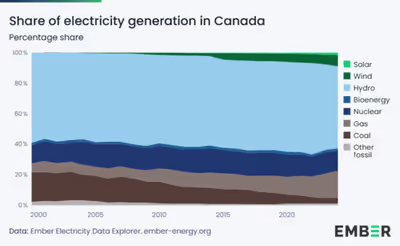
In 2020, Canada produced 435 terawatt hours (TWh) of electricity from renewable sources, representing 68% of its total electricity generation. Hydroelectric power was the primary source, accounting for 60% of the electricity mix. Over the last decade, wind and solar power generation in Canada saw considerable growth. Wind energy increased fourfold to 36 TWh, representing 5.6% of 2020's total electricity generation. Solar PV output grew from 0.3 TWh in 2010 to 4.3 TWh in 2020, accounting for 0.7%. Bioenergy, mainly from solid biomass, rose by 11%, making up 1.6% of the 2020 generation. As of 2021, Canada ranks as the fourth-largest producer of hydropower in the world by capacity.
From 2010 to 2017, the Environmental and Clean Technology (ECT) sector's growth rate outpaced Canada's overall economy by one-third. According to Simon Fraser University's Clean Energy Canada program, by June 2020, the sector employed 430,500 workers across Canada.
Overview
According to a 2017 Natural Resources Canada (NRCAN) document, renewable energy refers to energy sources that are replenished naturally and at a rate that is equal to or faster than the rate at which they are utilized. A variety of techniques and equipment in the environmental and clean technologies (ECT) sector have been developed and used to harness renewable resources for energy production.
The Daily reported in 2017, that the strong sales in renewable energy technologies and equipment reflected transitions made by Canada's towards a low-carbon economy. Companies engaged in these power generating projects including wind, solar, and hydro, reported revenues of $1.3 billion which represented 38% of total ECT sales.
In June 2021, the federal government invested $964-million program in ECT in the form of "wind, solar, storage, hydro, geothermal, tidal" and other renewable energy projects to lower emissions.
Politicians have expressed interest in increasing the percentage of Canada's electricity generated by renewable methods. Ontario has created a subsidy to assist wind and solar power producers.
All environmental and clean technology (ECT) activities accounted for 3.1% or $59.3 billion of the Canadian gross domestic product in 2016, edging up from 3.0% in 2007.
As of 2024, approximately 79% of Canada's electricity generation came from low-carbon sources, including hydroelectricity, wind, solar, and nuclear. Hydroelectric power remained the dominant source, accounting for roughly 55% of electricity generation, while wind and solar together contributed about 8.5%.
Canada has set a goal of achieving a net-zero electricity by 2035 as part of its broader strategy to reach economy-wide net-zero greenhouse-gas emissions by 2050.
Sign in to keep reading
3 more chapters are free with a Lably account.
Environmental and clean technology sector
The environmental and clean technology (ECT) sector includes goods and services that reduce environmental impact, such as such as renewable energy, clean electricity from wind, solar energy, and other renewable sources, power generation from nuclear sources, biofuels, waste management, and remediation services. Examples include designing and building structures that are energy-efficient and manufacturing solar panels, and Quebec's "municipal waste-to-energy industry".
In 2019, the value of the Canadian environmental and clean technology products sector was $70.5 billion, compared to $59.3 billion in 2016, representing 3% of the Canadian GDP. From 2010 to 2017, the sector experienced a growth rate that was one-third higher than the rest of the country's economy. The environmental and clean technology (ECT) products sector saw a 3.5% increase in GDP from 2018 to 2019.
All environmental and clean technology (ECT) activities accounted for 3.1% or $59.3 billion of the Canadian gross domestic product in 2016, edging up from 3.0% in 2007.
Simon Fraser University's Clean Energy Canada program reported that there were 430,500 ECT sector jobs in Canada in 2020.
In 2019, there were 339,000 ECT jobs in Canada, representing 1.7% of all jobs. Sixty percent of ECT workers had at least a high school education, about 25% had a college degree and about 20% had a university degree. Over 90% of jobs in the sector were full-time.
In Canada and the United States, clean energy workers tend to earn higher wages than the national median. In 2019, in Canada, males in administrative and regulatory positions in the ECT sector earned an annual salary of $93,294 on average; while women earned less—$64,363. The average annual wage in Canada was $63,490 in 2019, while in the ECT sector it was $$77,144.
Provinces and territories
Alberta
Energy generation from renewable sources increased by 66% between 2005—with 4,782 GW.h generated from renewables—to 2015, when 7,947 GW.h, representing 10% of total power generation in the province.
In June 2014, Medicine Hat, Alberta, opened the concentrated solar thermal installation connected to a thermal plant that was already in existence. Power from the installation along with natural gas fired plant provided power to the city. From 2008 to 2014, the city with considerable supply of natural gas reserves had invested about $4 million in renewable energy in a program called "Hat Smart". This included about a 100 projects involving solar energy.
As of 2018, Alberta had the highest GHG emission levels contributing to 37% of Canada's GHG emissions.
In December 2021, the Blackspring Ridge Wind Project expanded to 353MW.
According to a June 14, 2022 article in The Narwhal, one of the largest solar farms in Canada was in southern Alberta. The company, Travers Solar Farm secured a very large Amazon contract which provides stability for the company from volatility in the energy market. Amazon, which had also entered into large contracts for solar energy with the Calgary-based Greengate Power, benefits from the flexibility of Alberta's unique electricity system—which is not a monopoly or government owned—according to a University of Calgary economics professor, Blake Shaffer. Shaffer said that Alberta was experiencing a renewables boom in 2022, partly because the province has an "embarrassment of wind and solar riches", as the southern regions of both Alberta and Saskatchewan have the "best solar insolation in the country. As well, oil companies in Alberta are also making significant investments in renewable energy to "offset emissions".
British Columbia
As of 2016 98.4% of BC's electricity was generated from renewable sources. Hydro was the primary source of power generation (88%) followed by biomass at (9%) and wind (1.4%). As of 2016 there are four wind farms in operation in B.C of more than 10 MW of generation. Provincial Crown corporations own and operate about 80% of Renewable Energy infrastructure.
In 2024, BC Hydro committed to significantly increasing its wind energy capacity by initiating nine new wind farm projects. These are set to enhance the province's grid capacity by 8% with a total generation of nearly 5,000 gigawatt hours per year. This C$6 billion investment not only boosts British Columbia's renewable energy output but also strengthens partnerships with First Nations, who hold a 51% ownership in most of these projects, aligning economic development with environmental sustainability.
Manitoba
Most of Manitoba's electricity is generated through hydro-power. As of 2016, over 15 hydroelectric plants are located by the Nelson River. Two wind power facilities built at St. Leon and St. Joseph contribute over 200 MW of power. Provincial taxes were implemented on the use of coal and petroleum. There were plans to ban coal as a resource by 2017. Plans to reduce GHG's by 1⁄3 by the year 2030.
Ontario
Ontario led Canada with its wind and solar power capacity. The province phased out coal in 2014. The majority of the population used biomass energy. As of 2018 the Doug Ford administration cancelled the cap and trade program: "Effective July 3, 2018, we cancelled the cap and trade regulation and prohibited all trading of emission allowances." Current Provincial goals indicate a desire to increase renewable energy to over 20,000 MW by 2025 (half of the current generation).
As of 2018, the province has the second highest GHG emission levels contributing to 23% of Canada's GHG emissions.
Ontario's Green Energy and Green Economy Act, 2009 (GEGEA), previously in force, took a two-pronged approach to creating a renewable energy economy. The first was to bring more renewable energy sources to the province and the second was the creation of more energy efficiency measures to help conserve energy. The bill also appointed a Renewable Energy Facilitator to provide "one-window" assistance and support to project developers to help with project approvals. The approval process for transmission projects was also streamlined, and for the first time in Ontario, the bill enacted standards for renewable energy projects. Home owners had access to incentives to develop small-scale renewables such as low or no-interest loans to finance the capital cost of renewable energy generating facilities like solar panels.
The Act was controversial because it featured a feed-in tariff to fund the construction and operation of renewable energy infrastructure. This has driven up fees to the point that Ontario's electricity costs are among the highest in North America. Despite the vast expense of replacing coal generation with renewables, the reduction in air pollution has been minimal. The same results could have been achieved by retrofits to the existing coal power plants, at one-tenth the cost.
In 2018 with the election of a Conservative government, the minister of Energy, Northern Development and Mines announced the government was scrapping the Act and cancelling 750 energy contracts at a saving of $750 million for Ontario energy consumers. It was reported that the cost of the cancellation of a single one of these projects could reach $100 million, so the true cost to taxpayers of the cancellation of the Act is yet unknown
Northwest Territories
Energy use in the NWT can be split roughly into thirds – 1⁄3 electricity, 1⁄3 heating and 1⁄3 transportation. Roughly 1/3 of electricity generated in the NWT is renewable, with the majority coming from hydro-electricity. and smaller contributions from wind and solar PV. Roughly 10% of heating energy in the NWT is renewable, with the majority coming from wood pellets and smaller contributions from cordwood. The Northwest Territories has a high potential to generate energy through hydro and wind power. Initiatives were in place to expand and promote the use of biomass, wind power, and solar energy.
Nunavut
Almost all electricity is generated from Diesel fuel. Power lines to transport energy from Manitoba to Nunavut are in planning stages. Goals in place to reduce dependency on fossil fuels. There are currently no real renewable sources of energy or infrastructure that exists in the territory.
Quebec
Crown corporations own and generate most electricity in the province. Electricity is nearly all made from renewable sources. Hydro energy generating most of the electricity. Goals to reduce GHG emissions are set for 2020; through the implementation of the Climate Change Action Plan. Wind power provides over 4000 MW of electricity.
Saskatchewan
Coal is the primary source of energy followed by natural gas, hydro, and then wind power. Net-metering policies are in place. Initiatives are being implemented to add more wind farms to the current list of 5; Saskatchewan is hoping double wind power generation by 2017. Plans are being generated to develop Solar energy projects. Emissions from Saskatchewan contributes to over 18% of Canada's GHG emissions.
Yukon
Most electricity is generated by hydro but province also relies on diesel and Liquefied natural gas (LNG) to meet demand. Biomass energy strategies are in place to contribute towards home heating.
Responsibilities of levels of government
In Canada, the authority to legislate and put in place policies on renewable energy is divided between three levels of government — the federal, provincial, and local / municipal governments. Since the enactment of the Constitution Act, 1867, the power to legislate the use of natural resources remains mainly in the hands of the provincial governments as they have the power to govern and manage the natural resources that fall within its territorial boundaries. Accordingly, section 92(a) of the Constitution Act and its amendments from 1982 entails that provinces have total control over the forestry, electricity and other non-renewable energy sources. Furthermore, this also includes the power to put in place taxes and royalties against resource extraction operations. Moreover, provinces also obtained the authority to explore and develop both renewable and non-renewable sources of energy as well as manage facilities (and sites) responsible for generating electricity. Provinces were given authority to manage and plan for the use of provincial lands and thus acquired the right to develop their strategic energy market.
Responsibilities of the federal government differ completely. They include creating national legislation that regulates the trade and sale of renewable and non-renewable energy both nationwide and internationally. The federal authority also maintains and develops policies regarding fisheries. Moreover, it is tasked to create and enact laws to raise money and taxes of any sort, and as well as manage land resources owned by the federal government. Hypothetically, the federal government can neither interfere nor act on any territories owned or operated by the province but can indirectly influence them by setting the national agenda.
Finally, municipal/local governments which do not have the same level of authority to enact laws as the provincial and Federal Government, do influence the policy-making and implementation process. The power given to municipal governments is outlined in provincial legislation which allows local governments to create by-laws according to its constituency, and also includes issuing its own zoning regulations and construction permits. Similarly, indigenous communities and leaders practice as the primary authority on local native lands and reserves. Any resources that fall within indigenous borders remain under the control of the community and its leaders. As federal and provincial laws are required to be administered within the respective territories of Canada, it is a municipal government that is responsible for implementing such legislation.
One way that governments (usually federal) can increase the amount of renewable energy is by reallocating energy subsidies. By phasing out fossil fuel subsidies and replacing them with funding for renewable energy, the federal government would be able to accelerate the energy transition to meet their climate goals. Another impactful government action is carbon pricing. As of 2026, Canada has an industrial carbon tax, but has cancelled its consumer carbon tax. Both carbon taxes were proven to reduce emissions.
Civil society and interest groups
Numerous civil society interest groups are involved in the renewable energy policy-making process in Canada. These groups vary in their beliefs: they include non-profit organizations, environmental activist groups, as well as corporate interest groups with high levels of investment in industries other than renewable energy.
As a democracy it is uncommon for a policy to pass without some form of public participation, typically attended by active individual citizens and various interest groups. Members of these groups can be academic experts with first-hand knowledge of the topic/issue and can provide valuable information to help inform policymakers to create legislation. These groups can also consist of industries that have a stake in an issue area and might lobby on behalf of their private interests whether it is political, financial, or social.
Examples of some influential interest groups lobbying the Canadian government in the energy and environmental sector include the Canadian Association of Petroleum Producers (an organization dedicated to representing the interests of the oil sands) and the natural gas industry in Canada. Another private interest lobby group is the Mining Association of Canada, responsible for representing corporations interested in mining projects, and mineral exploration and industrial lobby groups.. One non-profit environmental is the Canadian Renewable Fuels Association (CFRA), an organization committed to the promotion of products and energy made from renewable resources such as ethanol, bio-diesel, and other various bio-fuels. The CFRA regularly works with federal and provincial governments in Canada to help achieve GHG reduction targets as well as to attract investment towards the renewable energy industry. Another example of non-profit groups involved in policy consultations is the International Institute for Sustainable Development: this collective body is committed to promoting sustainable development by conducting policy research as well by interacting with NGOs, governments, and private corporations to develop sustainable environmental policies. Governments also recognize influential interest groups that maintain input in the consultation phase of policy-making. The Federation of Canadian Municipalities acts as a voice for municipal/local governments nationwide. The group advocates on behalf of the needs of all Canadian citizens.
Indigenous efforts
First Nations communities throughout Canada play an integral part in the renewable energy market. With respect to renewable energy initiatives, they are in support of policies and plans that reduce environmental degradation. Indigenous communities argue that they are neither consulted nor briefed during the planning of projects causing an inequitable relationship between project developers, the government, and the First Nations in the region.
In a report about renewable energy in Canada, with a principal focus on Aboriginal and environmental issues, the emerging problem discussed was the inherent gridlock in the energy development sector. Gridlock occurs because projects fail to recognise the infringement of property rights in First Nations traditional territories There is an absence of trust between the parties, concerns over environmental degradation, and insufficient shared visions to create a mutually beneficial project. However, certain Indigenous communities own renewable energy projects on their land. Indigenous ownership of these projects was found to be correlated with higher community wellbeing. Aboriginal rights, such as hunting and fishing, remain protected under the Constitution of Canada.
Renewable energy initiatives are deployed throughout Indigenous communities: Whitesand First Nation, which is a community north of Thunder Bay, Ontario is not integrated within the provincial electrical grid. This is one of the twenty-five communities in Northern Ontario that are solely reliant on diesel fuel. These communities face many challenges, such as blackouts, diesel spills, and the volatile costs of transporting fuel (often by means of ice roads or by air). With diesel generators constantly running throughout winter, Ontario has been working on means to expand the electrical grid. After long delays, Whitesand First Nation with the coordination of the province has been developing a new renewable power station in this community. The energy plant develops organic wood pellets to heat and power biomass locations and facilities.
Renewable energy development can also be seen at the Cat Lake First Nations, where this Indigenous community has signed an agreement to install solar power that would generate 40 MW (which would power an estimated 6,650 homes). In this agreement, the First Nations own 51 percent of the company while the rest is owned by a mining company (AurCrest). Many scholars believe indigenous communities play a significant role within the energy market, and they need to be consulted to ensure a good relationship is created between private corporations and the government. As renewable energy becomes more prevalent, the cheaper cost of implementing (and manufacturing) energy such as solar power, wind power, geothermal power, and bio-energy will result in a more competitive renewable energy market.