


Related on Lably
Through Parsec, Light-year and Milky Way
Structure and composition
The internal structure of this cloud is complex, with varying densities and temperatures. The cloud is divided into three main cores, designated north (N), middle or main (M) and south (S) respectively. Thus Sgr B2(N) represents the north core. The sites Sgr B2(M) and Sgr B2(N) are sites of prolific star formation. The first 10 H II regions discovered were designated A through J. H II regions A–G, I and J lie within Sgr B2(M), while region K is in Sgr B2(N) and region H is in Sgr B2(S). The 5-parsec-wide core of the cloud is a star-forming region that is emitting about 10 million times the luminosity of the Sun.
The cloud is composed of various kinds of complex molecules, of particular interest: alcohol. The cloud contains ethanol, vinyl alcohol, and methanol. This is due to the conglomeration of atoms resulting in new molecules. The composition was discovered via spectrograph in an attempt to discover amino acids. An ester, ethyl formate, was also discovered, which is a major precursor to amino acids. This ester is also responsible for the flavour of raspberries, leading some articles on Sagittarius B2 to postulate the cloud as smelling of ‘raspberry rum’. Large quantities of butyronitrile (propyl cyanide) and other alkyl cyanides have also been detected as being present in the cloud.
Temperatures in the cloud vary from 300 K (27 °C) in dense star-forming regions to 40 K (−233.2 °C) in the surrounding envelope. Because the average temperature and pressure in Sgr B2 are low, chemistry based on the direct interaction of atoms is exceedingly slow. However, the Sgr B2 complex contains cold dust grains consisting of a silicon core surrounded by a mantle of water ice and various carbon compounds. The surfaces of these grains allow chemical reactions to occur by accreting molecules that can then interact with neighboring compounds. The resulting compounds can then evaporate from the surface and join the molecular cloud.
Sign in to keep reading
One more chapter is free with a Lably account.
Observation and research
The molecular components of this cloud can be readily observed in the 102–103 μm range of wavelengths. About half of all the known interstellar molecules were first found near Sgr B2, and nearly every other currently known molecule has since been detected in this feature.
The European Space Agency's gamma-ray observatory INTEGRAL has observed gamma rays interacting with Sgr B2, causing X-ray emission from the molecular cloud. This energy was emitted about 350 years prior by the supermassive black hole (SMBH) at the galaxy's core, Sagittarius A*. The total luminosity from this outburst is an estimated million times stronger than the current output from Sagittarius A*. This conclusion was supported in 2011 by Japanese astronomers who observed the Galactic Center with the Suzaku satellite.
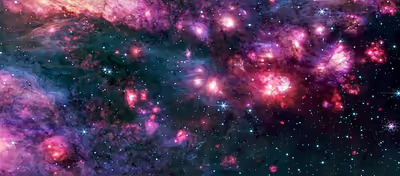
Observations with the James Webb Space Telescope revealed new candidate H II region that were missed with radio observations. At 25 μm the researchers found infrared radiation escaping the protocluster Sgr B2 N, following the path of a large-scale outflow. YSOs previously detected with ALMA in the western side of the cloud are not detected with JWST, but hot dust around their outflows is detected with JWST. On the eastern side JWST detects recent star-formation.