

Saguenay River
Major tributary of the St. Lawrence River in Quebec, Canada
- 3 min read
- 2 chapters

Related on Lably
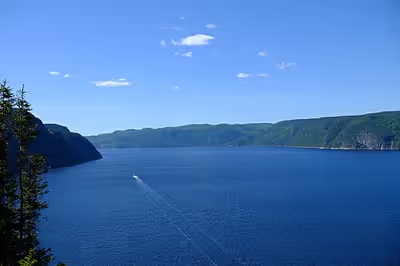
The river has a very high flow-rate and is bordered by steep cliffs associated with the Saguenay Graben. Tide waters flow in its fjord upriver as far as Chicoutimi (about 100 kilometres). Many beluga whales breed in the cold waters at its mouth, which makes Tadoussac a popular site for whale watching and sea kayaking, and Greenland sharks also frequent the depths of the river. The area of the confluence of the Saguenay and Saint Lawrence is protected by the Saguenay–St. Lawrence Marine Park, one of Canada's national parks.
History
First Nations people, including Innus, have inhabited the Saguenay Fjord area for thousands of years prior to the arrvival of the first Europeans. The first European to visit the area was Jacques Cartier, in 1535. After Samuel de Champlain established a fort in 1608 on the northern shores of the St. Lawrence River around present-day Quebec City, various Indigenous peoples, including Innu, Haudenosaunee (Iroquois), Huron, Algonquins, and Cree, traded along the Saguenay River. They named the river for the legendary Kingdom of Saguenay, which is the namesake of Saguenay Herald of the Canadian Heraldic Authority.
In the 19th century, the river was begun to be used for transport and power by the logging and pulp and paper industries. A dam on the upper Saguenay generates hydroelectricity for local industries such as aluminum smelting and paper mills.
Severe flooding of the Saguenay's tributary rivers devastated the region in one of Canada's costliest natural disasters, the Saguenay Flood from July 18 to 21, 1996. However, an unexpected effect of the flood was to cover the heavily-contaminated sediments at the bottom of the river with 10 to 50 centimetres (3.9 to 19.7 in) of new, relatively clean sediments. Research has shown that the old sediments are no longer a threat to ecosystems.
Sign in to keep reading
One more chapter is free with a Lably account.
Geography
The Saguenay originates in Lac Saint-Jean at Alma. There are two channels: La Petite Décharge and La Grande Décharge. The dam of the Île Maligne hydroelectric plant is built on the latter. The island formed by both rivers is part of the municipality of Alma. At this place, the water is freshwater. Three bridges cross La Petite Décharge, and two others cross La Grande Décharge. When both rivers meet just east of Alma, the Saguenay really begins. It begins in the form of a reservoir several kilometres long unlike the rapids and powerful falls that dotted the river before the erection of dams.
At Shipshaw, the Saguenay splits again into two. On the north side is the Shipshaw hydroelectric station, and on the south side is the Chute-à-Caron power plant. It is here that the Aluminum Bridge is located.
Between Chicoutimi and Jonquière, the two spillway weirs come together to form the Saguenay, which becomes accessible to navigation at thar point. Moreover, Chicoutimi means "how deep is it" in Innu-aimun. In downtown Chicoutimi are the Dubuc Bridge and the Sainte-Anne Bridge. At Tadoussac, a ferry provides a link between Tadoussac and Baie-Sainte-Catherine.
Tributaries
The significant tributaries of the Saguenay are (going upstream):
- Sainte-Marguerite River
- North-East Sainte-Marguerite River
- Saint-Jean River
- Ha! Ha! River
- Mars River
- Valin River
- Rivière du Moulin
- Chicoutimi River
- Shipshaw River
- Rivière aux Sables
- Rivière aux Écorces
- Lake Saint-Jean
- Peribonka River
- Manouane River
- Mistassini River
- Mistassibi River
- Ashuapmushuan River
- Ouiatchouaniche River
- Métabetchouane River
- Peribonka River
Riverside municipalities
Downstream
- Alma
- Saint-Charles-de-Bourget, Quebec
- Shipshaw, Quebec (amalgamated with Saguenay)
- Jonquière (amalgamated with Saguenay)
- Chicoutimi (amalgamated with Saguenay)
- Saint-Fulgence, Quebec
- La Baie, Quebec (at the bottom of Ha! Ha! Bay, amalgamated with Saguenay)
- Sainte-Rose-du-Nord, Quebec
- Rivière-Éternité, Quebec
- L'Anse-Saint-Jean, Quebec
- Petit-Saguenay, Quebec
- Sacré-Cœur, l'Anse de Roche
- Tadoussac, Quebec
- Baie-Sainte-Catherine, Quebec