

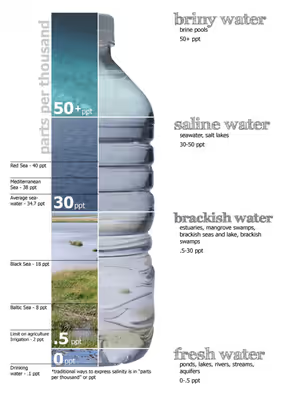
Saline water
Water that contains a high concentration of dissolved salts
- 2 min read
- 1 chapter
- 2 labs on Lably

Learn it on Lably
Properties
At 100 °C (212 °F; 373 K), saturated sodium chloride brine is about 28% salt by weight. At 0 °C (32 °F; 273 K), brine can only hold about 26% salt. At 20 °C one liter of water can dissolve about 357 grams of salt, a concentration of 26.3%.
The thermal conductivity of seawater (3.5% dissolved salt by weight) is 0.6 W/mK at 25 °C (77 °F). The thermal conductivity decreases with increasing salinity and increases with increasing temperature. The salt content can be determined with a salinometer.
Density ρ of brine at various concentrations and temperatures from 200 to 575 °C (392 to 1,067 °F) can be approximated with a linear equation:
where the values of an are:
Electrolysis
About four percent of hydrogen gas produced worldwide is created by electrolysis. The majority of this hydrogen produced through electrolysis is a side product in the production of chlorine.
- 2 NaCl(aq) + 2 H2O(l) → 2 NaOH(aq) + H2(g) + Cl2(g)