

Sapsan
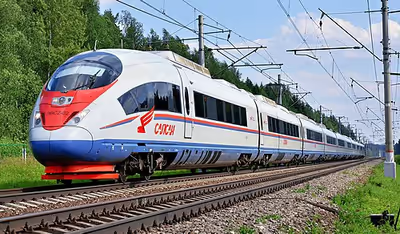
Russian gauge high speed electric express train
- 5 min read
- 5 chapters

Explore on Lably
ToursExplore Lably’s 3D toursOn 22 March 2022, following the 2022 Russian invasion of Ukraine, Siemens suspended its contract to supply additional trainsets, as well as announcing it would end maintenance and other services from 13 May 2022, with Russian Railways stepping in to continue their maintenance.
Construction history
On 18 May 2006, Siemens and Russian Railways signed a €276 million order for eight high-speed trains with a 30-year service contract worth around €300 million.
The trains were ordered to connect Moscow with Saint Petersburg and later Nizhny Novgorod at a speed of up to 250 km/h (155 mph). They are derived from the German ICE 3 train but with bodies widened by 330 mm (13.0 in) to 3,265 mm (10 ft 8.5 in) to suit Russia's wide loading gauge. Four of the trains (EVS2) are equipped for both 3 kV DC and 25 kV 50 Hz AC operation. The total length of each ten-car train is 250 m (820 ft 3 in), carrying up to 600 passengers.
Development and construction were carried out by Siemens at Erlangen and Krefeld in Germany. In August 2009, it was announced that the fifth Sapsan had been delivered to Russia, of the eight that were planned.
Four single-voltage ("EVS1", 3 kV DC powered, trainsets 5-8) trains entered passenger service at the end of 2009 on the Moscow – St Petersburg route, with the dual-system trains (EVS2, trainsets 1-4) entering service on the Nizhny Novgorod route on 30 July 2010.
Sapsan set records for the fastest train in Russia on 2 May 2009, travelling at 281 km/h (175 mph) and on 7 May 2009, travelling at 290 km/h (180 mph).
On 19 December 2011, a €600 million order for an additional twenty trainsets including eight EVS2 sets was signed in order to facilitate an increased number of services on existing lines and the expansion of new service elsewhere in the system. The second-batch EVS1 sets (trainsets 9-20) will be same details as the first-batch EVS1 sets, but the second-batch EVS2 sets (trainsets 21 onward) will have retractable steps suited for low platforms, unlike the first-batch EVS2 sets.
Sign in to keep reading
4 more chapters are free with a Lably account.
Operations
According to the timetable valid from 30 October 2011, the direct train from Moscow to St Petersburg without intermediate stops needs 3 hours 40 minutes, the train from Moscow to Nizhny Novgorod 3 hours 55 minutes.
Introduction of Sapsan initially caused cancelation of affordable daytime trains between Moscow and St Petersburg. Since the end of 2012, Moscow – St Petersburg daytime trains other than Sapsan have been running again.
New bridge crossings were built, platforms along the railway were reconstructed and an additional track was completed in 2015. New Lastochka commuter trains were introduced on the Moscow – Tver and St Petersburg – Bologoye routes. Local trains in the rural areas were saved.
Wagon layout
Top — single-system train of the EVS1 series with direct current of 3 kV (version B1)
Bottom — dual-system train of the EVS2 series with direct current of 3 kV and alternating current of 25 kV and 50 Hz (version B2)
- ГПм — head carriage, first class, motor, 23 seats (including four in the VIP section) + a three-seat sofa.
- ГТм — head carriage, passenger (third) class, motor, 51 seats (including 7 in the children's section) + baby cradle.
- ДБ — throttle, business (second) class, trailer, 52 seats.
- ДТ — throttle, passenger class, trailer, 99 seats.
- Т — passenger class, trailer, 66 seats.
- ТТр — passenger class, with transformer for alternating current, trailer, 66 seats.
- Тм — passenger class, motor, 66 seats,
- Та — passenger class, battery-powered, brake resistors on the roof, trailer, 60 seats.
- ТаБ — passenger class, battery-powered, brake resistors on the roof, with a bistro (restaurant), trailer, 40 seats + tables at the bar.
From 1 July 2018, a new class of service will appear in Sapsan carriage № 4 (14) — basic with a reduced cost and without additional services. According to the project, the carriage will have 66 seats.
Route
Moscow – Saint Petersburg route
The first and the only (since 2015) route for Sapsan trains.
Moscow (Leningradsky railway terminal) – Tver (756A, 762A, 770A, 778A, 780A) – Vyshny Volochyok (758A, 768A, 776A) – Bologoye (756A, 762A, 770A, 778A, 780A, 784A) – Uglovka (758A, 760A, 768A, 778A) – Okulovka (758A, 760A, 768A, 778A) – Chudovo (756A, 758A, 768A, 776A, 780A, 784A, 786A) – Saint Petersburg (Moskovsky railway terminal)
There are no Sapsan trains stopping at all stations on the route. The fastest ones do not stop between Moscow and Saint Petersburg at all. Numbers of the trains which stop at intermediate stations are listed above. Such measures were implemented to increase speed.
Moscow – Nizhny Novgorod route
Former route of Sapsan trains. Since 2015, new Talgo Strizh trains were introduced. All of the Sapsans were subsequently used on the Moscow – St Petersburg route.
Saint Petersburg – Nizhny Novgorod route
On 1 March 2018, Russian Railways reopened the discontinued Saint Petersburg – Moscow – Nizhny Novgorod route which allows passengers to take an 8 hour 11 minute journey without a train change in Moscow.
Tickets
On 1 July 2012, the Russian Railways company introduced a new tariff system for Sapsan trains which dynamically prices tickets based on two factors:
- The date of sale of the ticket,
- Percentage of occupied seats on the train.
The new rates range from 0.8 to 1.2 times the base rate for the day. It is possible to see the final price of a ticket for a specific date during the booking process.