


Related on Lably
While all scissors largely follow the same working principle, heavy-duty scissors intended for cutting tough materials tend to be called shears instead of scissors (e.g. pruning shears and grass shears), and some larger, two-handed implements are called trimmers instead (e.g. hedge trimmer). Choosing the optimal type of scissors/shears is crucial, as otherwise it can cause unwanted damage to the target material and/or the instrument itself. For example, hair-cutting shears and kitchen shears are functionally equivalent scissors, but hair-cutting shears have specific blade angles ideal for cutting heaped bundles of hair, and using the incorrect type of scissors will result in increased damage or split ends, or both, by breaking the hair; kitchen shears, also known as kitchen scissors, are intended for cutting and trimming tough food materials such as meat, tendon and bones. Surgical scissors, used to divide tissues and trim/reshape implants during surgical operations, have even a greater variety to deal with different anatomical and procedural circumstances.
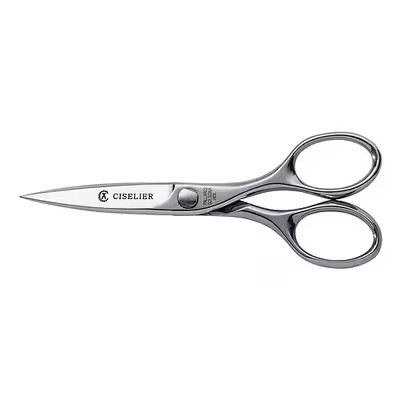
Most scissors have a ringed handle to allow readily opening for repeated cutting, and some even have spring between the shanks to assist opening (especially for shears with straight handle). While historically inexpensive, mass-produced scissors often have bare metal handles, modern scissors are often designed ergonomically with composite thermoplastic and rubber covering on handles, which are more comfortable for the hand.
Terminology
The noun scissors is treated as a plural noun and therefore takes a plural verb (e.g., these scissors are). Alternatively, the tool is referred to by the singular phrase a pair of scissors. The word shears is used to describe similar instruments that are larger in size and for heavier cutting.
Sign in to keep reading
3 more chapters are free with a Lably account.
History
Early manufacture
The Hangzhou Zhang Xiaoquan Company in Hangzhou, China, has been manufacturing scissors since 1663.
Pivoted scissors were not manufactured in large numbers until 1761, when Robert Hinchliffe of Sheffield produced the first pair of modern-day scissors made of hardened and polished cast steel. His major challenge was to form the bows; first, he made them solid, then drilled a hole, and then filed away metal to make this large enough to admit the user's fingers. This process was laborious, and apparently Hinchliffe improved upon it in order to increase production. Hinchliffe lived in Cheney Square (now the site of Sheffield Town Hall), and set up a sign identifying himself as a "fine scissor manufacturer". He achieved strong sales in London and elsewhere.
Modern manufacturing regions
China
The vast majority of global scissor manufacturing takes place in China. As of 2019, China was responsible for 64.3% of worldwide scissors exports. When combined with Chinese Taipei exports, this rises to 68.3%.
The Hangzhou Zhang Xiaoquan Company, founded in 1663, is one of the oldest continuously operating scissor manufacturers in the world. The company was nationalized in 1958 and now employs 1500 people who annually mass-produce an estimated seven million pairs of inexpensive scissors that retail for an average of US$4 each.
France
In the late 14th century, the English word "scissors" came into usage. It was derived from the Old French word cisoires, which referred to shears.
There are several historically important scissor-producing regions in France: Haute-Marne in Nogent-en Bassigny, Châtellereault, Thiers and Rouen. These towns, like many other scissor-producing communities, began with sabre, sword and bayonet production, which transitioned to scissors and other blades in the late 18th and early 19th centuries.
Thiers, in the Puy-de-Dôme department of Auvergne, remains an important centre of scissor and cutlery production. It is home to both the Musée de la Coutellerie, which showcases the town's 800-year history of blade-making, as well as Coutellia, an industry tradeshow that advertises itself as one of the largest annual gatherings of artisanal blade-makers in the world.
Germany
Germany was responsible for manufacturing just under 7% of global scissors exports in 2019. Often called "The City of Blades", Solingen, in North Rhine-Westphalia, has been a center for the manufacturing of scissors since medieval times. At the end of the 18th century it's estimated that there were over 300 scissorsmiths in Solingen.
In 1995 the City of Solingen passed The Solingen Ordinance, an update to a 1930s law that decreed "Made in Solingen" stamps could only be applied to products almost entirely manufactured in the old industrial area of Solingen. In 2019 this applied to approximately 150 companies making high-quality blades of all kinds, including scissors.
Friedrich Herder, founded in Solingen in 1727, is one of the oldest scissors manufacturers still operating in Germany.
Italy
Premana, in Lecco Province, has its origins in ironworks and knife manufacturing beginning in the 16th century. In 1900 there were ten scissor manufacturing workshops, 20 in 1952 and 48 by 1960. Today, Consorzio Premax, an industrial partnership, organizes over 60 local companies involved in the manufacture of scissors for global markets. In 2019 Italy exported 3.5% of scissors manufactured globally.
One of the oldest Premanese scissor manufacturing firms still in operation is Sanelli Ambrogio, which was founded in 1869.
Japan
Scissormaking in Japan evolved from sword making in the 14th century. Seki, in Gifu Prefecture, was a renowned center of swordmaking beginning in the 1200s. After citizens were no longer permitted to carry swords, the city's blacksmiths turned to making scissors and knives. There are many specialized types of Japanese scissors, but sewing scissors were introduced by American Commodore Matthew Perry from the United States in 1854.
The Sasuke workshop in Sakai City south of Osaka is run by Yasuhiro Hirakawa, a 5th generation scissorsmith. The company has been in operation since 1867. Yasuhiro Hirakawa is the last traditional scissormaker in Japan, making scissors in the traditional style where the blades are believed to be thinner, lighter and sharper than European scissors. In 2018 he was profiled in a documentary that featured a pair of his bonsai snips which retailed for US$35,000.
Spain
In Solsona, Spain, scissor manufacturing began in the 16th century. At the industry's peak in the 18th century there were 24 workshops, organized as the Guild of Saint Eligius, the patron saint of knife makers. By the mid-1980s there were only two, and by 2021, Pallarès Solsona, founded in 1917 by Lluìs and Carles Pallarès Canal, and still family-operated, was the town's sole remaining artisanal scissor manufacturer.
United Kingdom
Sheffield was home to the first mass production of scissors beginning in 1761. By the 19th century there were an estimated 60 steel scissor companies in Sheffield. However, since the 1980s, industry globalization and a shift towards cheaper, mass-produced scissors created price deflation that many artisanal manufacturers could not compete with. The Sheffield scissor industry consisted of just two local companies in 2021.
The two remaining Sheffield scissor manufacturers are William Whiteley, founded in 1760, and Ernest Wright, which was established in 1902. Both now focus on high-end/niche crafting of "products for life" rather than mass production. Between these two firms it is estimated that there are no more than ten "putter-togetherers" or "putters" who are the master-trained craftspeople responsible for high quality Sheffield scissor assembly. In 2020, Ernest Wright was recognized with the Award for Endangered Crafts by the British Heritage Crafts Association.
Right-handed and left-handed scissors
There are two varieties of left-handed scissors. Many common left-handed scissors (often called "semi"-left-handed scissors) simply have reversed finger grips. The blades open and close as with right-handed scissors, so that users tend to pull the blades apart as they are cutting. This can be challenging for craftspeople as the blades still obscure the cut. "True" left-handed scissors have both reversed finger grips and reversed blade layout, like mirror images of right-handed scissors. A left-handed person accustomed to using semi-left handed scissors may find using true left-handed scissors difficult at first, as they may have learned to rely heavily on the strength of their thumb to pull the blades apart vs. pushing the blades together in order to cut.
Some scissors are marketed as ambidextrous. These have symmetric handles so there is no distinction between the thumb and finger handles, and have very strong pivots so that the blades rotate without any lateral give. However, most "ambidextrous" scissors are in fact still right-handed in that the upper blade is on the right, and hence is on the outside when held in the right hand. Even if they cut successfully, the blade orientation will block the view of the cutting line for a left-handed person. True ambidextrous scissors are possible if the blades are double-edged and one handle is swung all the way around (to almost 360 degrees) so that what were the backs of the blades become the new cutting edges. U.S. patent 3,978,584 was awarded for true ambidextrous scissors.
Specialized scissors and shears
Specialized scissors and shears include: