


Related on Lably
Through Ritual, Caste system in India and Religion
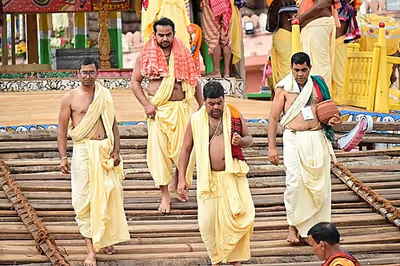
The Sevayat system is an example of a ritual-occupational hierarchy in Hindu temple institutions. It is based on customary laws and written records like the temple's Record of Rights. The system combines religious duty with social identity and hereditary privilege. Sevayats traditionally use specific ritual colours in their attire and temple practice.
Terminology and Variants
Etymology
The word "Sevayat" (also spelled Sewayat, or Sebayat) comes from the Sanskrit word seva, which means service, attendance, or devotional duty, and a suffix -yat that means agent or practitioner. In this context, a Sevayat literally means "one who performs service," especially in a religious or ritual setting. In eastern India, especially in Odisha, the term is closely linked to temple traditions. Also known as Sevak, it came to mean people who were given certain tasks to do in the service of gods.
Historically, the term evolved within the institutional context of the Jagannath Temple in Puri, where it developed a more specific connotation pertaining to hereditary temple servitors. Over time, Sevayat became more than just a job title; it also became a way for people to identify themselves socially, reflecting both their jobs and their caste ties within the temple hierarchy.
Variant spellings
Because of differences in transliteration, regional pronunciation, and colonial-era documentation, the term exists in several variant forms, including:
- Sevayat (; say-VAA-yut)
- Sebayat (; say-BAA-yut)
- Sewayat (; say-WAA-yut)
These variations are mostly due to phonetic differences arising from the interaction between Sanskrit, Odia and English transliteration systems and do not indicate differences in meaning. The spelling Sebayat is particularly common in Odia usage, where the phoneme "/v/" is often realised as "/b/".
The term Sevak (सेवक) is, on the other hand, a more general Sanskrit-derived term meaning servant or devotee, and is employed in many Hindu traditions more broadly without necessarily implying a formal or hereditary role.
Sign in to keep reading
15 more chapters are free with a Lably account.
Historical Background
The Sevayat system came about around the same time that the Jagannath Temple in Puri became a major religious center in eastern India. The structure of hereditary temple service can usually be traced back to the Middle Ages, especially during the rule of the Eastern Ganga dynasty (12th–15th centuries), when the temple emerged as a center of royal patronage and ritual authority. The Gajapati kings made temple administration organized, and different groups were given specific service roles. This was the start of the Sevayat system.
The Sevayats' work was guided by temple records and customary practices. The Madala Panji, the temple's traditional chronicle, was the most important of these. These records show how the duties, privileges, and hierarchies of servitors changed over time. They also show that there was a clear system of occupational specialization based on lineage and caste. As time went on, the Sevayat roles became hereditary, passing from one generation to the next. This made the institutional structure more stable.
In the colonial period the British administrators intended to control temple affairs indirectly, generally accepting the existing servitor rights but imposing administrative controls. This resulted in partial codification of roles and disputes regarding authority and entitlement between different Sevayat groups. After independence, a major development took place in the form of enactment of Shri Jagannath Temple Act, 1955 whereby the temple was brought under a statutory management but at the same time traditional rights and duties of the Sevayats as recorded in the Record of Rights of the temple were preserved.
Today, the Sevayat system represents a continuity of medieval temple traditions adapted within a modern legal and administrative framework, maintaining its central role in the ritual and cultural life associated with the Jagannath tradition.
Record of Rights
The Record of Rights (RoR) of the Jagannath Temple, Puri was prepared under the Shri Jagannath Temple (Administration) Act, 1952 (Orissa Act XIV of 1952) and published in the Orissa Gazette in 1954–55. It constitutes the primary legal document governing the duties, privileges, and customary rights of sevayats. The Record was prepared by a Special Officer appointed under the Act, and objections to its entries were permitted before the District Judge of Puri within a prescribed period.
Structure of the Record
The Record of Rights is indexed into two primary parts:
- Part I – Record of Temples and Properties
Part I provides a detailed survey and listing of the temple complex and its associated religious establishments. It features:
- Lord Jagannath Main Temple (with plot numbers and plans)
- Temples and locations inside temple premises
- Temples, subsidiary shrines and associated institutions
These are recorded in tabular form (Form A) giving serial number, plot number, name of temple, its location and remarks. This portion deals with the institutional and spatial framework for the performance of sevayat duties.
- Part II – Record of Nitis (Rituals)
Part II is a systematic record of all Nitis (ritual services) and includes:
- Daily rituals
- Periodical rituals
- Festival ceremonies
These are listed in Form B which separates each ritual into:
- Name of the ritual
- Time and sequencing
- Responsible sevayat or servitor group
- Materials and procedure information
This section clearly defines ritual responsibilities of certain classes of sevayats. Their functional roles are defined in operational terms.
Codification of Sevayat Roles
The RoR does not speak of sevayats in generalities, but assigns duties at the level of individual ritual components. Each niti has stages and different sevayat groups are given for each stage. The document thus continues:
- Defining the exact nature of each seva
- Prescribing the order and timing of ritual performance
- Identifying the responsible sevayat category for every ritual act
Part II also identifies numerous specialised sevayat roles in a lengthy Odia text, suggesting a highly differentiated and function-specific service system.
Hereditary and Conditional Rights
The Record considers sevayatship largely hereditary, with rights traditionally vested in certain families or groups. However, the rights are inseparable from the obligation to perform the corresponding services. It reads:
- Entitlement to perform specified rituals
- Associated honours, perquisites and shares
- Mandatory performance of duties according to established customs
Thus the RoR formalizes customary practices into what is subject to statutory regulation, which makes service a legal condition for the enjoyment of rights.
Organisation and hierarchy
The Sevayat system operates on a thoroughly structured ritual and occupational hierarchy that was created within the Jagannath Temple, Puri's institutional framework. Sevayats are split into different service groups, each with its own set of roles, privileges, and responsibilities that are spelled out in the temple's Record of Rights.
The hierarchy is based on a mix of ritual status, caste, and specialization in a certain area. Brahmin Sevayats usually work as priests, while non-Brahmin groups do logistical, artisanal, and support work. Authority is also affected by family lineage, with positions passed down through generations.
Adya Sevak (the principal sevak)
Gajapati is another common name for Maharaja of Puri, commonly known as the king of Puri. He is the primary Sevak, and he plays a significant part in the Car Festival, Snana Yatra, Dola Yatra, and Chandan Yatra. Additionally, he plays a significant part in Navkalebar, which occurs once every 19 years. He is the Temple Managing Committee's hereditary chairman.
Other sevaks
There are 119 other types of servants besides the king. However, according to the official Record of Rights, only 119, including the king himself, is mentioned. One seva that was not recorded in the Record of Rights was revived in the year 1988 by the temple administration i.e. Beherakaran Seva. There are 14 sevas (ritual services) that are no longer performed. They include Panikikata, Daudibandha, Binakar, Gitagovind, Bhitargayani, Madeli, Patarabindha, Sankhua, Kalabethia, Kumbharibisoi, Malachula, Banua, Mapasaitakaran, Charchakaran. The temple officials have given a number of explanations for why some sevas have been discontinued. These include the system's hereditary character, which caused some sevayat families without male heirs to stop performing the rituals, and the lack of procedures for enlisting people from outside the sevayat society, which ultimately contributed to their discontinuation. Furthermore, several sevas were limited in scope and did not generate enough revenue to support a livelihood, which led to their termination. Furthermore, as societal conditions changed, some traditions, like the Devdasi seva, which required new Devadasis to be introduced by practitioners, progressively stopped.
Ritual system (Nitis)
The rituals or nitis system of Lord Jagannath is incredibly detailed and involves more than 100 categories of sevayat or servitors, who, through the year, take their specified turn to perform their seva. The rituals or nitis are so much interlinked and interdependent with one another that the performance of a particular service is a sine qua non for the performance of the next service. The whole system of ritual is divided into three categories.
These are daily rituals, periodical or special occasion rituals and the major festival rituals. Daily rituals are something fixed or observed every day. Special or periodical rituals are according to the specialty and occurrence on certain days and months. Throughout the year, a varying number of festival rituals are conducted regularly both inside and outside the temple. The main temple sanctum sanctorum is famous for its main deities Lord Jagannath, Lord Baladhara, Goddess Subhadra and Lord Sudharshan. There are more than 20 gods and goddesses in the temple complex like Goddess Mahalaxmi, Goddess Bimala, Lord Ganesh (at 3 places in different poses) and the famous Kalpa Bata (The wish-fulfilling oldest banyan tree) in the center of the temple.
Daily rituals
The rules and regulations for the daily rituals of Jagannath Temple are mentioned in the Record of Rights. The ROR descriptively mentions the daily rituals, the work performed and the involvement of the sevayat categories.
Periodic rituals
According to scriptures, there are some periodical rituals also. Each Thursday Lord Jagannath and Goddess Laxmi meet in the afternoon, which is believed to discuss the affairs of the world. On each Ekadashi (11th day as per Lunar calendar) evening, lamps are taken to the top of the temple and circumambulated around Neela Chakra. On each Amabasya day (last day of the dark fortnight) Lord Jagannath goes to the seashore to perform a special ritual as Mahodadhi Arati as the sacred sea is believed to be his father-in-law as per Skanda Purana. This ritual is performed by Sabat Nijoga a particular class of servitors earmarked for the purpose.
The Lord's regal status is also symbolized by the annual Benta, or hunting ceremony, and Banaka Laagi, where paintings of the deities are performed. Additionally, the birthday celebrations of Lord Balabhadra, also known as Shravana Makara, Sri Jagannatha, also known as Rohini Brusha, and Goddess Subhadra, also known as Jyestha Bichha, are marked by particular rites based on the constellation of stars. On certain days of the year, such as Sri Ram Navami, Janmashtami, and Nrushingha Janma, the birthday celebrations of Sri Ram, Sri Krishna, and Nrusingha are also commemorated according to the rituals.
Festival rituals
According to the Niladri Mahodaya, there are about 65 rituals performed annually, of which 12 are well-known festivals like Chandan Yatra, Devsnana Purnima (when the Deities take celestial bath), Car Festival, Sayan Ekadashi, Dola Utsav, Dakshinayana Yatra, Uttarayana Yatra, Damanak Yatra, Parswa Paribartan, Hari Utthapan Ekadasi, Pravarana Sasthi, and Pusyabhiseka, where additional servants are hired to perform certain roles.
Special festival rituals
The role of the ritual functionaries becomes increasingly prominent on important occasions like Navakalebar, which is a very complicated and challenging process. Every 19 years, Navkalebar, also known as the embodiment ceremony, takes place. It lasts for about two months and attracts millions of people from all over the world.
Ritual attire and colours
Traditionally, the Sevayats wear cotton clothes where red and white colours are important in daily rituals.
During important festivals and rituals, such as Ratha Yatra, Sevayats are also expected to wear certain ceremonial cloths such as pata (silken fabric) as part of their assigned duties. These colours are symbolic in the temple tradition of purity of ritual, auspiciousness and devotion.
Classification of Sevayats
There are 120 hereditary service categories for sevayats. The Jagannath temple's Record of Rights initially had just 119 categories. The Temple administration later brought back one seva. Many rites, like Devadasi Seva, have been discontinued and are no longer carried out. Each one is linked to a certain set of ritual or administrative duties.
List of Sevayat categories
The following table lists the hereditary categories of Sevayats as recorded in the Record of Rights of the Jagannath Temple.
These classifications represent a complex structure of ritual specialization integrated within the overarching caste system in India.
Duties and functions
The Sevayats' duties cover a wide range of ritual, administrative, and service-related roles necessary for the day-to-day functioning of the temple. This includes conducting worship, preparing offerings, looking after the temple premises, managing pilgrim services and organizing festivals.
Each duty is regulated by established customs and textual prescriptions, often recorded in temple documents such as the 'Madala Panji'. The performance of these duties is regarded as both a religious obligation and a hereditary right.
Role in rituals and festivals
The Sevayats play a crucial role in the performance of daily rituals (nitis) and major festivals of the Jagannath tradition. Different groups of Sevayats perform specific duties during festivals like the Ratha Yatra, such as the formal handover of the deities, the construction of the chariots and making ritual offerings. For example, the Daita servitors play a big role during certain ritual phases, like Anasara, when the gods are thought to be sick and are taken out of public view for a short time.
Legal status and rights
Both customary law and statutory regulation have had an impact on the legal status of Sevayats. The Shri Jagannath Temple Act, 1955 put the temple under state control and officially recognized the traditional rights and duties of Sevayats as they are written down in the Record of Rights.
There have been legal fights over service rights, pay, and administrative power from time to time. These fights show the tension between hereditary privilege and modern governance.
Socio-economic conditions
The socio-economic conditions of Sevayats are different in different service groups. Some Sevayats earn a regular income and social standing through service at the temple, but others are economically unstable due to irregular pay and reliance on donations from pilgrims.
The traditional modes of livelihood have been significantly affected by the modern changes in temple administration, tourism and economic structures. For nearly nine centuries, despite social, economic, and political turbulent times, the Sevayats have persevered and came about as the most devoted and authentic guardians of this mystifying religious heritage.
Customs and social life
Sevayat communities have their own social and cultural practices that are shaped by their hereditary roles and ritual duties. It is common for people in subgroups to marry within their own group, and family identity is closely linked to certain temple services.
Religious observances, festivals, and domestic rituals frequently reflect the temple's liturgical calendar, thereby reinforcing the amalgamation of occupational and social life.
Reforms and contemporary issues
The Sevayat system has gone through a number of changes in the modern era to make it more open, accountable, and efficient. State intervention, especially after the 1955 Act was passed, has added regulatory oversight to how temples are run.
Contemporary issues include disputes over inherited rights, calls for better pay and conditions, and disputes over modernization versus the preservation of tradition.
Cultural significance
The Sevayat system is a unique blend of religion, social organization and cultural continuity in the Jagannath tradition. It is a living heritage which links medieval temple practices with contemporary religious life in Odisha.
The Sevayats are important in safeguarding the ritual lore, oral tradition and cultural identity associated with the cult of Jagannath.
Comparative perspective
There are similar systems of hereditary temple servitors in other Hindu temple traditions across India but the scale and complexity of the Sevayat system at Puri is unique.
Comparative studies indicate similarities with temple functionary systems in South India, in which roles are similarly organized according to ritual hierarchy and hereditary succession, but which are distinct in terms of administrative incorporation and regional differences in caste dynamics.
Notable people
The individuals listed below are renowned for their involvement with the Jagannath Temple's Sevayat institution, either by hereditary service responsibilities or historically documented participation in its ritual system:
- Dibyasingha Deba – Gajapati Maharaja of Puri and Lord Jagannath's Adyasevak, or chief servant, who is considered the most important Sevayat in the ritual hierarchy.
- Sasimani Debi – considered the last known devadasi of the Jagannath Temple, belonged to a class of temple servants that is no longer in existence.