

Sieve
Tool for separation of solid materials by particle size
- 3 min read
- 5 chapters
- 3 labs on Lably

Learn it on Lably
In cooking, a sifter is used to separate and break up clumps in dry ingredients such as flour, as well as to aerate and combine them. A strainer (see colander), meanwhile, is a form of sieve used to separate suspended solids from a liquid by filtration.
Sieving
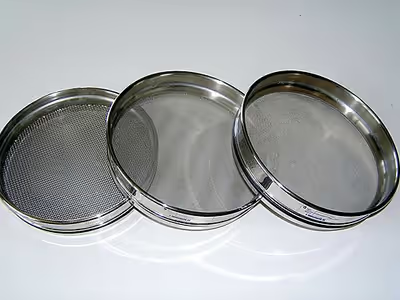
Sieving is a simple technique for separating particles of different sizes. A sieve such as used for sifting flour has very small holes. Coarse particles are separated or broken up by grinding against one another and the screen openings. Depending upon the types of particles to be separated, sieves with different types of holes are used. Sieves are also used to separate stones from sand. Sieving plays an important role in food industries where sieves (often vibrating) are used to prevent the contamination of the product by foreign bodies. The design of the industrial sieve is of primary importance here.
Sign in to keep reading
4 more chapters are free with a Lably account.
Wooden sieves
The mesh in a wooden sieve might be made from wood or wicker. Use of wood to avoid contamination is important when the sieve is used for sampling. Henry Stephens, in his Book of the Farm, advised that the withes of a wooden riddle or sieve be made from fir or willow with American elm being best. The rims would be made of fir, oak or, especially, beech.
US standard test sieve series
A sieve analysis (or gradation test) is a practice or procedure used (commonly used in civil engineering or sedimentology) to assess the particle size distribution (also called gradation) of a granular material. Sieve sizes used in combinations of four to eight sieves.
In culture
In iconography, the sieve was used as a symbol of chastity, in reference to the Latin legend recounting how the vestal virgin Tuccia carried water from the Tiber in a sieve without losing a drop, thus proving her virginity.
At least two portraits of Queen Elizabeth I of England, known as the Virgin Queen, show her holding a sieve in her hand. The earliest was the 1579 portrait by George Gower, showing the 46 year-old queen with a globe as symbol of imperial expansion, and a sieve for her declared virginity. The same symbols appear in a later portrait signed by Quentin Metsys the Younger.
Other types
- Chinois, or conical sieve used as a strainer, also sometimes used like a food mill
- Cocktail strainer, a bar accessory
- Colander, a (typically) bowl-shaped sieve used as a strainer in cooking
- Flour sifter or bolter, used in flour production and baking
- Graduated sieves, used to separate varying small sizes of material, often soil, rock or minerals
- Mesh strainer, or just "strainer", usually consisting of a fine metal mesh screen on a metal frame
- Laundry strainer, to drain boiling water from laundry removed from a wash copper, usually with a wooden frame to facilitate manual handling with hot contents
- Pickle lifter – Device for lifting pickled goods from a container
- Riddle, used for soil
- Spider, used in Chinese cooking
- Tamis, also known as a drum sieve
- Tea strainer, specifically intended for use when making tea
- Zaru, or bamboo sieve, used in Japanese cooking
- Other uses
- "Sieve" is a common term used in trash-talk referring to a goaltender in ice hockey who lets in too many goals
- "Leaks like a sieve" is an English language idiom to describe a container that has multiple leaks, or, by allegory, an organization whose confidential information is routinely disclosed to the public.