


Related on Lably
Through Colonialism, Bamako and Ghana
History
Sikasso was a small village until 1870, when Tieba Traoré, whose mother came from Sikasso, became Faama of the Kénédougou Kingdom and moved the capital there. He established his palace on the sacred Mamelon hill (now home to a water tower) and constructed a massive tata to defend against the attacks of both the Malinke conqueror Samori Ture and the French colonial army. This made Sikasso the largest fortified city ever built in west Africa.
Sikasso withstood a 15-month siege by Ture from 1887 to 1888 before the French, allies of Kenedougou against Ture, relieved the city. Despite this, the French contrived a diplomatic crisis to attack in 1898. They began a major artillery barrage against the tata on April 15th 1898, and the city fell on May 1st amid furious house-to-house fighting. Babemba Traore, Tieba's brother who had succeeded him as faama, ordered his bodyguards to kill him rather than let him fall into French hands. He is still remembered for honoring the Bamanankan saying "Saya ka fisa ni maloya ye" (literally: death is preferable to shame). 4000 captives were taken from the sack and parcelled out as slaves among the French and their African auxiliaries. They were marched back west to the Niger, with many too weak or starved to continue dying or being killed along the way.
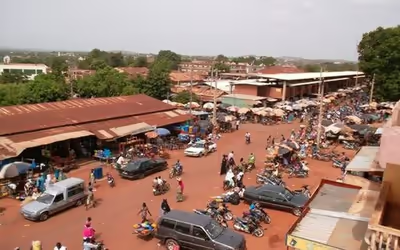
In modern-day Sikasso, attractions include the large market, Mamelon hill, the remains of Tieba Traoré's tata, and the nearby Missirikoro Grotto. The festival Triangle du balafon takes place every June, celebrating the traditional Malian instrument.
Sign in to keep reading
4 more chapters are free with a Lably account.
Geography
Located 375 kilometres (233 mi) southeast of Bamako, 100 kilometres (62 mi) north of Côte d'Ivoire, and 45 kilometres (28 mi) west of Burkina Faso, Sikasso acts as a crossroads between the coastal countries (Togo, Bénin, Ghana, Côte d'Ivoire) and the landlocked Mali and Burkina Faso. Sikasso's ethnic groups include the Senufo Bamana,(mainly the Supyire), the Bobo (or Bobo Fing, lit. 'black Bobo'), and the Minianka (Mamara Senufo).
Sikasso has abundant agriculture. Sikasso's fruit and vegetable production guarantees the city's self-sufficiency, sparing it from reliance on international food aid.
Climate
Sikasso features a tropical wet and dry climate under the Köppen climate classification. The city receives just under 1,200 millimetres (47 in) of rain each year, most of which falls between May and October. August is the wettest month, with an average rainfall of 308.8 millimetres (12.16 in). The highest temperatures are reached at the end of the dry season in March and April when the average daily maximum temperatures are just above 37 °C (98.6 °F).
Places of worship
Among the places of worship, they are predominantly Muslim mosques. There are also Christian churches and temples : Roman Catholic Diocese of Sikasso (Catholic Church), Église Chrétienne Évangélique du Mali (Alliance World Fellowship), Assemblies of God.
Sister Cities
Sikasso's sister city is Brive-la-Gaillarde, in France.