


Related on Lably
Through Extinction, Species and Muscle
Description
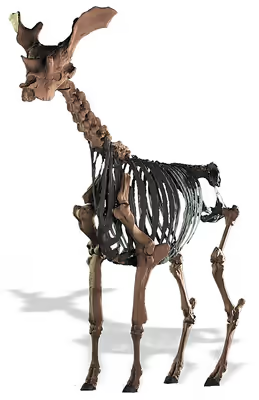
Sivatherium resembled the modern okapi, but was far larger, and more heavily built, being about 2.2 m (7.2 ft) tall at the shoulder, 3 m (9.8 ft) in total height with a weight up to 400–500 kg (880–1,100 lb). A newer estimate has come up with an estimated average body mass of about 1,246 kg (2,747 lb), with a range of 857–1,812 kg (1,889–3,995 lb). This would make Sivatherium one of the largest known ruminants, rivalling the modern giraffe and the largest bovines. Sivatherium had a wide, antler-like pair of ossicones on its head, and a second pair of ossicones above its eyes. Its shoulders were very powerful to support the neck muscles required to lift the heavy skull. Sivatherium was initially misidentified as an archaic link between modern ruminants and the now obsolete, polyphyletic "pachyderms" (elephants, rhinoceroses, hippopotamuses and tapirs). The confusion arose in part due to its graviportal (robust) morphology, which was unlike anything else studied at that time.
Sign in to keep reading
3 more chapters are free with a Lably account.
Palaeobiology
A dental wear analysis of S. hendeyi from the Early Pliocene of South Africa found that the teeth were brachyodont, but had a higher hypsodonty than a giraffe, and that it was best classified as a mixed feeder, being able to both graze and browse. Analysis of dental microwear and mesowear paired with δ13C and δ18O measurements of S. maurusium from Ahl al Oughlam in western Morocco show it predominantly fed on C3 vegetation.
Palaeopathology
The osteohistology of S. hendeyi specimens from the Langebaanweg site in South Africa shows numerous interruptions in growth related to extended, non-cyclical stress events likely related to drought, fire, or flooding that decreased food availability.
Paleoecology
Locations of fossils
Fossils attributed to Sivatherium are known from several localities in Eurasia and Africa.
Relationship with humans
Remains of Sivatherium from Olduvai Gorge in Tanzania, dating to around 1.35 million years ago have been found associated with stone tools and bearing cut marks, indicating butchery by archaic humans, likely Homo erectus. Historically, it has been suggested that figurines from Sumer and ancient rock paintings in the Sahara and Central West India represent Sivatherium. However, these claims are not substantiated by fossil evidence (which suggest that the genus was extinct long before the emergence of modern humans), and the depictions likely represent other animals.