

Slab pull
Part of the motion of a tectonic plate caused by its subduction
- 2 min read
- 1 chapters

Related on Lably
Through Plate tectonics, Year and Friction
Carlson et al. (1983) in Lallemand et al. (2005) defined the slab pull force as:
Where:
- K is 4.2g (gravitational acceleration = 9.81 m/s2) according to McNutt (1984);
- Δρ = 80 kg/m3 is the mean density difference between the slab and the surrounding asthenosphere;
- L is the slab length calculated only for the part above 670 km (the upper/lower mantle boundary);
- A is the slab age in Ma at the trench.
The slab pull force manifests itself between two extreme forms:
- The aseismic back-arc extension as in the Izu–Bonin–Mariana Arc.
- The Aleutian and Chile tectonics with strong earthquakes and back-arc thrusting.
Between these two examples there is the evolution of the Farallon Plate: from the huge slab width with the Nevada, the Sevier and Laramide orogenies; the Mid-Tertiary ignimbrite flare-up and later left as Juan de Fuca and Cocos plates, the Basin and Range Province under extension, with slab break off, smaller slab width, more edges and mantle return flow.
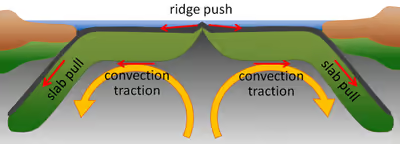
Some early models of plate tectonics envisioned the plates riding on top of convection cells like conveyor belts. However, most scientists working today believe that the asthenosphere does not directly cause motion by the friction of such basal forces. The North American Plate is nowhere being subducted, yet it is in motion, and likewise for the African, Eurasian and Antarctic Plates. Ridge push is thought responsible for the motion of these plates.
The subducting slabs around the Pacific Ring of Fire cool down the Earth and its core-mantle boundary. Around the African Plate upwelling mantle plumes from the core-mantle boundary produce rifting including the African and Ethiopian rift valleys.