

Super star cluster
Type of very massive young open cluster thought to be the precursor of a globular cluster
- 3 min read
- 3 chapters

Related on Lably
Through Milky Way, Extinction (astronomy) and Electron
Generally, SSCs have been seen to form in the interactions between galaxies and in regions of high amounts of star formation with high enough pressures to satisfy the properties needed for the formation of a star cluster. These regions can include newer galaxies with much new star formation, dwarf starburst galaxies, arms of a spiral galaxy that have a high star formation rate, and in the merging of galaxies. In an Astronomical Journal published in 1996, using pictures taken in the ultraviolet (UV) spectrum by the Hubble Space Telescope of star-forming rings in five different barred galaxies, numerous star clusters were found in clumps within the rings which had high rates of star formation. These clusters were found to have masses of about 103 M☉ to 105 M☉, ages of about 100 Myr, and radii of about 5 pc, and are thought to evolve into globular clusters later in their lifetimes. These properties match those found in SSCs.
Characteristics and properties
The typical characteristics and properties of SSCs:
- Mass 105 M☉
- Radius ≈ 5 pc ≈ 1019 cm
- Age ≈ 100 Myr (although other sources state that observed SSCs have an age of 1 Gyr)
- Large electron densities = 103–106 cm−3 (this is a property of the HII region associated with the SSC)
- Pressures = 107–1010 K⋅cm−3. (this is a property of the HII region associated with the SSC)
Sign in to keep reading
2 more chapters are free with a Lably account.
Hubble Space Telescope contributions
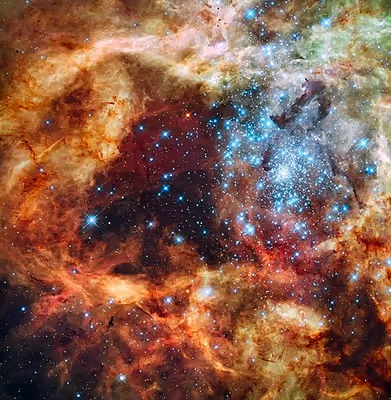
Given the relatively small size of SSCs compared to their host galaxies, astronomers have had trouble finding them in the past due to the limited resolution of the ground-based and space telescopes at the time. With the introduction of the Hubble Space Telescope (HST) in the 1990s, finding SSCs (as well as other astronomical objects) became much easier thanks to the higher resolution of the HST (angular resolution of ~1/10 arcsecond). This has not only allowed astronomers to see SSCs, but also allowed for them to measure their properties as well as the properties of the individual stars within the SSC. Recently, a massive star, Westerlund 1-26, was discovered in the SSC Westerlund 1 in the Milky Way. The radius of this star is thought to be larger than the radius of Jupiter's orbit around the Sun. Essentially, the HST searches the night sky, specifically nearby galaxies, for star clusters and "dense stellar objects" to see if any have the properties similar to that of a SSC or an object that would, in its lifetime, evolve into a globular cluster.