

Supervolcano
Volcano that has erupted with a volcanic explosivity index of 8
- 4 min read
- 4 chapters

Related on Lably
Through Volcano, Climate variability and change and Extinction event
Supervolcanoes occur when magma in the mantle rises into the crust but is unable to break through it. Pressure builds in a large and growing magma pool until the crust is unable to contain the pressure and ruptures. This can occur at hotspots (for example, Yellowstone Caldera) or at subduction zones (for example, Toba).
Large-volume supervolcanic eruptions are also often associated with large igneous provinces, which can cover huge areas with lava and volcanic ash. These can cause long-lasting climate change (such as the triggering of a small ice age) and threaten species with extinction. The Oruanui eruption of New Zealand's Taupō Volcano (about 25,600 years ago) was the world's most recent VEI-8 eruption.
Terminology
The term "supervolcano" was first used in a volcanic context in 1949. Its origins lie in an early 20th-century scientific debate about the geological history and features of the Three Sisters volcanic region of Oregon in the United States. In 1925, Edwin T. Hodge suggested that a very large volcano, which he named Mount Multnomah, had existed in that region. He believed that several peaks in the Three Sisters area were remnants of Mount Multnomah after it had been largely destroyed by violent volcanic explosions, similarly to Mount Mazama. In his 1948 book The Ancient Volcanoes of Oregon, volcanologist Howel Williams ignored the possible existence of Mount Multnomah, but in 1949 another volcanologist, F. M. Byers Jr., reviewed the book, and in the review, Byers refers to Mount Multnomah as a "supervolcano".
More than fifty years after Byers' review was published, the term supervolcano was popularised by the BBC popular science television program Horizon in 2000, referring to eruptions that produce extremely large amounts of ejecta.
The term megacaldera is sometimes used for caldera supervolcanoes, such as the Blake River Megacaldera Complex in the Abitibi greenstone belt of Ontario and Quebec, Canada.
Though there is no well-defined minimum explosive size for a "supervolcano", there are at least two types of volcanic eruptions that have been identified as supervolcanoes: large igneous provinces and massive eruptions.
Sign in to keep reading
3 more chapters are free with a Lably account.
Large igneous provinces
Large igneous provinces, such as Iceland, the Siberian Traps, Deccan Traps, and the Ontong Java Plateau, are extensive regions of basalts on a continental scale resulting from flood basalt eruptions. When created, these regions often occupy several thousand square kilometres and have volumes on the order of millions of cubic kilometers. In most cases, the lavas are normally laid down over several million years. They release large amounts of gases.
The Réunion hotspot produced the Deccan Traps about 66 million years ago, coincident with the Cretaceous–Paleogene extinction event. The scientific consensus is that an asteroid impact was the cause of the extinction event, but the volcanic activity may have caused environmental stresses on extant species up to the Cretaceous–Paleogene boundary. Some scientists have hypothesised that the volcanism around the Deccan Traps could have been intensified by the Chicxulub impact, which would have been close to the antipodal point of the Traps at that time.
Additionally, the largest flood basalt event (the Siberian Traps) occurred around 250 million years ago and was coincident with the largest mass extinction in history, the Permian–Triassic extinction event, although it is unknown whether it was solely responsible for the extinction event.
Such outpourings are not explosive, though lava fountains may occur. Many volcanologists consider Iceland to be a large igneous province that is currently being formed. The last major outpouring occurred in 1783–84 from the Laki fissure, which is approximately 40 km (25 mi) long. An estimated 14 km3 (3.4 cu mi) of basaltic lava was poured out during the eruption (VEI 4).
The Ontong Java Plateau has an area of about 2,000,000 km2 (770,000 sq mi), and the province was at least 50% larger before the Manihiki and Hikurangi Plateaus broke away.
Massive explosive eruptions
Volcanic eruptions are classified using the volcanic explosivity index. It is a logarithmic scale, and an increase of one in VEI number is equivalent to a tenfold increase in volume of erupted material. VEI 7 or VEI 8 eruptions are so powerful that they often form circular calderas rather than cones because the downward withdrawal of magma causes the overlying rock mass to collapse into the empty magma chamber beneath it.
Known super eruptions
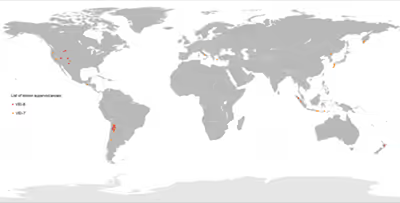
Based on incomplete statistics, at least 60 VEI 8 eruptions have been identified.
Media portrayal
- Nova featured an episode "Mystery of the Megavolcano" in September 2006 examining such eruptions in the last 100,000 years.
- Supervolcano is the title of a British-Canadian television disaster film, first released in 2005. It tells a fictional story of a supereruption at Yellowstone.
- In the 2009 disaster film 2012, a supereruption of Yellowstone is one of the events that contributes to a global cataclysm.
- The 2025 political thriller Paradise takes place after an eruption of a fictional Antarctic supervolcano and subsequent megatsunami, causing the United States federal government and other prominent individuals to relocate to an underground city in Colorado.