


Related on Lably
Through Australia
Description
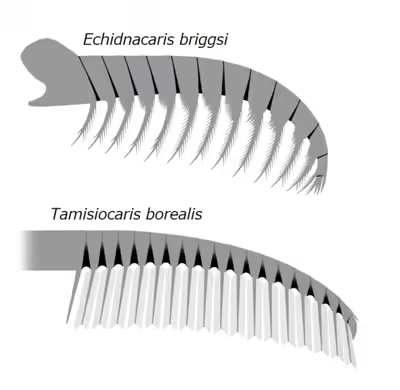
Like most radiodonts, tamisiocaridids have spiny frontal appendages. However, in this family the auxiliary spines are fine and densely arranged, which are modified for use in filter feeding like modern basking sharks and mysticete whales. For example, Tamisiocaris is estimated to have fed on prey roughly a millimeter in size.
Sign in to keep reading
2 more chapters are free with a Lably account.
Classification
Tamisiocarididae was originally named Cetiocaridae. In the 2013 speculative paleoart book All Your Yesterdays, paleoartist John Meszaros depicted a hypothetical filter-feeding anomalocaridid he named "Ceticaris". This artwork inspired the name of Cetiocaridae. However, as no genus "Cetiocaris" actually exists, the name Cetiocaridae does not comply with article 29 of the International Code of Zoological Nomenclature and is invalid. The family Tamisiocarididae was subsequently devised as a replacement name for the clade. Cetiocaridae was originally defined phylogenetically as all species more closely related to Tamisiocaris borealis than to Anomalocaris canadensis, Amplectobelua symbrachiata, or Hurdia victoria. A 2025 paper described the genus Verrocaris and found it to be an intermediate between the predatory Anomalocarididae and the suspension feeding Tamisiocarididae.
Distribution
Tamisocaridid fossils have been found in the Emu Bay Shale of Australia, Sirius Passet lagerstätte of Greenland, and Kinzers Formation of the United States. Their fossils date to stage 3 and stage 4 of the Cambrian.