

Tectonite
Rock whose structure reflects its history of deformation
- 1 min read
- 1 chapter

Related on Lably
Through Metamorphic rock, Tectonics and Rock (geology)
- The orientation of shearing and compressive stresses during (dynamic) metamorphism
- The later (or final) stages of metamorphism
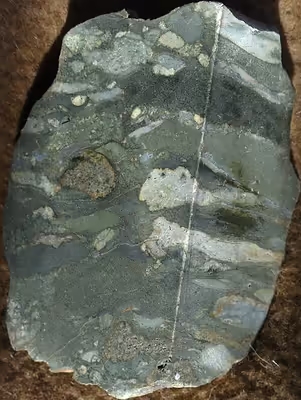
According to the nature of mineral orientation, there are three main groups of tectonites, L-tectonites, S-tectonites, and L-S tectonites. The different types reflect the different ways that matter moves.
Classification
- S-tectonites (from the German, Schiefer for schist) have a dominant planar fabric and may indicate a flattening type of strain. This may also be due to a lack of minerals capable of giving a lineation e.g. in a phyllonite.
- L-tectonites have a dominant linear fabric and generally indicate a constrictional type of strain. This may be due to a lack of platey phases.
- L-S tectonites have equally developed linear and planar fabric elements and may indicate a plane strain deformation. Many mylonites are L-S tectonites consistent with a simple shear deformation.