


Related on Lably
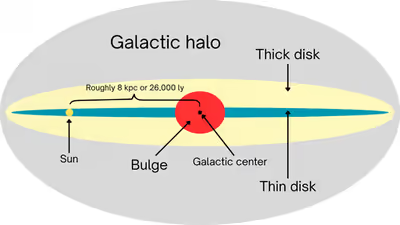
The thick disk is a source of early kinematic and chemical evidence for a galaxy's composition and thus is regarded as a very significant component for understanding galaxy formation.
With the availability of observations at larger distances away from the Sun, it has become apparent that the Milky Way thick disk does not have the same chemical and age composition at all distances from the galactic centre. Instead, it is metal-poor inside the solar radius, but becomes more metal-rich outside it. Additionally, observations have revealed that the average stellar age of thick disk stars quickly decreases as one moves from the inner to the outer disk.
Origin
Various scenarios for the formation of this structure have been proposed, including:
- Thick disks come from the heating of the thin disk
- It is a result of a merger event between the Milky Way and a dwarf galaxy
- More energetic stars migrate outwards from the inner galaxy to form a thick disk at larger radii
- The disk forms thick at high redshift with the thin disk forming later
- Disk flaring combined with inside-out disk formation
- Scattering by massive clumps:
- Stars born in massive gas clumps tend to be scattered into a thick disc, and to be enriched in alpha process elements
- Stars formed outside of such clumps tend to settle into a thin disc, and are alpha-element poor
Sign in to keep reading
One more chapter is free with a Lably account.
Dispute
Although the thick disk is mentioned as a bona fide galactic structure in numerous scientific studies and is thought to be a common component of disk galaxies in general, its nature is still under dispute. The view of the thick disk as a single separate component has been questioned by a series of papers that describe the galactic disk with a continuous spectrum of components with different thicknesses.