

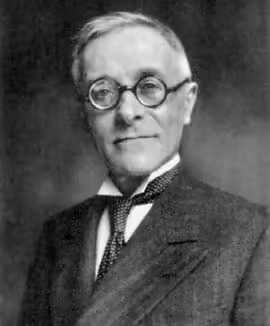
Tullio Levi-Civita
Italian mathematician (1873–1941)
- 3 min read
- 2 chapters

Related on Lably
Through Jews, Albert Einstein and Gravitational field
Biography
Born into an Italian Jewish family in Padova, Levi-Civita was the son of Giacomo Levi-Civita, a lawyer and former senator. He graduated in 1892 from the University of Padova Faculty of Mathematics. In 1894 he earned a teaching diploma after which he was appointed to the Faculty of Science teacher's college in Pavia. In 1898 he was appointed to the Padova Chair of Rational Mechanics (left uncovered by death of Ernesto Padova) where he met and, in 1914, married Libera Trevisani, one of his students. He remained in his position at Padova until 1918, when he was appointed to the Chair of Higher Analysis at the University of Rome; in another two years he was appointed to the Chair of Mechanics there.
In 1900 he and Ricci-Curbastro published the theory of tensors in Méthodes de calcul différentiel absolu et leurs applications, which Albert Einstein used as a resource to master tensor calculus, a critical tool in the development of the theory of general relativity. In 1917 he introduced the notion of parallel transport in Riemannian geometry, motivated by the will to simplify the computation of the curvature of a Riemannian manifold. Levi-Civita's series of papers on the problem of a static gravitational field were also discussed in his 1915–1917 correspondence with Einstein. The correspondence was initiated by Levi-Civita, as he found mathematical errors in Einstein's use of tensor calculus to explain the theory of relativity. Levi-Civita methodically kept all of Einstein's replies to him; and even though Einstein had not kept Levi-Civita's, the entire correspondence could be re-constructed from Levi-Civita's archive. It is evident from this that, after numerous letters, the two men had grown to respect each other. In one of the letters, regarding Levi-Civita's new work, Einstein wrote "I admire the elegance of your method of computation; it must be nice to ride through these fields upon the horse of true mathematics while the like of us have to make our way laboriously on foot". In 1933 Levi-Civita contributed to Paul Dirac's equations in quantum mechanics as well.
His textbook on tensor calculus, The Absolute Differential Calculus (originally a set of lecture notes in Italian co-authored with Ricci-Curbastro), remains one of the standard texts almost a century after its first publication, with several translations available.
In 1936, receiving an invitation from Einstein, Levi-Civita traveled to Princeton, United States and lived there with him for a year. But when the risk of war in Europe again rose, he returned to Italy. The 1938 race laws enacted by the Italian Fascist government deprived Levi-Civita of his professorship and of his membership of all scientific societies. Isolated from the scientific world, he died in his apartment in Rome on 29 December, 1941.
Among his PhD students were Octav Onicescu, Attilio Palatini, Giovanni Lampariello and Gheorghe Vrânceanu.
Later on, when asked what he liked best about Italy, Einstein said "spaghetti and Levi-Civita".
Sign in to keep reading
One more chapter is free with a Lably account.
Other studies and honors
Analytical dynamics was another aspect of Levi-Civita's studies: many of his articles examine the three-body problem. He wrote articles on hydrodynamics and on systems of differential equations. He is credited with improvements to the Cauchy–Kowalevski theorem, on which he wrote a book in 1931. In 1933, he contributed to work on the Dirac equation. He developed the Levi-Civita field, a system of numbers that includes infinitesimal quantities.
Levi-Civita was elected an international honorary member of the American Academy of Arts and Sciences in 1917. The Royal Society awarded him the Sylvester Medal in 1922 and elected him as a foreign member in 1930. He became an honorary member of the London Mathematical Society, of the Royal Society of Edinburgh, and of the Edinburgh Mathematical Society, following his participation in their colloquium in 1930 at the University of St Andrews. He was also a member of the Accademia dei Lincei, the Pontifical Academy of Sciences, and the American Philosophical Society.