


Related on Lably
Through Chromatography, Velocity and Diffusion
Van Deemter equation
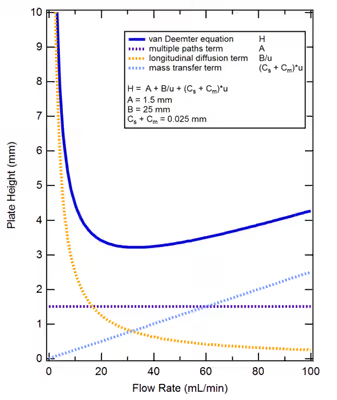
The van Deemter equation relates height equivalent to a theoretical plate (HETP) of a chromatographic column to the various flow and kinetic parameters which cause peak broadening, as follows:
Where
- HETP = a measure of the resolving power of the column [m]
- A = Eddy-diffusion parameter, related to channeling through a non-ideal packing [m]
- B = diffusion coefficient of the eluting particles in the longitudinal direction, resulting in dispersion [m2 s−1]
- C = Resistance to mass transfer coefficient of the analyte between mobile and stationary phase [s]
- u = speed [m s−1]
In open tubular capillaries, the A term will be zero as the lack of packing means channeling does not occur. In packed columns, however, multiple distinct routes ("channels") exist through the column packing, which results in band spreading. In the latter case, A will not be zero. The version of the Van Deemter equation that applies to capillary columns called the Golay equation which is as follows:
The form of the Van Deemter equation is such that HETP achieves a minimum value at a particular flow velocity. At this flow rate, the resolving power of the column is maximized, although in practice, the elution time is likely to be impractical. Differentiating the van Deemter equation with respect to velocity, setting the resulting expression equal to zero, and solving for the optimum velocity yields the following:
Sign in to keep reading
3 more chapters are free with a Lably account.
Plate count
The plate height given as:
with the column length and the number of theoretical plates can be estimated from a chromatogram by analysis of the retention time for each component and its standard deviation as a measure for peak width, provided that the elution curve represents a Gaussian curve.
In this case the plate count is given by:
By using the more practical peak width at half height the equation is:
or with the width at the base of the peak:
Expanded van Deemter Eq.
The Van Deemter equation can be further expanded to:
Where:
- H is plate height
- λ is particle shape (with regard to the packing)
- dp is particle diameter
- γ, ω, and R are constants
- Dm is the diffusion coefficient of the mobile phase
- dc is the capillary diameter
- df is the film thickness
- Ds is the diffusion coefficient of the stationary phase.
- u is the linear velocity
Rodrigues equation
The Rodrigues equation, named for Alírio Rodrigues, is an extension of the Van Deemter equation used to describe the efficiency of a bed of permeable (large-pore) particles.
The equation is:
where
and is the intraparticular Péclet number.