

Virgin Islands
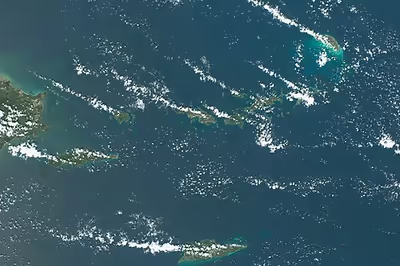
Island group of the Caribbean Leeward Islands
- 3 min read
- 4 chapters

Related on Lably
Through Archipelago, Atlantic Ocean and Geology
Geologically separated from the Lesser Antilles by the Anegada Passage and from the Greater Antilles by the Mona passage, all the islands except for Saint Croix lie on the same carbonate platform and insular shelf, known as the Puerto Rico Bank, and same tectonic plate, known as the Puerto Rico–Virgin Islands microplate.
Politically, the islands fall into three jurisdictions: the easternmost British overseas territory of the Virgin Islands, commonly referred to as the British Virgin Islands; the central unincorporated American territory of the Virgin Islands of the United States, commonly known as the U.S. Virgin Islands; and the westernmost island-municipalities of the unincorporated American territory of Puerto Rico, officially named Vieques and Culebra but generally called the Spanish Virgin Islands or Puerto Rican Virgin Islands.
Etymology
Christopher Columbus named the islands after Saint Ursula and the 11,000 Virgins (Spanish: Santa Úrsula y las Once Mil Vírgenes), shortened to the Virgins (las Vírgenes). The official name of the British territory is the Virgin Islands, and the official name of the U.S. territory is the Virgin Islands of the United States. In practice, the two island groups are almost universally referred to as the British Virgin Islands and the U.S. Virgin Islands.
Sign in to keep reading
3 more chapters are free with a Lably account.
History
The Virgin Islands were originally inhabited by the Arawak and Carib, many of whom are thought to have perished during the colonial period due to enslavement, foreign disease, and war brought about by European colonists.
European colonists later settled here and established sugar plantations and at least one tobacco plantation, and brought slaves from Africa. The descendants of the enslaved people remain the bulk of the population, sharing a common African-Caribbean heritage with the rest of the English-speaking Caribbean.
Like Puerto Rico, the Virgin Islands that belonged to Spain were ceded to the United States in 1898. The United States took possession of the islands after the signing of the armistice that put an end to military operations in the Spanish–American War.
A 1916 treaty in-between the United States and Denmark (not ratified by the United States until 1917) resulted in Denmark selling the Danish West Indies to the United States for $25 million in gold.
Historical affiliations
The Virgin Islands have been under the sovereignty of several nations and groups throughout history. Below is a table which represents the affiliation of the various islands:
* Largely under control of pirates.
** Coexisting claim.
*** Leased/shared territory.
Demographics
The total population of the Virgin Islands is 147,778: 87,146 in the U.S. Virgin Islands, 31,758 in the British, and 11,119 in the Spanish. Roughly three-quarters of islanders are black in the British and U.S. Virgin Islands, while the majority of inhabitants in Culebra and Vieques are Puerto Rican of European descent, with a significant Afro-Puerto Rican community. The main languages are English and Virgin Islands Creole in the U.S. and British Virgin Islands, and Spanish in the Puerto Rican territory. St. Thomas is the most populous island, with St. Croix close behind (51,634 and 50,601, respectively).
Traffic control
Motor vehicles are driven on the left-hand side of the road in both the British and the U.S. Virgin Islands, although the steering wheels on most cars are located on the left side (as is the norm for drive-on-the-right localities). In the Spanish Virgin Islands, vehicles are driven on the right-hand side of the road.