

Viverridae
Family of carnivorans
- 3 min read
- 2 chapters

Related on Lably
Through Species, Africa and South Asia
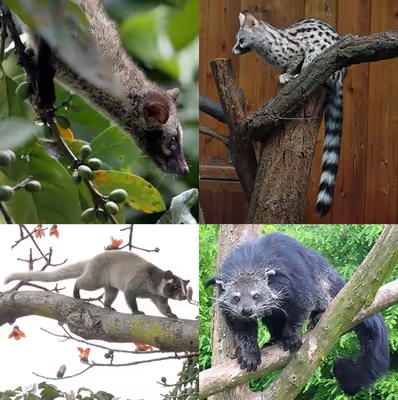
The species of the subfamily Genettinae are known as genets and oyans. The viverrids of the subfamily Viverrinae are commonly called civets; the Paradoxurinae and most Hemigalinae species are called palm civets.
Characteristics
Viverrids have four or five toes on each foot and half-retractile claws. They have six incisors in each jaw and molars with two tubercular grinders behind in the upper jaw, and one in the lower jaw. The tongue is rough with sharp prickles. A pouch or gland occurs beneath the anus, but there is no cecum. The male's urethral opening is directed backward.
Viverrids are the most primitive of all the families of feliform Carnivora and clearly less specialized than the Felidae. In external characteristics, they are distinguished from the Felidae by the longer muzzle and tuft of facial vibrissae between the lower jaw bones, and by the shorter limbs and the five-toed hind foot with the first digit present. The skull differs by the position of the postpalatine foramina on the maxilla, almost always well in advance of the maxillopalatine suture, and usually about the level of the second premolar; and by the distinct external division of the auditory bulla into its two elements either by a definite groove or, when rarely this is obliterated, by the depression of the tympanic bone in front of the swollen entotympanic. The typical dental formula is: 3.1.4.23.1.4.2, but the number may be reduced, although never to the same extent as in the Felidae.
Their flesh-shearing carnassial teeth are relatively undeveloped compared to those of other feliform carnivorans. Most viverrid species have a penis bone (a baculum).
Sign in to keep reading
One more chapter is free with a Lably account.
Classification
Living species
In 1821, Gray defined this family as consisting of the genera Viverra, Genetta, Herpestes, and Suricata. Reginald Innes Pocock later redefined the family as containing a great number of highly diversified genera, and being susceptible of division into several subfamilies, based mainly on the structure of the feet and of some highly specialized scent glands, derived from the skin, which are present in most of the species and are situated in the region of the external generative organs. He subordinated the subfamilies Hemigalinae, Paradoxurinae, Prionodontinae, and Viverrinae to the Viverridae.
In 1833, Edward Turner Bennett described the Malagasy fossa (Cryptoprocta ferox) and subordinated the Cryptoprocta to the Viverridae. A molecular and morphological analysis based on DNA/DNA hybridization experiments suggests that Cryptoprocta does not belong within Viverridae, but is a member of the Eupleridae.
The African palm civet (Nandinia binotata) resembles the civets of the Viverridae, but is genetically distinct and belongs in its own monotypic family, the Nandiniidae. There is little dispute that the Poiana species are viverrids.
DNA analysis based on 29 carnivoran species, comprising 13 Viverrinae species and three species representing Paradoxurus, Paguma and Hemigalinae, confirmed Pocock's assumption that the African linsang Poiana represents the sister group of the genus Genetta. The placement of Prionodon as the sister group of the family Felidae is strongly supported, and it was proposed that the Asiatic linsangs be placed in the monogeneric family Prionodontidae.
Phylogeny
The phylogenetic relationships of Viverridae are shown in the following cladogram: