

100 metres
Sprint race
- 11 min read
- 15 chapters
- 1 lab on Lably

Learn it on Lably
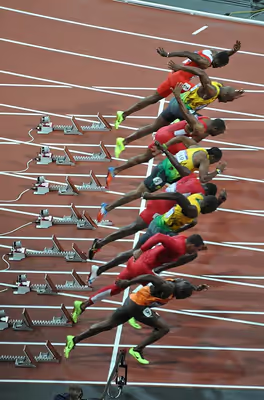
On an outdoor 400-metre running track, the 100 m is held on the home straight, with the start usually being set on an extension to make it a straight-line race. There are three instructions given to the runners immediately before and at the beginning of the race: "on your marks", "set", and the firing of the starter's pistol. The runners move to the starting blocks when they hear the "on your marks" instruction. The following instruction, to adopt the "set" position, allows them to adopt a more efficient starting posture and isometrically preload their muscles: this will help them to start faster. A race-official then fires the starter's pistol to signal the race beginning and the sprinters stride forwards from the blocks. Sprinters typically reach top speed after somewhere between 50 and 60 m. Their speed then slows towards the finish line.
The 10-second barrier has historically been a barometer of fast men's performances, while the best female sprinters take eleven seconds or less to complete the race. The men's world record is 9.58 seconds, set by Jamaica's Usain Bolt in 2009, while the women's world record is 10.49 seconds, set by American Florence Griffith Joyner in 1988.
The 100 metres is considered one of the blue ribbon events of the Olympics and is among the highest profile competitions at the games. It is the most prestigious 100 metres race at an elite level and is the shortest sprinting competition at the Olympics – a position it has held at every edition except for a brief period between 1900 and 1904, when a men's 60 metres was contested. The unofficial "world's fastest man or woman" title typically goes to the Olympic or world 100 metres champion. The 200 metre time almost always yields a "faster" average speed than a 100-metre race time, since the initial slow speed at the start is spread out over the longer distance. The current men's Olympic champion is Noah Lyles, while the current world champion is Oblique Seville. The current women's Olympic champion is Julien Alfred, and the world champion is Melissa Jefferson-Wooden.
Race dynamics
Start
At the start, some athletes play psychological games such as trying to be last to the starting blocks.
At high level meets, the time between the gun and first kick against the starting block is measured electronically, via sensors built in the gun and the blocks. A reaction time less than 0.100 s is considered a false start. This time interval accounts for the sum of the time it takes for the sound of the starter's pistol to reach the runners' ears, and the time they take to react to it.
For many years a sprinter was disqualified if responsible for two false starts individually. However, this rule allowed some major races to be restarted so many times that the sprinters started to lose focus. The next iteration of the rule, introduced in February 2003, meant that one false start was allowed among the field, but anyone responsible for a subsequent false start was disqualified.
This rule led to some sprinters deliberately false-starting to gain a psychological advantage: an individual with a slower reaction time might false-start, forcing the faster starters to wait and be sure of hearing the gun for the subsequent start, thereby losing some of their advantage. To avoid such abuse and to improve spectator enjoyment, the IAAF implemented a further change in the 2010 season – a false starting athlete now receives immediate disqualification. This proposal was met with objections when first raised in 2005, on the grounds that it would not leave any room for innocent mistakes. Justin Gatlin commented, "Just a flinch or a leg cramp could cost you a year's worth of work." The rule had a dramatic impact at the 2011 World Championships, when current world record holder Usain Bolt was disqualified.
Mid-race
Runners usually reach their top speed just past the halfway point of the race and progressively decelerate to the finish. Maintaining that top speed for as long as possible is a primary focus of training for the 100 m. Pacing and running tactics do not play a significant role in the 100 m, as success in the event depends more on pure athletic qualities and technique.
Finish
The winner, by IAAF Competition Rules, is determined by the first athlete with their torso (not including limbs, head, or neck) over the nearer edge of the finish line. There is therefore no requirement for the entire body to cross the finish line. When the placing of the athletes is not obvious, a photo finish is used to distinguish which runner was first to cross the line.
Climatic conditions
Climatic conditions, in particular air resistance, can affect performances in the 100 m. A strong head wind is very detrimental to performance, while a tail wind can improve performances significantly. For this reason, a maximum tail wind of 2.0 metres per second (4.5 mph) is allowed for a 100 m performance to be considered eligible for records, or "wind legal".
Furthermore, sprint athletes perform a better run at high altitudes because of the thinner air, which provides less air resistance. In theory, the thinner air would also make breathing slightly more difficult (due to the partial pressure of oxygen being lower), but this difference is negligible for sprint distances where all the oxygen needed for the short dash is already in the muscles and bloodstream when the race starts. While there are no limitations on altitude, performances made at altitudes greater than 1000 m above sea level are marked with an "A".
Sign in to keep reading
14 more chapters are free with a Lably account.
10-second and 11-second barriers
The 10-second mark had been widely considered a barrier for the 100 metres in men's sprinting. The first man to break the 10-second barrier with automatic timing was Jim Hines at the 1968 Summer Olympics. Since then, more than 200 sprinters have run faster than 10 seconds. Similarly, 11 seconds is considered the standard for female athletes. The first woman to go under 11 seconds was Marlies Göhr in 1977.
Record performances
Major 100 m races, such as at the Olympic Games, attract much attention, particularly when the world record is thought to be within reach.
The men's world record has been improved upon twelve times since electronic timing became mandatory in 1977. The current men's world record of 9.58 s is held by Usain Bolt of Jamaica, set at the 2009 World Athletics Championships final in Berlin, Germany on 16 August 2009, breaking his own previous world record by 0.11 s. The current women's world record of 10.49 s was set by Florence Griffith Joyner of the US, at the 1988 United States Olympic Trials in Indianapolis, Indiana, on 16 July 1988 breaking Evelyn Ashford's four-year-old world record by 0.27 seconds. The extraordinary nature of this result and those of several other sprinters in this race raised the possibility of a technical malfunction with the wind gauge which read at ±0.0 m/s – a reading which was at complete odds to the windy conditions on the day with high wind speeds being recorded in all other sprints before and after this race as well as the parallel long jump runway at the time of the Griffith Joyner performance. The next best wind legal performance is Elaine Thompson-Herah's 10.54 second clocking in 2021 at the Prefontaine Classic. Griffith Joyner's next best legal performance of 10.61 from 1988, would have her third on the all-time list behind Thompson-Herah and Shelly-Ann Fraser-Pryce (10.60).
Some records have been marred by prohibited drug use – in particular, the scandal at the 1988 Summer Olympics when the winner, Canadian Ben Johnson, was stripped of his medal and world record.
Jim Hines, Ronnie Ray Smith and Charles Greene were the first to break the 10-second barrier in the 100 m, all on 20 June 1968, the Night of Speed. Hines also recorded the first legal electronically timed sub-10 second 100 m in winning the 100 metres at the 1968 Olympics. Bob Hayes ran a wind-assisted 9.91 seconds at the 1964 Olympics.
Area records
- Updated 1 August 2026.
All-time top 25 men
As of July 2026
Assisted marks
Any performance with a following wind of more than 2.0 metres per second is not counted for record purposes. Below is a list of wind-assisted times (equal or superior to 9.80). Only times that are superior to legal bests are shown:
- Marcell Jacobs (ITA) ran 9.67 (+4.1 m/s) in Eisenstadt on 1 July 2026.
- Tyson Gay (USA) ran 9.68 (+4.1 m/s) during the US Olympic Trials in Eugene, Oregon on 29 June 2008.
- Obadele Thompson (BAR) ran 9.69 (+5.0 m/s) A in El Paso, Texas on 13 April 1996.
- Andre De Grasse (CAN) ran 9.69 (+4.8 m/s) during the Diamond League in Stockholm on 18 June 2017, 9.74 (+2.9 m/s) during the Diamond League in Eugene, Oregon on 21 August 2021, and 9.75 (+2.7 m/s) during the NCAA Division I Championships in Eugene, Oregon on 12 June 2015.
- Kanyinsola Ajayi (NGR) ran 9.72 (+2.2 m/s) during the NCAA Division I Championships in Eugene, Oregon on 12 June 2026.
- Kenny Bednarek (USA) ran 9.72 (+2.4 m/s) in Los Angeles, California on 14 June 2026.
- Richard Thompson (TTO) ran 9.74 (+5.0 m/s) in Clermont, Florida on 31 May 2014.
- Eddie Osei-Nketia (AUS) ran 9.74 (+5.6 m/s) in Lincoln, Nebraska on 17 May 2026.
- Darvis Patton (USA) ran 9.75 (+4.3 m/s) in Austin, Texas on 30 March 2013.
- Trayvon Bromell (USA) ran 9.75 (+2.1 m/s) in Jacksonville, Florida on 30 April 2022.
- Jordan Anthony (USA) ran 9.75 (+2.1 m/s) in College Station, Texas on 30 May 2025.
- Jaleel Croal (IVB) ran 9.75 (+6.0 m/s) in Denton, Texas on 16 May 2026.
- Churandy Martina (AHO) ran 9.76 (+6.1 m/s) A in El Paso, Texas on 13 May 2006.
- Romell Glave (GBR) ran 9.76 (+4.1 m/s) in Eisenstadt on 1 July 2026.
- Noah Lyles (USA) ran 9.76 (+2.1 m/s) in New York City, New York on 24 July 2026.
- Carl Lewis (USA) ran 9.78 (+5.2 m/s) during the US Olympic Trials in Indianapolis, Indiana on 16 July 1988 and 9.80 (+4.3 m/s) during the World Championships in Tokyo on 24 August 1991.
- Maurice Greene (USA) ran 9.78 (+3.7 m/s) in Palo Alto, California on 31 May 2004.
- Ronnie Baker (USA) ran 9.78 (+2.4 m/s) during the Diamond League in Eugene, Oregon on 26 May 2018.
- Andre Cason (USA) ran 9.79 (+5.3 m/s) and 9.79 (+4.5 m/s) during the USA Championships in Eugene, Oregon on 16 June 1993.
- Favour Ashe (NGR) ran 9.79 (+3.0 m/s) in Baton Rouge, Louisiana on 30 April 2022.
- Walter Dix (USA) ran 9.80 (+4.1 m/s) during the US Olympic Trials in Eugene, Oregon on 29 June 2008.
- Mike Rodgers (USA) ran 9.80 (+2.7 m/s) during the Diamond League in Eugene, Oregon on 31 May 2014 and 9.80 (+2.4 m/s) in Sacramento, California on 27 June 2014.
- Terrance Laird (USA) ran 9.80 (+3.2 m/s) in College Station, Texas on 15 May 2021.
- Marvin Bracy (USA) ran 9.80 (+2.9 m/s) in Montverde, Florida on 4 June 2022.
- Patrick Ize-Iyamu (USA) ran 9.80 (+5.6 m/s) in Lincoln, Nebraska on 17 May 2026.
Annulled marks
- Tyson Gay (USA) also ran 9.75 (+1.1 m/s) during the USA Championships in Des Moines, Iowa on 21 June 2013, but he was later disqualified after he failed a drug test and his time was subsequently rescinded.
- Justin Gatlin (USA) also ran 9.77 (+1.7 m/s) in Doha on 12 May 2006, which at the time equalled the world record and was later ratified. However, that same year, Gatlin tested positive for testosterone and the record was subsequently rescinded.
- Tim Montgomery (USA) ran 9.78 (+2.0 m/s) in Paris on 14 September 2002, which was at the time ratified as a world record. However, the record was rescinded in December 2005 following his indictment in the BALCO scandal on drug use and drug trafficking charges. The time had stood as the world record until Asafa Powell first ran 9.77.
- Ben Johnson (CAN) ran 9.79 (+1.1 m/s) during the Olympics in Seoul on 24 September 1988, but he was disqualified after he tested positive for stanozolol after the race. He subsequently admitted to drug use between 1981 and 1988, and also his time of 9.83 (+1.0 m/s) during the World Championships in Rome on 30 August 1987 was rescinded.
All-time top 25 women
As of September 2026
Assisted marks
Any performance with a following wind of more than 2.0 metres per second is not counted for record purposes. Below is a list of wind-assisted times (equal or superior to 10.75). Only times that are superior to legal bests are shown:
- Sha'Carri Richardson (USA) ran 10.57 (+4.1 m/s) in Miramar, Florida on 8 April 2023.
- Brittany Brown (USA) ran 10.66 (+3.2 m/s) in Waco, Texas on 23 April 2022.
- Tori Bowie (USA) ran 10.72 (+3.2 m/s) during the USA Championships in Eugene, Oregon on 26 June 2015 and 10.74 (+3.1 m/s) during the US Olympic Trials in Eugene, Oregon on 3 July 2016.
- Tawanna Meadows (USA) ran 10.72 (+4.5 m/s) in Lubbock, Texas on 6 May 2017.
- Blessing Okagbare (NGR) ran 10.72 (+2.7 m/s) in Austin, Texas on 31 March 2018 and 10.75 (+2.2 m/s) during the Diamond League in Eugene, Oregon on 1 June 2013.
- Aleia Hobbs (USA) ran 10.72 (+2.9 m/s) during the USA Championships in Eugene, Oregon on 24 June 2022.
- Cambrea Sturgis (USA) ran 10.74 (+2.2 m/s) during the NCAA Division I Championships in Eugene, Oregon on 12 June 2021.
- Twanisha Terry (USA) ran 10.74 (+2.9 m/s) during the USA Championships in Eugene, Oregon on 24 June 2022.
- Brianna Selby (USA) ran 10.74 (+3.8 m/s) in Lincoln, Nebraska on 17 May 2026.
- Jenna Prandini (USA) ran 10.75 (+4.3 m/s) in Montverde, Florida on 4 June 2022.
Annulled assisted marks
- Blessing Okagbare (NGR) ran 10.63 (+2.7 m/s) in Lagos on 17 June 2021. Following the heats during the Olympics in Tokyo, she was suspended on 31 July 2021 after failing a drug test taken on 19 July 2021, which tested positive for human growth hormone. Her time was subsequently rescinded.
- Sha'Carri Richardson (USA) ran 10.64 (+2.6 m/s) during the US Olympic trials in Eugene, Oregon on 19 June 2021, but her result was later nullified due to a positive test for cannabis.
World leading times
Top 25 junior (under-20) men
Updated June 2026
Top 25 junior (under-20) women
Updated August 2025
Top 25 youth (under-18) boys
Updated August 2025
Top 25 youth (under-18) girls
Updated August 2025
100 metres per age category
The best performances by 5- to 19-year-old athletes are also recorded by Dominique Eisold, exclusively considering performances from 60 countries.
Para world records men
Updated June 2025
Para world records women
Updated November 2025