


Related on Lably
Through Salt (chemistry), Acetic acid and Alkali metal
Most of the approximately 5 million tonnes of acetic acid produced annually in industry are used in the production of acetates, which usually take the form of polymers. In nature, acetate is the most common building block for biosynthesis.
Nomenclature and common formula
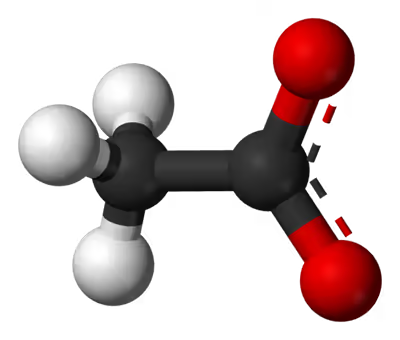
When part of a salt, the formula of the acetate ion is written as CH
3CO−
2, C
2H
3O−
2, or CH
3COO−
. Chemists often represent acetate as OAc− or, less commonly, AcO−. Thus, HOAc is the symbol for acetic acid, NaOAc for sodium acetate, and EtOAc for ethyl acetate (as Ac is common symbol for acetyl group CH3CO). The pseudoelement symbol "Ac" is also sometimes encountered in chemical formulas as indicating the entire acetate ion (CH
3CO−
2). It is not to be confused with the symbol of actinium, the first element of the actinide series; context guides disambiguation. For example, the formula for sodium acetate might be abbreviated as "NaOAc", rather than "NaC2H3O2". Care should also be taken to avoid confusion with peracetic acid when using the OAc abbreviation; for clarity and to avoid errors when translated, HOAc should be avoided in literature mentioning both compounds.
Although its systematic name is ethanoate (), the common acetate remains the preferred IUPAC name.
Sign in to keep reading
6 more chapters are free with a Lably account.
Salts
The acetate anion, [CH3COO]−,(or [C2H3O2]−) is one of the carboxylate family. It is the conjugate base of acetic acid. Above a pH of 5.5, acetic acid converts to acetate:
- CH3COOH ⇌ CH3COO− + H+
Many acetate salts are ionic, indicated by their tendency to dissolve well in water. A commonly encountered acetate in the home is sodium acetate, a white solid that can be prepared by combining vinegar and sodium bicarbonate ("bicarbonate of soda"):
- CH3COOH + NaHCO3 → CH3COO−Na+ + H2O + CO2
Transition metals can be complexed by acetate. Examples of acetate complexes include chromium(II) acetate and many other transition metal carboxylate complexes.
Commercially important acetate salts are aluminium acetate, used in dyeing, ammonium acetate, a precursor to acetamide, and potassium acetate, used as a diuretic. All three salts are colourless and highly soluble in water.
Esters
Acetate esters have the general formula CH3CO2R, where R is an organyl group. The esters are the dominant forms of acetate in the marketplace. Unlike the acetate salts, acetate esters are often liquids, lipophilic, and sometimes volatile. They are popular because they have inoffensive, often sweet odors, they are inexpensive, and they are usually of low toxicity.
Almost half of acetic acid production is consumed in the production of vinyl acetate, precursor to polyvinyl alcohol, which is a component of many paints. The second largest use of acetic acid is consumed in the production of cellulose acetate. In fact, "acetate" is jargon for cellulose acetate, which is used in the production of fibres or diverse products, e.g. the acetate discs used in audio record production. Cellulose acetate can be found in many household products. Many industrial solvents are acetates, including methyl acetate, ethyl acetate, isopropyl acetate, and ethylhexyl acetate. Butyl acetate is a fragrance used in food products.
Acetate in biology
Acetate is a common anion in biology. It is mainly utilized by organisms in the form of acetyl coenzyme A.
Intraperitoneal injection of sodium acetate (20 or 60 mg per kg body mass) was found to induce headache in sensitized rats, and it has been proposed that acetate resulting from oxidation of ethanol is a major factor in causing hangovers. Increased serum acetate levels lead to accumulation of adenosine in many tissues including the brain, and administration of the adenosine receptor antagonist caffeine to rats after ethanol was found to decrease nociceptive behavior.
Acetate has known immunomodulatory properties and can affect the innate immune response to pathogenic bacteria such as the respiratory pathogen Haemophilus influenzae.
Fermentation of acetyl CoA to acetate
Pyruvate is converted into acetyl-coenzyme A (acetyl-CoA) by the enzyme pyruvate dehydrogenase. This acetyl-CoA is then converted into acetate in E. coli, whilst producing ATP by substrate-level phosphorylation. Acetate formation requires two enzymes: phosphate acetyltransferase and acetate kinase.
acetyl-CoA + phosphate → acetyl-phosphate + CoA
acetyl-phosphate + ADP → acetate + ATP
Fermentation of acetate
Acetic acid can also undergo a dismutation reaction to produce methane and carbon dioxide:
- CH3COO− + H+ → CH4 + CO2 ΔG° = −36 kJ/mol
This disproportionation reaction is catalysed by methanogen archaea in their fermentative metabolism. One electron is transferred from the carbonyl function (e− donor) of the carboxylic group to the methyl group (e− acceptor) of acetic acid to respectively produce CO2 and methane gas.