


Related on Lably
Through Sodium, Acetic acid and Hygroscopy
Applications
Biochemistry and biotechnology
Buffer solutions composed of sodium acetate and acetic acid are routinely used to maintain pH in a mildly acidic range (pH 4–6). It is also used as a carbon source for culturing bacteria and industrial waste treatment. Sodium acetate can also be useful for increasing yields of DNA isolation by ethanol precipitation.
Industrial
Sodium acetate is used in the textile industry to neutralize sulfuric acid waste streams and also as a photoresist while using aniline dyes. It is also a pickling agent in chrome tanning and helps to impede vulcanization of chloroprene in synthetic rubber production. It is also used to reduce static electricity during production of disposable cotton pads.
Food
Anhydrous sodium acetate is widely used as a shelf-life extending agent and pH control agent. It is safe to eat at low concentration.
Heating pad
Sodium acetate is also used in heating pads, hand warmers, and "hot ice". A supersaturated solution of sodium acetate in water is supplied with a device to initiate crystallization, a process that releases substantial heat.
Sodium acetate trihydrate crystals melt at 58–58.4 °C (136.4–137.1 °F), and the liquid sodium acetate dissolves in the released water of crystallization. When heated past the melting point and subsequently allowed to cool, the aqueous solution becomes supersaturated. This solution is capable of cooling to room temperature without forming crystals. By pressing on a metal disc within the heating pad, a nucleation center is formed, causing the solution to crystallize back into solid sodium acetate trihydrate. The process of crystallization is exothermic. The latent heat of fusion is about 264–289 kJ/kg. Unlike some types of heat packs, such as those dependent upon irreversible chemical reactions, a sodium acetate heat pack can be easily reused by immersing the pack in boiling water for a few minutes, until the crystals are completely dissolved, and allowing the pack to slowly cool to room temperature.
Sign in to keep reading
3 more chapters are free with a Lably account.
Preparation
Hydrated sodium acetate is produced commercially by treating acetic acid with aqueous sodium hydroxide.
- CH3CO2H + NaOH → CH3CO2Na + H2O
Structure
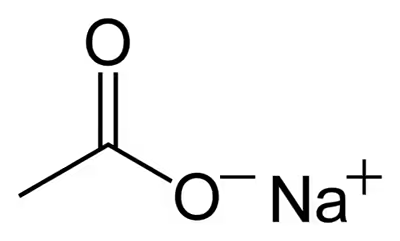
The crystal structure of anhydrous sodium acetate has been described as alternating sodium-carboxylate and methyl group layers. Sodium acetate trihydrate's structure consists of distorted octahedral coordination at sodium. Adjacent octahedra share edges to form one-dimensional chains. Hydrogen bonding in two dimensions between acetate ions and water of hydration links the chains into a three-dimensional network.
Reactions
Sodium acetate can be alkylated to form esters. For example, treatment with bromoethane gives ethyl acetate:
- CH3CO2Na + BrC2H5 → CH3CO2C2H5 + NaBr
Sodium acetate undergoes decarboxylation to form methane and carbon dioxide.