

Al-Battani
Muslim astronomer and mathematician (died 929)
- 9 min read
- 4 chapters

Related on Lably
Through Arabs, Muslims and Axial tilt
Al-Battānī's writings became instrumental in the development of science and astronomy in the west. His Kitāb az-Zīj aṣ-Ṣābi’ (c. 900), is the earliest extant zīj (astronomical table) made in the Ptolemaic tradition that is hardly influenced by Hindu or Sasanian astronomy. Al-Battānī refined and corrected Ptolemy's Almagest, but also included new ideas and astronomical tables of his own. A handwritten Latin version by the Italian astronomer Plato Tiburtinus was produced between 1134 and 1138, through which medieval astronomers became familiar with al-Battānī. In 1537, a Latin translation of the zīj was printed in Nuremberg. An annotated version, also in Latin, published in three separate volumes between 1899 and 1907 by the Italian Orientalist Carlo Alfonso Nallino, provided the foundation of the modern study of medieval Islamic astronomy.
Al-Battānī's observations of the Sun led him to understand the nature of annular solar eclipses. He accurately calculated the Earth's obliquity (the angle between the planes of the equator and the ecliptic), the solar year, and the equinoxes (obtaining a value for the precession of the equinoxes of one degree in 66 years). The accuracy of his data encouraged Nicolaus Copernicus to pursue ideas about the heliocentric nature of the cosmos. Al-Battānī's tables were used by the German mathematician Christopher Clavius in reforming the Julian calendar, and the astronomers Tycho Brahe, Johannes Kepler, Galileo Galilei and Edmund Halley all used Al-Battānī's observations.
Al-Battānī introduced the use of sines and tangents in geometrical calculations, replacing the geometrical methods of the Greeks. Using trigonometry, he created an equation for finding the qibla (the direction which Muslims need to face during their prayers). His equation was widely used until superseded by more accurate methods, introduced a century later by the polymath al-Biruni.
Life
Al-Battānī, whose full name was Abū ʿAbd Allāh Muḥammad ibn Jābir ibn Sinān al-Raqqī al-Ḥarrānī al-Ṣābiʾ al-Battānī, and whose Latinized name was Albategnius, was born before 858 in Harran in Bilād ash-Shām (Islamic Syria), 44 kilometres (27 mi) southeast of the modern Turkish city of Urfa. He was the son of Jabir ibn Sinan al-Harrani, a maker of astronomical instruments. The epithet al-Ṣabi’ suggests that his family belonged to the pagan Sabian sect of Harran, whose religion featured star worship, and who had inherited the Mesopotamian legacy of an interest in mathematics and astronomy. His contemporary, the polymath Thābit ibn Qurra, was also an adherent of Sabianism, which died out during the 11th century.
Although his ancestors were likely Sabians, al-Battānī was a Muslim, as shown by his first name. Between 877 and 918/19 he lived in Raqqa, now in north central Syria, which was an ancient Roman settlement beside the Euphrates, near Harran. During this period he also lived in Antioch, where he observed a solar and a lunar eclipse in 901. According to the Arab biographer Ibn al-Nadīm, the financial problems encountered by al-Battānī in old age forced him to move from Raqqa to Baghdad.
Al-Battānī died in 929 at Qasr al-Jiss, near Samarra, after returning from Baghdad where he had resolved an unfair taxation grievance on behalf of a clan from Raqqa.
Sign in to keep reading
3 more chapters are free with a Lably account.
Astronomy
Al-Battānī is considered to be the greatest and most famous of the known astronomers of the medieval Islamic world. He made more accurate observations of the night sky than any of his contemporaries, and was the first of a generation of new Islamic astronomers that followed the founding of the House of Wisdom in the 8th century. His meticulously described methods allowed others to assess his results, but some of his explanations about the movements of the planets were poorly written, and have mistakes.
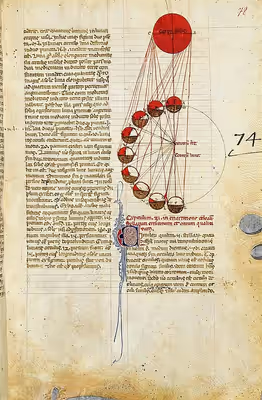
Sometimes referred to as the "Ptolemy of the Arabs", al-Battānī's works reveal him to have been a devout believer in Ptolemy's geocentric model of the cosmos. He refined the observations found in Ptolemy's Almagest, and compiled new tables of the Sun and the Moon, previously long accepted as authoritative. Al-Battānī established his own observatory at Raqqa. He recommended that the astronomical instruments there were greater than one metre (3 ft 3 in) in size. Such instruments, being larger—and so having scales capable of measuring smaller values—were capable of greater precision than had previously been achieved. Some of his measurements were more accurate than those taken by the Polish astronomer and mathematician Nicolaus Copernicus during the Renaissance. One reason for this is thought to be that al-Battānī's location for his observations at Raqqa was closer to the Earth's equator, so that the ecliptic and the Sun, being higher in the sky, were less susceptible to atmospheric refraction. The careful construction and alignment of his astronomical instruments enabled him to achieve an accuracy of observations of equinoxes and solstices that had previously been unknown.
Al-Battānī was one of the first astronomers to observe that the distance between the Earth and the Sun varies during the year, which led him to understand the reason why annular solar eclipses occur. He saw that the position in the sky at which the angular diameter of the Sun appeared smallest was no longer located where Ptolemy had stated it should be, and that since Ptolemy's time, the longitudinal position of the apogee had increased by 16°47'.
Al-Battānī was an excellent observer. He improved Ptolemy's measurement of the obliquity of the ecliptic (the angle between the planes of the equator and the ecliptic), producing a value of 23° 35'; the accepted value is around 23°.44. Al-Battānī obtained the criterion for observation of the lunar crescent—i.e., if the longitude difference between the Moon and the Sun is greater than 13° 66˝ and the Moon's delay after sunset is more than 43.2 minutes, the crescent will be visible. His value for the solar year of 365 days, 5 hours, 46 minutes and 24 seconds, is 2 minutes and 22 seconds from the accepted value.
Al-Battānī observed changes in the direction of the Sun's apogee, as recorded by Ptolemy, and that as a result, the equation of time was subject to a slow cyclical variation. His careful measurements of when the March and September equinoxes took place allowed him to obtain a value for the precession of the equinoxes of 54.5" per year, or 1 degree in 66 years, a phenomenon that he realised was altering the Sun's annual apparent motion through the zodiac constellations.
It was impossible for al-Battānī, who adhered to the ideas of a stationary Earth and geocentricism, to understand the underlying scientific reasons for his observations or the importance of his discoveries.
Mathematics
One of al-Battani's greatest contributions was his introduction of the use of sines and tangents in geometrical calculations, especially spherical trigonometric functions, to replace Ptolemy's geometrical methods. Al-Battānī's methods involved some of the most complex mathematics developed up to that time. He was aware of the superiority of trigonometry over geometrical chords, and demonstrated awareness of a relation between the sides and angles of a spherical triangle, now given by the expression:
Al-Battānī produced a number of trigonometrical relationships:
- , where .
He also solved the equation
- ,
discovering the formula
Al-Battānī used the Iranian astronomer Habash al-Hasib al-Marwazi's idea of tangents to develop equations for calculating and compiling tables of both tangents and cotangents. He discovered their reciprocal functions, the secant and cosecant, and produced the first table of cosecants for each degree from 1° to 90°, which he referred to as a "table of shadows", in reference to the shadow produced on a sundial.
Using these trigonometrical relationships, al-Battānī created an equation for finding the qibla, which Muslims face in each of the five prayers they practice every day. The equation he created did not give accurate directions, as it did not take into account the fact that Earth is a sphere. The relationship he used was precise enough only for a person located in (or close to) Mecca, but was still a widely used method at the time. Al-Battānī's equation for , the angle of the direction of a place towards Mecca is given by:
where is the difference between the longitude of the place and Mecca, and is the difference between the latitude of the place and Mecca.
Al-Battānī's equation was superseded a century after it was first used, when the polymath al-Biruni summarized several other methods to produce results that were more accurate than those that could be obtained using al-Battānī's equation.
A small work on trigonometry, Tajrīd uṣūl tarkīb al-juyūb ("Summary of the principles for establishing sines") is known. Once attributed to the Iranian astronomer Kushyar Gilani by the German orientalist Carl Brockelmann, it is a fragment of al-Battānī's zīj. The manuscript is extant in Istanbul as MS Carullah 1499/3. The authenticity of this work has been questioned, as scholars believe al-Battānī would have not have included al-juyūb for "sines" in the title.
Legacy
Medieval period
The al-Zīj al-Ṣābī was renowned by medieval Islamic astronomers; the Arab polymath al-Bīrūnī wrote Jalā' al-adhhān fī zīj al-Battānī ("Elucidation of genius in al-Battānī's Zīj"), now lost.
Al-Battānī's work was instrumental in the development of science and astronomy in the west. Once it became known, it was used by medieval European astronomers and during the Renaissance. He influenced Jewish rabbis and philosophers such as Abraham ibn Ezra and Gersonides. The 12th-century scholar Moses Maimonides, the intellectual leader of medieval Judaism, closely followed al-Battānī. Hebrew editions of the al-Zīj al-Ṣābī were produced by the 12th-century Catalan astronomer Abraham bar Hiyya and the 14th-century French mathematician Immanuel Bonfils.
Copernicus referred to "al-Battani the Harranite" when discussing the orbits of Mercury and Venus. He compared to his own value for the sidereal year with those obtained by al-Battānī, Ptolemy and a value he attributed to the 9th-century scholar Thabit ibn Qurra. The accuracy of al-Battānī's observations encouraged Copernicus to pursue his ideas about the heliocentric nature of the cosmos, and in the book that initiated the Copernican Revolution, the De Revolutionibus Orbium Coelestium, al-Battānī is mentioned 23 times.
16th and 17th centuries
Al-Battānī's tables were used by the German mathematician Christopher Clavius in reforming the Julian calendar, leading to it being replaced by the Gregorian calendar in 1582. The astronomers Tycho Brahe, Giovanni Battista Riccioli, Johannes Kepler and Galileo Galilei cited Al-Battānī or his observations. His almost exactly correct value obtained for the Sun's eccentricity is better than the values determined by both Copernicus and Brahe.
The lunar crater Albategnius was named in his honour during the 17th century. Like many of the craters on the Moon's near side, it was given its name by Riccioli, whose 1651 nomenclature system has become standardized.
In the 1690s, the English physicist and astronomer Edmund Halley, using Plato Tiburtius's translation of al-Battānī's zīj, discovered that the Moon's speed was possibly increasing. Halley researched the location of Raqqa, where al-Battānī's observatory had been built, using the astronomer's calculations for the solar obliquity, the interval between successive autumnal equinoxes and several solar and lunar eclipses seen from Raqqa and Antioch. From this information, Halley derived the mean motion and position of the Moon for the years 881, 882, 883, 891, and 901. To interpret his results, Halley was dependent upon on knowing the location of Raqqa, which he was able to do once he had corrected the accepted value for the latitude of Aleppo.
18th century – present
Al-Battānī's observations of eclipses were used by the English astronomer Richard Dunthorne to determine a value for the increasing speed of the Moon in its orbit, he calculated that the lunar longitude was changing at a rate of 10 arcseconds per century.
Al-Battānī's data is still used by geophysicists.