


Related on Lably
Biosynthesis and biological functions
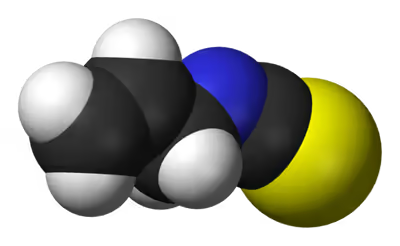
Allyl isothiocyanate can be obtained from the seeds of black mustard (Rhamphospermum nigrum) or brown Indian mustard (Brassica juncea). When these mustard seeds are broken, the enzyme myrosinase is released and acts on a glucosinolate known as sinigrin to give allyl isothiocyanate. This serves the plant as a defense against herbivores; since it is harmful to the plant itself, it is stored in the harmless form of the glucosinolate, separate from the myrosinase enzyme. When an animal chews the plant, the allyl isothiocyanate is released, repelling the animal. Human appreciation of the pungency is learned.
The compound has been shown to strongly repel fire ants (Solenopsis invicta). AITC vapor is also used as an antimicrobial and shelf life extender in food packaging.
Sign in to keep reading
2 more chapters are free with a Lably account.
Production and applications
Allyl isothiocyanate is produced commercially by the reaction of allyl chloride and potassium thiocyanate:
- CH2=CHCH2Cl + KSCN → CH2=CHCH2NCS + KCl
The product obtained in this fashion is sometimes known as synthetic mustard oil. Allyl thiocyanate isomerizes to the isothiocyanate:
- CH2=CHCH2SCN → CH2=CHCH2NCS
Allyl isothiocyanate can also be liberated by dry distillation of the seeds. The product obtained in this fashion is known as volatile oil of mustard.
It is used principally as a flavoring agent in foods. Synthetic allyl isothiocyanate is used as an insecticide, as an anti-mold agent, bacteriocide, and nematicide, and is used in certain cases for crop protection. It is also used in fire alarms for the deaf.
Hydrolysis of allyl isothiocyanate gives allylamine.
Safety
Allyl isothiocyanate has an LD50 of 151 mg/kg and is a lachrymator (similar to tear gas or mace).
Oncology
Based on in vitro experiments and animal models, allyl isothiocyanate exhibits many of the desirable attributes of a cancer chemopreventive agent.