


Related on Lably
Gaudí's work was influenced by his passions in life: architecture, nature, and religion. He considered every detail of his creations and combined crafts such as ceramics, stained glass, wrought ironwork forging, and carpentry. He introduced new techniques in the treatment of materials, such as trencadís which used waste ceramic pieces.
Influenced by neo-Gothic art and Oriental techniques, Gaudí became part of the Modernista movement, which peaked in the late 19th and early 20th centuries. His work eventually transcended mainstream Modernisme, developing into a unique style inspired by natural forms. Gaudí rarely drew detailed plans, preferring to create three-dimensional scale models and mold the details as he conceived them.
Gaudí's work enjoys global admiration and ongoing study. His masterpiece, the still-incomplete Sagrada Família, is the most-visited monument in Spain. Between 1984 and 2005, seven of his works were declared UNESCO World Heritage Sites.
Gaudí's Catholic faith intensified throughout his life, and religious imagery appears in many of his works. This earned him the nickname "God's Architect". His cause for canonisation was opened in the Archdiocese of Barcelona in 2003. Pope Francis authorised Gaudi's declaration as Venerable in April 2025.
Life
The beginning
Gaudí was born on 25 June 1852 in Reus, or possibly Riudoms, to coppersmith Francesc Gaudí i Serra (1813–1906) and Antònia Cornet i Bertran (1819–1876). He was the youngest of five children, and far outlived the other two who survived to adulthood: Rosa (1844–1879) and Francesc (1851–1876). Gaudí's family originated in the Auvergne region in southern France. One of his ancestors, Joan Gaudí, a hawker, moved to Catalonia in the 17th century. Possible derivations of the Gaudí family name include Gaudy or Gaudin.
Gaudí's exact birthplace is uncertain, with scant supporting documents. Controversy has arisen as to whether he was born in Reus or Riudoms, two neighbouring municipalities of the Baix Camp region. Most of Gaudí's identification documents gave Reus as his birthplace. From 1915, Gaudí stated on various occasions that he was born in Riudoms, his paternal family's village; this alteration in his stated natal village may have stemmed from Gaudí's later displeasure with Reus. Gaudí was baptised in the church of Sant Pere Apòstol in Reus the day after his birth under the name "Antoni Plàcid Guillem Gaudí i Cornet".
Young Gaudí suffered from poor health, including rheumatism, which may have contributed to his reticent and reserved character. These health concerns and the hygienist theories of Sebastian Kneipp contributed to Gaudí's early decision to adopt vegetarianism. His religious faith and strict vegetarianism led him to undertake lengthy and severe fasts. These fasts were often unhealthy and occasionally, as in 1894, led to life-threatening illness.
Schooling and later studies
Gaudí attended a nursery school run by Francesc Berenguer, whose son, also called Francesc, later became one of Gaudí's main assistants. He enrolled in the Piarists school in Reus where he displayed artistic talent via drawings for a seminar called El Arlequín ('the Harlequin'). During this time, he worked as an apprentice in the Vapor Nou textile mill in Reus. In 1868, he moved to Barcelona to study teaching in the Convent del Carme. As an adolescent, Gaudí became interested in utopian socialism and, together with his fellow students Eduard Toda i Güell and Josep Ribera i Sans, planned a restoration of the Poblet Monastery that would have transformed it into a Utopian phalanstère.
Between 1875 and 1878, Gaudí completed his compulsory military service in the infantry regiment in Barcelona as a Military Administrator. Most of his service was spent on sick leave, enabling him to continue his studies. His poor health kept him from having to fight in the Third Carlist War, which lasted from 1872 to 1876. In 1876, Gaudí's mother died at age 57, and his brother Francesc, who had just graduated as a physician, died aged 25. During this time Gaudí studied architecture at the Llotja School and the Barcelona Higher School of Architecture, graduating in 1878. To finance his studies, Gaudí worked as a draughtsman for various architects and constructors such as Leandre Serrallach, Joan Martorell, Emili Sala Cortés, Francisco de Paula del Villar y Lozano and Josep Fontserè. In addition to his architecture classes, he studied French, history, economics, philosophy, and aesthetics. His grades were average and he occasionally failed courses. When handing him his degree, Elies Rogent, director of Barcelona Architecture School, said: "We have given this academic title either to a fool or a genius. Time will show." Gaudí, when receiving his degree, reportedly told his friend, the sculptor Llorenç Matamala, with his ironical sense of humour, "Llorenç, they're saying I'm an architect now." Time spent outdoors, particularly during summer stays in the Gaudí family home Mas de la Calderera, afforded Gaudí the opportunity to study nature. His interest in the natural world led him to join the Centre Excursionista de Catalunya in 1879, when he was 27. The organisation arranged expeditions to explore Catalonia and southern France, often on horseback or on foot, covering up to ten kilometres (6.2 mi) a day.
Adulthood and professional work
Gaudí's first projects were the lampposts he designed for the Plaça Reial in Barcelona, the unfinished Girossi newsstands, and the Cooperativa Obrera Mataronense (Workers' Cooperative of Mataró) building. He gained wider recognition for his first important commission, the Casa Vicens, and subsequently received more significant proposals. At the Paris World's Fair of 1878, Gaudí displayed a showcase he had produced for the glove manufacturer Comella. Its functional and aesthetic modernista design impressed Catalan entrepreneur Eusebi Güell, who then commissioned some of Gaudí's most outstanding work: the Bodegas Güell (wine cellars), the Güell pavilions, the Palau Güell (Güell palace), the Park Güell and the crypt of the church of the Colònia Güell. Gaudí also became a friend of Antonio López, 1st Marquess of Comillas, Güell's father-in-law, for whom he designed "El Capricho" in Comillas, Cantabria, Gaudí designed other buildings in Spain.
In 1883 Gaudí was put in charge of the recently initiated project to build a Barcelona church called the Basílica i Temple Expiatori de la Sagrada Família ('basilica and expiatory church of the holy family', or simply Sagrada Família, 'holy family'). Gaudí completely changed the initial design and imbued it with his own distinctive style. From 1915 until his death, he devoted himself entirely to this project. Given the number of commissions he began receiving, he had to rely on his team to work on multiple projects simultaneously. His team consisted of professionals from all fields of construction. Several of the architects who worked under him became prominent in the field later on, such as Josep Maria Jujol, Joan Rubió, Cèsar Martinell, Francesc Folguera, and Josep Francesc Ràfols. In 1885, Gaudí moved to rural Sant Feliu de Codines to escape the cholera epidemic that was ravaging Barcelona. He lived in Francesc Ullar's house, for whom he designed a dinner table in gratitude.
The 1888 World Fair was one of the era's major events in Barcelona and represented a key point in the history of the Modernisme movement. Leading architects displayed their best works, including Gaudí, who showcased the building he had designed for the Compañía Trasatlántica (Transatlantic Company). Consequently, he received a commission to restructure the Saló de Cent of the Barcelona City Council, but this project was not constructed. In the early 1890s, Gaudí received two commissions from outside of Catalonia, namely the Episcopal Palace, Astorga, and the Casa Botines in León. These works contributed to Gaudí's growing renown across Spain. In 1891, he travelled to Málaga and Tangiers to examine the site for a project for the Franciscan Catholic Missions that the 2nd marquis of Comillas had requested him to design.
In 1899 Gaudí joined the Cercle Artístic de Sant Lluc ('Saint Luke artists' circle'), a Catholic artistic society founded in 1893 by the bishop Josep Torras i Bages and the brothers Josep and Joan Llimona. He also joined the Lliga Espiritual de la Mare de Déu de Montserrat ('spiritual league of Our Lady of Montserrat'), another Catholic Catalan organisation. The conservative and religious character of his political thought was closely linked to his defence of the cultural identity of the Catalan people.
At the beginning of the century, Gaudí was working on numerous projects simultaneously. They reflected his shift to a more personal style inspired by nature. In 1900, he received an award for the best building of the year from the Barcelona City Council for his Casa Calvet. During the first decade of the century Gaudí dedicated himself to projects like the Casa Figueras (better known as Bellesguard), the Park Güell, an unsuccessful urbanisation project, and the restoration of the Cathedral of Palma de Mallorca, for which he visited Mallorca several times. Between 1904 and 1910 he constructed the Casa Batlló and the Casa Milà, two of his most emblematic works.
As a result of Gaudí's increasing fame, in 1902 the painter Joan Llimona chose Gaudí's features to represent Saint Philip Neri in the paintings for the aisle of the Sant Felip Neri church in Barcelona. Together with Joan Santaló, son of his friend the physician Pere Santaló, he unsuccessfully founded a wrought iron manufacturing company the same year.
After moving to Barcelona, Gaudí frequently changed his address: As a student he lived in residences, generally in the area of the Gothic Quarter; when he started his career he moved among rented flats in the Eixample area. Finally, in 1906, he settled in the house in Güell Park that he owned and which had been constructed by his assistant Francesc Berenguer as a showcase property for the estate. It has since become the Gaudí Museum. There he lived with his father (who died in 1906 at the age of 93) and his niece Rosa Egea Gaudí (who died in 1912 at age 36). He lived in the house until 1925, several months before his death, when he began residing inside the workshop of the Sagrada Família. The Tragic Week in 1909 had a profound impact on Gaudí's personality. Gaudí remained in his house in Güell Park during this turbulent period. The anticlerical atmosphere and attacks on churches and convents caused Gaudí to worry for the safety of the Sagrada Família, but the building escaped damage.
In 1910, an exhibition in the Grand Palais of Paris was devoted to his work, during the annual salon of the Société des Beaux-Arts (Fine Arts Society) of France. Gaudí participated on the invitation of count Güell, displaying a series of pictures, plans and plaster scale models of several of his works. Although he participated hors concours, he received good reviews from the French press. A large part of this exposition could be seen the following year at the I Salón Nacional de Arquitectura that took place in the municipal exhibition hall of El Buen Retiro in Madrid.
During the Paris exposition in May 1910, Gaudí spent a holiday in Vic, where he designed two basalt lampposts and wrought iron for the Plaça Major of Vic in honour of Jaume Balmes's centenary. The following year he resided as a convalescent in Puigcerdà while suffering from tuberculosis. During this time he conceived the idea for the façade of the Passion of the Sagrada Família. Due to ill health he prepared a will at the office of the notary Ramon Cantó i Figueres on 9 June, but later recovered.
The decade from 1910 was hard for Gaudí. During this decade, the architect experienced the deaths of his niece Rosa in 1912 and his main collaborator Francesc Berenguer in 1914; a severe economic crisis which paralysed work on the Sagrada Família in 1915; the 1916 death of his friend Josep Torras i Bages, bishop of Vic; the 1917 disruption of work at the Colònia Güell; and the 1918 death of his friend and patron Eusebi Güell. Perhaps because of these tragedies he devoted himself entirely to the Sagrada Família from 1915, taking refuge in his work. Gaudí confessed to his collaborators:
My good friends are dead; I have no family and no clients, no fortune nor anything. Now I can dedicate myself entirely to the Church.
Gaudí dedicated the last years of his life entirely to the "Cathedral of the Poor", as it was commonly known, for which he took alms in order to continue. Apart from his dedication to this cause, he participated in few other activities, the majority of which were related to his Catholic faith: in 1916 he participated in a course about Gregorian chant at the Palau de la Música Catalana taught by the Benedictine monk Gregori M. Sunyol.
Death
On 7 June 1926, Gaudí took his daily walk to the Sant Felip Neri church for his habitual prayer and confession. While walking along the Gran Via de les Corts Catalanes between Girona and Bailén streets, he was struck by a passing number 30 tram and lost consciousness. Assumed to be a beggar, the unconscious Gaudí did not receive immediate aid. Eventually passers-by transported him in a taxi to the Santa Creu Hospital, where he received rudimentary care.
By the time that the chaplain of the Sagrada Família, Mosén Gil Parés, recognised him on the following day, Gaudí's condition had deteriorated too severely to benefit from additional treatment. Gaudí died on 10 June 1926 at age 73. A large crowd gathered to bid farewell in the chapel of Our Lady of Mount Carmel in the crypt of the Sagrada Família. His gravestone bears this inscription:
Latin: Antonius Gaudí Cornet. Reusensis. Annos natus LXXIV, vitae exemplaris vir, eximiusque artifex, mirabilis operis hujus, templi auctor, pie obiit Barcinone die X Junii MCMXXVI, hinc cineres tanti hominis, resurrectionem mortuorum expectant. R.I.P.
[Antoni Gaudí Cornet. From Reus. At the age of 74, a man of exemplary life, and an extraordinary craftsman, the author of this marvelous work, the church, died piously in Barcelona on the tenth day of June 1926; henceforward the ashes of so great a man await the resurrection of the dead. May he rest in peace.]
Sign in to keep reading
4 more chapters are free with a Lably account.
Personal life
Gaudí devoted his life entirely to his profession, remaining single. He is reported to have been attracted to only one woman—Josefa Moreu, teacher at the Mataró Cooperative, in 1884—who did not reciprocate. His niece disputed this, saying, "He didn't even look at women." Thereafter Gaudí took refuge in his Catholic faith. Gaudí is often depicted as unsociable and unpleasant, a man of gruff reactions and arrogant gestures. However, those who were close to him described him as friendly and polite, pleasant to talk to and faithful to friends. Among these, his patrons Eusebi Güell and the bishop of Vic, Josep Torras i Bages, stand out, as well as writers Joan Maragall and Jacint Verdaguer, physician Pere Santaló and some of his most faithful collaborators, such as Francesc Berenguer and Llorenç Matamala.
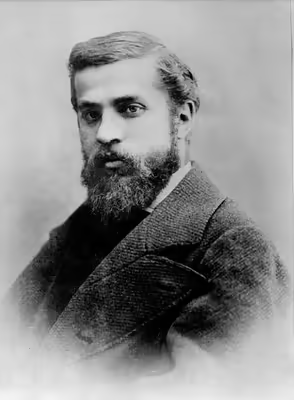
Gaudí's personal appearance—Nordic features, blond hair and blue eyes—and manner of living changed radically over the course of time. As a young man, he dressed like a dandy in costly suits, sporting well-groomed hair and beard, indulging gourmet taste, making frequent visits to the theatre and the opera and visiting his project sites in a horse carriage. The older Gaudí ate frugally, dressed in old, worn-out suits, and neglected his appearance to the extent that sometimes he was taken for a beggar, such as after the accident that caused his death.
Gaudí left hardly any written documents, apart from technical reports of his works required by official authorities, some letters to friends (particularly to Joan Maragall) and a few journal articles. Some quotes collected by his assistants and disciples have been preserved, above all by Josep Francesc Ràfols, Joan Bergós, Cèsar Martinell and Isidre Puig i Boada. The only written document Gaudí left is known as the Manuscrito de Reus (Reus Manuscript) (1873–1878), a kind of student diary in which he collected diverse impressions of architecture and decorating, putting forward his ideas on the subject. Included are an analysis of the Christian church and of his ancestral home, as well as a text about ornamentation and comments on the design of a desk.
Catalan identity
Gaudí was a proponent of Catalan culture but was not politically active. He refused suggestions by politicians such as Francesc Cambó and Enric Prat de la Riba that he run for deputy. His Catalan identity was less political and more geared towards art, history, culture, and language.
Gaudí had a deep attachment to his native Catalan language. When King of Spain, Alfonso XIII visited the Sagrada Família, Gaudí spoke to him only in Catalan. Gaudí also refused to speak Spanish with Prime Minister Antonio Maura, who, as a native of Mallorca and therefore Catalan-speaking, responded to Gaudí in Catalan, thus breaking protocol in front of the King. Similarly, when philosopher Miguel de Unamuno visited the Sagrada Família, poet Joan Maragall had to translate Gaudí's Catalan tour into Spanish. Gaudí also spoke Catalan in public, although it had been declared illegal by Miguel Primo de Rivera, who tried to suppress Catalan culture.
In 1920 he was beaten by police in a riot during the Floral Games celebrations, a Catalan culture celebration.
On 11 September 1924, National Day of Catalonia, he was beaten at a demonstration against the Catalan language ban. He was arrested by the Civil Guard as he travelled to the Basilica of Sant Just i Sant Pastor to attend a mass in memory of Catalonian patriots. Gaudí refused to speak Spanish and kept responding in Catalan, stating that "My profession obliges me to pay my taxes, and I pay them, but not to stop speaking my own language." He was then taken to prison, and was released after paying 50 pesetas bail.
Gaudí incorporated elements of Catalan culture in his works. He was part of the Renaixença, the Catalan Renaissance, a romantic revivalist and cultural movement that aimed at restoring Catalan language and arts combined with an anti-Castilian political "Catalanism". Park Güell, which was commissioned by Catalan patriot Eusebi Güell, was envisioned by Gaudí as a focus of Catalan nationalism and cultural aspirations. Gaudí inserted numerous Catalan motifs in the park, such as a large mosaic with the Catalan flag or the representations of dragons, which were seen as Catalan symbols during the Renaixença because of their connection to Catalan patron saint George. The Park hosted the First Congress of the Catalan Language during construction. Casa Batlló, which is considered among Gaudí's finest works, is known as "House of the Dragon" due to its Georgian symbolism. Sagrada Família is decorated with many words and writings, such as on the towers and doors, and are mainly in Catalan, such as the Lord's Prayer in Catalan on the main doors. The Palau Güell's entrance is decorated with the Catalan coat of arms and a helmet with a phoenix as an alegory to the rebirth of Catalan culture. His project for Barcelona's Muralla de Mar featured shields and names of battles and Catalan admirals. The Torre Bellesguard (1900–1909), former summer palace of King Martin I the Humane, was restored by Gaudí and its spire decorated the Catalan flag and the royal crown. He designed a project (not completed) to crown El Cavall Bernat (a mountain peak) with a viewpoint in the shape of a royal crown and a 20 metres (66 ft) high Catalan coat of arms. The Catalan flag was also present in a banner designed for Our Lady of Mercy of Reus and a monument (not completed) to Catalan politician Enric Prat de la Riba in Castellterçol. Even before he became an architect, he was interested in the history of mediaeval Catalonia, when it was important in Mediterranean politics and history. He joined several Catalan associations, such as Cercle Artístic de Sant Lluc, Lliga Espiritual de la Mare de Déu de Montserrat, Associació Catalanista d'Excursions Científiques. The latter was a group dedicated to preserving and celebrating Catalan art, landscape, culture, and language.
Art and Mediterranean heritage
Gaudí had a deep appreciation for his native land and great pride in his Mediterranean heritage for his art. He believed Mediterranean people to be endowed with creativity, originality and an innate sense for art and design. Gaudí described the Mediterranean distinction he perceived: "We own the image. Fantasy comes from the ghosts. Fantasy is what people in the North own. We are concrete. The image comes from the Mediterranean area. Orestes knows his way, where Hamlet is torn apart by his doubts." He elaborated this view by stating:
Do not go to the North to seek art and beauty, this is found in the Mediterranean; from its shores ... have come all works of art. In the North and the tropic they do not receive the light at 45 degrees, which best illuminates objects for a perfect viewing; ... Northerners, instead of the object see the ghost of the object; their heads fill with ghosts and in them fantasy predominates. In the North, literature is fantastic and Gothic architecture, too. We in the Mediterranean ... are more imaginative than fantastic, and therefore more appropriate for the visual arts.
Gaudí considered the light of the Mediterranean purer than that of other regions. He stated: "Architecture is, then, Mediterranean because of the harmony of the light. And this light does not exist in the northern countries, which have a sad and horizontal light, nor in the hot climates, where it is vertical."
Style development
Early work
Gaudí's professional life continually investigated mechanical building structures. Early on, Gaudí was inspired by oriental arts (India, Persia, Japan) through the study of the historicist architectural theoreticians, such as Walter Pater, John Ruskin, and William Morris. The influence of the Oriental movement can be seen in works like the Capricho, the Güell Palace, the Güell Pavilions and the Casa Vicens.
As a student, Gaudí studied a collection of photographs of Egyptian, Indian, Persian, Mayan, Chinese and Japanese art owned by the School of Architecture. The collection also included Moorish monuments in Spain, which inspired many of his early works. He studied the book Plans, elevations, sections and details of the Alhambra by Owen Jones. He took various structural and ornamental solutions from Nasrid and Mudéjar art, which he used with variations and stylistic freedom. Notably, Gaudí observed of Islamic art its spatial uncertainty, its concept of structures with limitless space; its feeling of sequence, fragmented with holes and partitions, which create a divide without disrupting the feeling of open space by enclosing it with barriers.
Gothic revival
The Gothic Revival most influenced him, promoted in the latter half of the 19th century by the theoretical works of Eugène Viollet-le-Duc. The French architect called for studying the styles of the past and adapting them in a rational manner, taking into account both structure and design. This influence is reflected in the Teresian College, the Episcopal Palace in Astorga, the Casa Botines and the Bellesguard house as well as in the crypt and the apse of the Sagrada Família.
Nonetheless, for Gaudí the Gothic style was "imperfect", because despite the effectiveness of some of its structural solutions it was an art that had yet to be "perfected". In his own words:
Gothic art is imperfect, only half resolved; it is a style created by the compasses, a formulaic industrial repetition. Its stability depends on constant propping up by the buttresses: it is a defective body held up on crutches. ... The proof that Gothic works are of deficient plasticity is that they produce their greatest emotional effect when they are mutilated, covered in ivy and lit by the moon.
Modernisme
After these initial influences, Gaudí moved towards Modernisme, then in its heyday. Modernisme in its earlier stages was inspired by historic architecture. Its practitioners saw its return to the past as a response to the industrial forms imposed by the Industrial Revolution's technological advances. The use of these older styles represented a moral regeneration that allowed the bourgeoisie to identify with values they regarded as their cultural roots. The Renaixença ('rebirth'), the revival of Catalan culture that began in the second half of the 19th century, brought more Gothic forms into the Catalan "national" style that aimed to combine nationalism and cosmopolitanism while at the same time integrating into the European modernizing movement.
Essential features of Modernisme included: an anticlassical language inherited from Romanticism with a tendency to lyricism and subjectivity; the determined connection of architecture with the applied arts and artistic work, yielding an overtly ornamental style; the use of new materials, rich in contrasts, that sought a plastic effect for the whole; a strong sense of optimism and faith in progress that reflected the atmosphere of prosperity of the time, a bourgeois aesthetic.
Quest for a new architectural language
Gaudí is usually considered the great master of Catalan Modernism, but his works find their main inspiration in geometry and from nature. Gaudí studied natural and anarchic geometric forms, searching for a way to give expression to these forms in architecture. Some of his inspirations came from visits to the mountain of Montserrat, the caves of Mallorca, the saltpetre caves in Collbató, the Fraguerau gorge in the Prades Mountains behind Reus, the Pareis mountain in the north of Mallorca and Sant Miquel del Fai in Bigues i Riells.
Geometrical forms
This study of nature translated into his use of ruled geometrical forms such as the hyperbolic paraboloid, the hyperboloid, the helicoid and the cone, which reflect forms Gaudí found in nature. Ruled surfaces are forms generated by a straight line known as the generatrix, as it moves over one or several lines known as directrices. Gaudí found abundant examples of them in nature, for instance in rushes, reeds and bones; he said that no better structure exists than the trunk of a tree or a human skeleton. These forms are both functional and aesthetic, and Gaudí adapted nature to the structural needs of architecture. He used to equate the helicoid form to movement and the hyperboloid to light. Concerning ruled surfaces, he said:
Paraboloids, hyperboloids and helicoids, constantly varying the incidence of the light, are rich in matrices themselves, which make ornamentation and even modelling unnecessary.
Another element widely used by Gaudí was the catenary arch. He had studied geometry when he was young, absorbing numerous articles about engineering, a field that praised the catenary curve as a mechanical element, although at that time they were used only in the construction of suspension bridges. Gaudí was the first to use this element in common architecture. Catenary arches in works like the Casa Milà, the Teresian College, the crypt of the Colònia Güell and the Sagrada Família allowed Gaudí to add strength to his structures, given that the catenary distributes weight evenly, affected only by self-cancelling tangential forces.
Gaudí evolved from planar to spatial geometry, and then to ruled geometry. These forms allowed the use of cheap materials such as brick. Gaudí frequently used brick laid with mortar in successive layers, as in the traditional Catalan vault, laying the brick flat instead of on its side or its end. This quest for new structural solutions culminated between 1910 and 1920, when he exploited his research and experience in his masterpiece, the Sagrada Família. Gaudí conceived the interior of the church as if it were a forest, with a set of tree-like columns growing into branches to support a structure of intertwined hyperboloid vaults. He inclined the columns so they could better resist the perpendicular pressure on their section. He also gave them a double-turn helicoidal shape (right turn and left turn), as in the branches and trunks of trees. This structure is now known to be fractal. Together with a modulation of the space that divides it into small, independent and self-supporting segments, it creates a structure that supports the mechanical traction forces without need for buttresses, as required by the neo-Gothic style. Gaudí thus achieved a structured and logical solution, establishing an architectural style that was original, simple, practical and aesthetic.
Surpassing the Gothic
This new constructional technique allowed Gaudí to achieve his greatest architectural goal; to perfect and surpass Gothic style. The hyperboloid vaults have their centre where Gothic vaults placed their keystone, and the hyperboloid allows for a hole in this space to let in natural light. In the intersection between vaults, where Gothic vaults have ribs, the hyperboloid allows holes as well, which Gaudí employed to give the impression of a starry sky.
Gaudí complemented these insights with a unique spatial vision that allowed him to conceive his designs in three dimensions. He said that he had acquired this spatial sense as a boy by looking at his father's drawings of boilers and stills. Because of this spatial conception, Gaudí preferred to work with casts and scale models or even improvise on-site as a work progressed. Reluctant to draw plans, he sketched his works only when required.
Another of Gaudí's innovations in the technical realm was the use of a scale model to calculate structures: for the church of the Colònia Güell, he built a 1:10 scale model with a height of 4 metres (13 ft) in a shed next to the building. There, he set up a model that had strings with small bags full of birdshot hanging from them. On a drawing board that was attached to the ceiling he drew the floor of the church, and he hung the strings (for the catenaries) with the birdshot (for their weight) from the supporting points of the building—columns and corners. These weights produced a catenary curve in both the arches and vaults. At that point, he took a photograph that, when inverted, showed the structure for columns and arches. Gaudí then painted over these photographs with gouache or pastel. The outline of the church defined, he recorded every detail of the building: architectural, stylistic and decorative.
Gaudí's position in the history of architecture is that of a creative genius who, inspired by nature, developed a unique style that attained technical perfection as well as aesthetic value. Gaudí's structural innovations were to an extent the result of his journey through various styles. These styles culminated in his work, which reinterpreted and perfected them. Gaudí passed through the historicism and eclecticism of his generation without connecting with other 20th century architectural movements. The Bauhaus school represented an antithetical evolution to that initiated by Gaudí, given that it later reflected the disdain and the initial lack of comprehension of the work of the Modernista architect.
Among other factors that led to the initial neglect of Gaudi's work was that despite his numerous assistants and helpers, Gaudí created no school, never taught, nor did he leave written documents. Some of his subordinates adopted his innovations, above all Francesc Berenguer and Josep Maria Jujol; others, like Cèsar Martinell, Francesc Folguera and Josep Francesc Ràfols graduated towards Noucentisme, leaving the master's trail. Despite this, influence can be discerned in some architects that either formed part of the Modernista movement or departed from it and who had had no direct contact with him, such as Josep Maria Pericas (Casa Alòs, Ripoll), Bernardí Martorell (Olius cemetery) and Lluís Muncunill (Masia Freixa, Terrassa). Nonetheless, Gaudí left a deep mark on 20th-century architecture: masters like Le Corbusier declared themselves admirers, and he inspired other architects such as Pier Luigi Nervi, Friedensreich Hundertwasser, Oscar Niemeyer, Félix Candela, Eduardo Torroja and Santiago Calatrava. Frei Otto used Gaudí's forms in the construction of the Munich Olympic Stadium. In Japan, the work of Kenji Imai bears evidence of Gaudí's influence, as can be seen in the Memorial for the Twenty-six Martyrs of Japan in Nagasaki (Japanese National Architecture Award in 1962), where the use of Gaudí's famous "trencadís" stands out.
Design and craftsmanship
During his student days, Gaudí attended craft workshops, such as those taught by Eudald Puntí, Llorenç Matamala and Joan Oñós, where he learned the basic aspects of techniques relating to architecture, including sculpture, carpentry, wrought ironwork, stained glass, ceramics, plaster modelling, etc. He absorbed technological developments, integrating into his technique the use of iron and reinforced concrete. Gaudí took a broad view of architecture as a multifunctional design, in which the details in an arrangement must be harmoniously made and well-proportioned. This knowledge allowed him to design architectural projects, including all the elements of his works, from furnishings to illumination to wrought ironwork.
Gaudí was also a craft innovator, conceiving technical and decorative solutions with materials not always associated with architecture, for example designing ceramic mosaics made of waste pieces ("trencadís") in original and imaginative combinations. For the restoration of Mallorca Cathedral he invented a new technique to produce stained glass, which consisted of juxtaposing three glass panes of primary colours, and sometimes a neutral one, varying the thickness of the glass in order to graduate the light's intensity.
He personally designed many of the Sagrada Família's sculptures. He studied the anatomy of the figure, concentrating on gestures. For this purpose, he studied the human skeleton and sometimes used dummies made of wire to test the appropriate posture of the figure he was about to sculpt. In a second step, he photographed his models, using a mirror system that provided multiple perspectives. He then made plaster casts of the figures, both of people and animals (on one occasion he made a donkey stand up so it would not move). He modified the proportions of these casts to obtain the figure's desired appearance, depending on its place in the church (the higher up, the bigger it would be). Eventually, he sculpted the figures in stone.
Urban spaces and landscaping
Gaudí also practised landscaping, often in urban settings. He aimed to place his works in appropriate natural and architectural surroundings by studying the scene of his constructions thoroughly and trying to naturally integrate them into those surroundings. For this purpose, he often used material that was common in the nearby environment, such as Bellesguard slate and grey Bierzo granite in the Episcopal Palace, Astorga. Many of his projects were gardens, such as the Güell Park and the Can Artigas Gardens, or incorporated gardens, as in the Casa Vicens or the Güell Pavilions. Gaudí's harmonious approach to landscaping is exemplified at the First Mystery of the Glory of the Rosary at Montserrat, where the architectural framework is nature itself—here the Montserrat rock—nature encircles the group of sculptures that adorned the path to the Holy Cave.
Interiors
Equally, Gaudí stood out as interior decorator, decorating most of his buildings personally, from the furnishings to the smallest details. In each case he knew how to apply stylistic particularities, personalising the decoration according to the owner's taste, the predominant style of the arrangement or its place in the surroundings—whether urban or natural, secular or religious. Many of his works were related to liturgical furnishing. From the design of a desk for his office at the beginning of his career to the furnishings designed for the Sobrellano Palace of Comillas, he designed all furnishing of the Vicens, Calvet, Batlló and Milà houses, of the Güell Palace and the Bellesguard Tower, and the liturgical furnishing of the Sagrada Família. It is noteworthy that Gaudí studied some ergonomy in order to adapt his furnishings to human anatomy. Many of his furnishings are exhibited at Gaudí House Museum.
Another aspect is the intelligent distribution of space, always with the aim of creating a comfortable, intimate, interior atmosphere. For this purpose, Gaudí would divide spaces into sections, adapted to their specific use, by means of low walls, dropped ceilings, sliding doors and wall closets. Apart from taking care of every detail of all structural and ornamental elements, he made sure his constructions had good lighting and ventilation. For this purpose, he studied each project's orientation with respect to the cardinal points, as well as the local climate and its place in its surroundings. At that time, there was an increasing demand for more domestic comfort, with piped water and gas and the use of electric light, all of which Gaudí expertly incorporated. For the Sagrada Família, for example, he carried out thorough studies on acoustics and illumination, in order to optimise them. With regard to light, he stated:
Light achieves maximum harmony at an inclination of 45°, since it resides on objects in a way that is neither horizontal nor vertical. This can be considered medium light, and it offers the most perfect vision of objects and their most exquisite nuances. It is the Mediterranean light.
Lighting also served Gaudí for the organisation of space, which required a careful study of the gradient of light intensity to adequately adapt to each specific environment. He achieved this with different elements such as skylights, windows, shutters and blinds; a notable case is the gradation of colour used in the atrium of the Casa Batlló to achieve uniform distribution of light throughout the interior. He also tended to build south-facing houses to maximise sunlight.
Collaborators
Gaudí required the collaboration of many assistants, artists, architects and craftsmen to bring his designs to reality. Gaudí always led the way, but allowed his collaborators to express their individual abilities. A test of his management skills was to turn them into an integrated team.
Among his collaborators were:
- Architects: Francesc Berenguer, Josep Maria Jujol, Cristòfor Cascante i Colom, Josep Francesc Ràfols, Cèsar Martinell, Joan Bergós, Francesc Folguera, Josep Canaleta, Joan Rubió, Domènec Sugrañes, Francesc Quintana, Isidre Puig i Boada, Lluís Bonet i Garí.
- Sculptors: Carles Mani, Joan Flotats, Llorenç Matamala, Joan Matamala, Josep Llimona.
- Painters: Ricard Opisso, Aleix Clapés, Iu Pascual, Xavier Nogués, Jaume Llongueras, Joaquín Torres García.
- Builders and foremen: Agustí Massip, Josep Bayó i Font, Claudi Alsina i Bonafont, Josep Pardo i Casanova and his nephew Julià Bardier i Pardo.
- Craftsmen: Eudald Puntí (carpenter and forger), Joan Oñós (forger), Lluís y Josep Badia i Miarnau (forger), Joan Bertran (plasterer), Joan Munné (cabinet maker), Frederic Labòria (cabinet maker), Antoni Rigalt i Blanch (glazier), Josep Pelegrí (glazier), Mario Maragliano (mosaic artist), Jaume Pujol i Bausis and his son Pau Pujol i Vilà (ceramicists).
Death and legacy
While on his way to confession on 7 June 1926, Gaudí was hit by a tram on the Gran Via de les Corts Catalanes in Barcelona. Because he had stopped worrying about his appearance and health, he was poorly dressed and appeared quite gaunt, supposedly leading people to think he was homeless and ignore him. He had no identification on him and was unconscious. A civil guard ordered a taxi to take him to the Hospital de Sant Pau, where he was diagnosed with several broken ribs, bruises on the right leg and severe internal bleeding. After the Chaplain of the Sagrada Família identified him, several people visited him. He died of his wounds on 10 June.
He is buried in Sagrada Família. After his death, Gaudí's works suffered a period of neglect and were largely unpopular among international critics, who regarded them as baroque and excessively imaginative. In his homeland he was equally disdained by Noucentisme, the new movement which replaced Modernisme. In 1936, during the Spanish Civil War, Gaudí's workshop in the Sagrada Família was ransacked, and a great number of his documents, plans and scale models were destroyed.
Gaudí's reputation was beginning to recover by the 1950s, when his work was championed by Salvador Dalí and architect Josep Lluís Sert. In 1952, the centenary year of the architect's birth, the Asociación de Amigos de Gaudí (Friends of Gaudí Association) was founded with the aim of disseminating and conserving his legacy. Four years later, a retrospective was organised at the Saló del Tinell in Barcelona, and the Gaudí Chair at the Polytechnic University of Catalonia was created with the purpose of deepening the study and conservation of his works. These events were followed in 1957 by Gaudí's first international exhibition, held at the Museum of Modern Art in New York City. In 1976, on the 50th anniversary of his death, the Spanish Ministry of Foreign Affairs organised an exhibition about Gaudí and his works that toured the globe.
Between 1950 and 1960, research and writings by international critics like George R. Collins, Nikolaus Pevsner and Roberto Pane spread a renewed awareness of Gaudí's work, while in his homeland it was admired and promoted by Alexandre Cirici, Juan Eduardo Cirlot, and Oriol Bohigas. Gaudí's work later gained widespread international appreciation, such as in Japan where notable studies were published by Hiroya Tanaka, Kenji Imai and Tokutoshi Torii. International recognition of Gaudí's contributions to the field of architecture and design culminated in the 1984 listing of Gaudí's key works as UNESCO World Heritage Sites. Gaudí's style subsequently influenced contemporary architects such as Santiago Calatrava. and Norman Foster.
Gaudí was the subject of the 1984 documentary Antonio Gaudi.
Due to Gaudí's profoundly religious and ascetic lifestyle, the archbishop of Barcelona, Ricard Maria Carles proposed Gaudí's beatification in 1998. In 1999, American composer Christopher Rouse wrote the guitar concerto Concert de Gaudí, which was inspired by Gaudí's work; it went on to win the 2002 Grammy Award for Best Classical Contemporary Composition. On the occasion of the 150th anniversary of Gaudí's birth, official ceremonies, concerts, shows and conferences were held, and several books were published. On 24 September of the same year, the musical Gaudí had its premiere in the Palau dels Esports de Barcelona. Its authors were Jordi Galceran, Esteve Miralles and Albert Guinovart. In 2008 the Gaudí Awards were launched in his honour, organised by the Catalan Film Academy to award the best Catalan films of the year. An Iberia Airbus A340-642, EC-INO is named after Gaudí.
Japanese manga artist Takehiko Inoue wrote and illustrated a travel memoir on the life and architecture of Gaudí, titled Pepita: Takehiko Inoue Meets Gaudí and published in 2013.
Each year since 2013, World Art Nouveau Day is celebrated on 10 June, the day when Gaudí died.
World Heritage
Several of Gaudí's works have been granted World Heritage status by UNESCO: in 1984 the Park Güell, the Palau Güell and the Casa Milà; and in 2005 the Nativity façade, the crypt and the apse of Sagrada Família, Casa Vicens and Casa Batlló in Barcelona, together with the crypt of the Colònia Güell in Santa Coloma de Cervelló.
According to the citation:
- The work of Antoni Gaudí represents an exceptional and outstanding creative contribution to the development of architecture and building technology in the late 19th and early 20th centuries.
- Gaudí's work exhibits an important interchange of values closely associated with the cultural and artistic currents of his time, as represented in el Modernisme [sic] of Catalonia. It anticipated and influenced many of the forms and techniques that were relevant to the development of modern construction in the 20th century.
- Gaudí's work represents a series of outstanding examples of the building typology in the architecture of the early 20th century, residential as well as public, to the development of which he made a significant and creative contribution.
Beatification cause
A sainthood guild interested in canonisation for Gaudí began work in 1992. By 2003, the cause was officially opened by the bishops of Catalonia. On 14 April 2025, Pope Francis declared Gaudí venerable after recognizing what the Vatican described as his heroic virtue. There are multiple steps in the process of being recognised as a saint, including beatification, which Gaudí has not yet achieved, although advocates are confident that the official status of "blessed" is forthcoming.