


Related on Lably
Through Mathematics, Solid geometry and Sphere
These concepts are defined not only in three-dimensional Euclidean space but also for lower and higher dimensions, and for metric spaces in general. A ball in n dimensions is called a hyperball or n-ball and is bounded by a hypersphere or (n−1)-sphere. Thus, for example, a ball in the Euclidean plane is the same thing as a disk, the planar region bounded by a circle. In Euclidean 3-space, a ball is taken to be the region of space bounded by a 2-dimensional sphere. In a one-dimensional space, a ball is a line segment.
In other contexts, such as in Euclidean geometry and informal use, sphere is sometimes used to mean ball. In the field of topology the closed -dimensional ball is often denoted as or while the open -dimensional ball is or .
In Euclidean space
In Euclidean n-space, an (open) n-ball of radius r and center x is the set of all points of distance less than r from x. A closed n-ball of radius r is the set of all points of distance less than or equal to r from x.
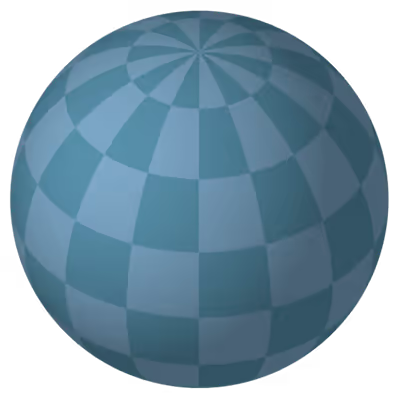
In Euclidean n-space, every ball is bounded by a hypersphere. The ball is a bounded interval when n = 1, is a disk bounded by a circle when n = 2, and is bounded by a sphere when n = 3.
Volume
The n-dimensional volume of a Euclidean ball of radius r in n-dimensional Euclidean space is given by where Γ is Leonhard Euler's gamma function (which can be thought of as an extension of the factorial function to fractional arguments). Using explicit formulas for particular values of the gamma function at the integers and half integers gives formulas for the volume of a Euclidean ball that do not require an evaluation of the gamma function. These are:
In the formula for odd-dimensional volumes, the double factorial (2k + 1)!! is defined for odd integers 2k + 1 as (2k + 1)!! = 1 ⋅ 3 ⋅ 5 ⋅ ⋯ ⋅ (2k − 1) ⋅ (2k + 1).
The surface area of an n-ball (an (n-1)-sphere) is:
Sign in to keep reading
4 more chapters are free with a Lably account.
In general metric spaces
Let (M, d) be a metric space, namely a set M with a metric (distance function) d, and let be a positive real number. The open (metric) ball of radius r centered at a point p in M, usually denoted by Br(p) or B(p; r), is defined the same way as a Euclidean ball, as the set of points in M of distance less than r away from p,
The closed (metric) ball, sometimes denoted Br[p] or B[p; r], is likewise defined as the set of points of distance less than or equal to r away from p,
In particular, a ball (open or closed) always includes p itself, since the definition requires r > 0. A unit ball (open or closed) is a ball of radius 1.
A ball in a general metric space need not be round. For example, a ball in real coordinate space under the Chebyshev distance is a hypercube, and a ball under the taxicab distance is a cross-polytope. A closed ball also need not be compact. For example, a closed ball in any infinite-dimensional normed vector space is never compact. However, a ball in a normed vector space will always be convex as a consequence of the triangle inequality.
A subset of a metric space is bounded if it is contained in some ball. A set is totally bounded if, given any positive radius, it is covered by finitely many balls of that radius.
The open balls of a metric space can serve as a base, giving this space a topology, the open sets of which are all possible unions of open balls. This topology on a metric space is called the topology induced by the metric d.
Let denote the closure of the open ball in this topology. While it is always the case that it is not always the case that For example, in a metric space with the discrete metric, one has but for any
In normed vector spaces
Any normed vector space V with norm is also a metric space with the metric In such spaces, an arbitrary ball of points around a point with a distance of less than may be viewed as a scaled (by ) and translated (by ) copy of a unit ball Such "centered" balls with are denoted with
The Euclidean balls discussed earlier are an example of balls in a normed vector space.
p-norm
In a Cartesian space Rn with the p-norm Lp, that is one chooses some and definesThen an open ball around the origin with radius is given by the set For n = 2, in a 2-dimensional plane , "balls" according to the L1-norm (often called the taxicab or Manhattan metric) are bounded by squares with their diagonals parallel to the coordinate axes; those according to the L∞-norm, also called the Chebyshev metric, have squares with their sides parallel to the coordinate axes as their boundaries. The L2-norm, known as the Euclidean metric, generates the well known disks within circles, and for other values of p, the corresponding balls are areas bounded by Lamé curves (hypoellipses or hyperellipses).
For n = 3, the L1-balls are within octahedra with axes-aligned body diagonals, the L∞-balls are within cubes with axes-aligned edges, and the boundaries of balls for Lp with p > 2 are superellipsoids. p = 2 generates the inner of usual spheres.
Often can also consider the case of in which case we define
General convex norm
More generally, given any centrally symmetric, bounded, open, and convex subset X of Rn, one can define a norm on Rn where the balls are all translated and uniformly scaled copies of X. Note this theorem does not hold if "open" subset is replaced by "closed" subset, because the origin point qualifies but does not define a norm on Rn.
In topological spaces
One may talk about balls in any topological space X, not necessarily induced by a metric. An (open or closed) n-dimensional topological ball of X is any subset of X which is homeomorphic to an (open or closed) Euclidean n-ball. Topological n-balls are important in combinatorial topology, as the building blocks of cell complexes.
Any open topological n-ball is homeomorphic to the Cartesian space Rn and to the open unit n-cube (hypercube) (0, 1)n ⊆ Rn. Any closed topological n-ball is homeomorphic to the closed n-cube [0, 1]n.
An n-ball is homeomorphic to an m-ball if and only if n = m. The homeomorphisms between an open n-ball B and Rn can be classified in two classes, that can be identified with the two possible topological orientations of B.
A topological n-ball need not be smooth; if it is smooth, it need not be diffeomorphic to a Euclidean n-ball.
Regions
A number of special regions can be defined for a ball:
- cap, bounded by one plane
- sector, bounded by a conical boundary with apex at the center of the sphere
- segment, bounded by a pair of parallel planes
- shell, bounded by two concentric spheres of differing radii
- wedge, bounded by two planes passing through a sphere center and the surface of the sphere