


Related on Lably
Through Igneous rock, Volcano and Erosion
Formation
Although they may appear uniform, batholiths are in fact structures with complex histories and compositions. They are composed of multiple masses, or plutons, bodies of igneous rock of irregular dimensions (typically at least several kilometers) that can be distinguished from adjacent igneous rock by some combination of criteria including age, composition, texture, or mappable structures. Individual plutons are solidified from magma that traveled toward the surface from a zone of partial melting near the base of the Earth's crust.
Traditionally, these plutons have been considered to form by ascent of relatively buoyant magma in large masses called plutonic diapirs. Because the diapirs are liquified and very hot, they tend to rise through the surrounding native country rock, pushing it aside and partially melting it. Most diapirs do not reach the surface to form volcanoes, but instead they slow down, cool, and usually solidify 5 to 30 kilometers underground as plutons (hence the use of the word pluton; in reference to the Roman god of the underworld Pluto). An alternate view is that plutons are formed by aggregation of smaller volumes of magma that ascend as dikes.
A batholith is formed when many plutons converge to form a huge expanse of granitic rock. Some batholiths are mammoth, paralleling past and present subduction zones and other heat sources for hundreds of kilometers in continental crust. One such batholith is the Sierra Nevada Batholith, which is a continuous granitic formation that makes up much of the Sierra Nevada in California. An even larger batholith, the Coast Plutonic Complex, is found predominantly in the Coast Mountains of western Canada; it extends for 1,800 kilometers and reaches into southeastern Alaska.
Sign in to keep reading
2 more chapters are free with a Lably account.
Surface expression and erosion
A batholith is an exposed area of (mostly) continuous plutonic rock that covers an area larger than 100 square kilometers (40 square miles). Areas smaller than 100 square kilometers are called stocks. However, the majority of batholiths visible at the surface (via outcroppings) have areas far greater than 100 square kilometers. These areas are exposed to the surface through the process of erosion accelerated by continental uplift acting over many tens of millions to hundreds of millions of years. This process has removed several tens of square kilometers of overlying rock in many areas, exposing the once deeply buried batholiths.
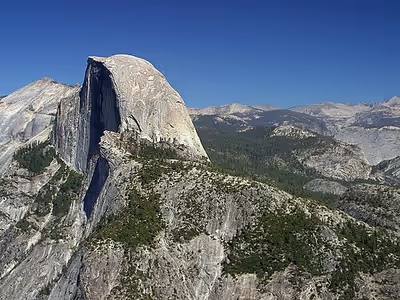
Batholiths exposed at the surface are subjected to huge pressure differences between their former location deep in the earth and their new location at or near the surface. As a result, their crystal structure expands slightly over time. This manifests itself by a form of mass wasting called exfoliation. This form of weathering causes convex and relatively thin sheets of rock to slough off the exposed surfaces of batholiths (a process accelerated by frost wedging). The result is fairly clean and rounded rock faces. A well-known result of this process is Half Dome in Yosemite Valley.