


Related on Lably
Description
Anatomy
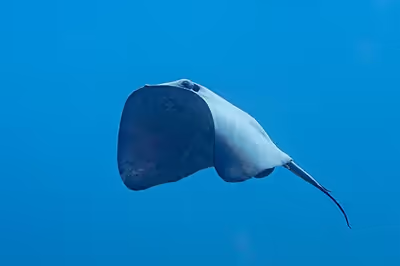
Like sharks, Batomorphs are cartilaginous fish (Chondrichthyes), meaning they have a boneless skeleton made of a tough, elastic cartilage. Most batomorphs are dorsoventrally flattened, with a mantle-like body, though the guitarfishes and sawfishes are somewhat less flattened, while most sharks have a spindle-shaped body. Many species of batomorph have developed their pectoral fins into broad flat appendages often referred to as the wings. The anal fin is absent. The eyes and spiracles are located on top of the head. Bottom-dwelling batomorphs breathe by taking water in through the spiracles, rather than through the mouth as most fish do, and passing it outward through the gills, whose openings or gill slits lie under the pectoral fins on the underside, whereas a shark's are on the sides of the head. Most batomorphs have five ventral gill slits, but the Hexatrygonidae have six.
Batomorphs have a ventrally located mouth and can considerably protrude their upper jaw (palatoquadrate cartilage) away from the cranium to capture prey. The jaws have euhyostylic type suspension, which relies completely on the hyomandibular cartilages for support. Most batomorphs have developed heavy, rounded teeth for crushing the shells of bottom-dwelling species, such as snails, clams, oysters, crustaceans, and some fish, depending on the species. Manta rays feed on plankton using dense gill rakers to capture them.
Habitat
Most species live on the sea floor, in a variety of geographical regions – mainly in coastal waters, although some live in deep waters to at least 3,000 metres (9,800 ft). Most batomorphs have a cosmopolitan distribution, preferring tropical and subtropical marine environments, although there are temperate and cold-water species. Only a few species, like manta rays, live in the open sea, and only a few live in freshwater, while some batomorphs can live in brackish bays and estuaries.
Reproduction
As is characteristic of elasmobranchs, batomorphs undergo internal fertilization. Internal fertilization is advantageous to batomorphs as it conserves sperm, does not expose eggs to consumption by predators, and ensures that all the energy involved in reproduction is retained and not lost to the environment. All skates and some rays are oviparous (egg laying) while other rays are ovoviviparous, meaning that they give birth to young which develop in a womb but without involvement of a placenta.
The eggs of oviparous skates are laid in leathery egg cases that are commonly known as mermaid's purses and which often wash up empty on beaches in areas where skates are common.
Capture-induced premature birth and abortion (collectively called capture-induced parturition) occurs frequently in sharks and rays when fished. Capture-induced parturition is rarely considered in fisheries management despite being shown to occur in at least 12% of live bearing sharks and rays (88 species to date).
Sign in to keep reading
2 more chapters are free with a Lably account.
Evolution
Batomorphs belong to the ancient lineage of cartilaginous fishes. Fossil denticles (tooth-like scales in the skin) resembling those of today's chondrichthyans date at least as far back as the Ordovician, with the oldest unambiguous fossils of cartilaginous fish dating from the middle Devonian. A clade within this diverse family, the Neoselachii, emerged by the Triassic, with the best-understood neoselachian fossils dating from the Jurassic. The oldest confirmed ray is Antiquaobatis, from the Pliensbachian of Germany. The clade is represented today by sharks, sawfish, rays and skates.
Classification
Molecular evidence refutes the hypothesis that skates and rays are derived sharks. The monophyly of the skates, the stingrays, and the electric rays has long been generally accepted. Along with Rhinopristiformes, these comprise the four traditionally accepted major batomorph lineages, as in Nelson's 2006 Fishes of the World. However, the exact phylogeny of the major batomorph lineages, internally and with respect to one another, has been subject to diverse treatments. The following cladogram is based on a comprehensive morphological assessment of batomorph phylogeny published in 2004:
However, a 2011 study significantly reevaluated the phylogeny of batomorphs, using nuclear and mitochondrial DNA from 37 taxa, representing almost all recognized families and all of the traditional four major lineages. This is a far more numerous and diverse set of sample taxa than in any previous study, producing findings reflected in the cladogram below.
This study strongly confirmed the traditionally accepted internal monophyly of skates, stingrays, and electric rays. It also recovered panrays as sister to the stingrays, as older morphological analyses had suggested. However, it found the Rhinopristiformes, including the sawfishes and various "guitarfishes", to be paraphyletic, comprising two distinct clades. Referred to as "Guitarfishes 1" and "Guitarfishes 2", the former contains only the Trygonorrhinidae, while the latter contains the remainder of Rhinopristiformes (the families Glaucostegidae, Pristidae, Rhinidae, and Rhinobatidae). In addition, while traditional phylogenies often find electric rays to be the basalmost batomorphs, followed by the Rhinopristiformes, this analysis finds a polytomy between skates, electric rays, and thornbacks at the base of Batomorphi, with weak support for skates being the actual most basal lineage, followed by a clade uniting the electric rays and thornbacks.
The Mesozoic Sclerorhynchoidea were long considered to be basal or incertae sedis; they show features of the Rajiformes but have snouts resembling those of sawfishes. Though considered to be the sister group to sawfishes for a time, they are now considered true skates (Rajiformes).
The following cladograms are derived from phylogenetic analyses taken from a 2022 study of batomorph morphology by Villalobos-Segura and colleagues;
Subdivisions
Eschmeyer's Catalog of Fishes classifies the rays as follows:
- Order Torpediniformes
- Order Rhinopristiformes
- Family Trygonorrhinidae Last, Séret & Naylor, 2016 (fiddler rays or banjo rays)
- Family Rhinobatidae Bonaparte, 1835 (guitarfishes)
- Family Rhinidae J. P. Müller & Henle, 1841 (bowmouth guitarfishes or wedgefishes)
- Family Glaucostegidae Last, Séret & Naylor, 2016 (giant guitarfishes)
- Family Pristidae Bonaparte, 1835 (sawfishes)
- Order Rajiformes
- Family Rajidae Blainville, 1816 (hardnose skates)
- Family Arhynchobatidae Fowler, 1934 (softnose skates or longtail skates)
- Family Gurgesiellidae de Buen, 1959 (pygmy skates)
- Family Anacanthobatidae von Bonde & Swart, 1923 (legskates or smooth skates)
- Order Myliobatiformes
- Family Zanobatidae Fowler. 1934 (panrays)
- Family Hexatrygonidae Heemstra & M. M. Smith, 1980 (sixgill stingrays)
- Family Dasyatidae D. S. Jordan & Gilbert, 1879 (whiptail stingrays)
- Family Potamotrygonidae Garman, 1877 (neotropical stingrays)
- Subfamily Styracurinae Carvalho, Loboda & da Silva 2016 (whiptail stingrays)
- Subfamily Potamotrygoninae Garman 1877 (river stingrays)
- Family Urotrygonidae McEachran, Dunn & Miyake, 1996 (American round stingrays)
- Family Gymnuridae Fowler, 1934 (butterfly rays)
- Family Plesiobatidae K. Nishida, 1990 (deepwater stingrays or giant stingarees)
- Family Urolophidae J. P. Müller & Henle 1841 (round stingrays or stingarees)
- Family Aetobatidae Agassiz, 1858 (pelagic eagle rays)
- Family Myliobatidae Bonaparte, 1835 (eagle rays)
- Family Rhinopteridae D. S, Jordan & Evermann, 1896 (cownose rays)
- Family Mobulidae Gill, 1893 (mantas or devil rays)
Conservation
According to a 2021 study in Nature, the number of oceanic sharks and rays has declined globally by 71% over the preceding 50 years, jeopardising "the health of entire ocean ecosystems as well as food security for some of the world's poorest countries". Overfishing has increased the global extinction risk of these species to the point where three-quarters are now threatened with extinction. This is notably the case in the Mediterranean Sea - most impacted by unregulated fishing - where a recent international survey of the Mediterranean Science Commission concluded that only 38 species of rays and skates still subsisted.