


Related on Lably
Through Tropics, Temperate climate and Fresh water
Genera
The taxonomy of Dasyatidae was revised by Peter Last, Gavin Naylor, and Mabel Manjaji-Matsumoto in 2016, based on morphological and molecular phylogenetic data. The placement of Megatrygon within the family is provisional pending further research, as evidence suggests it may be more closely related to the families Potamotrygonidae and Urotrygonidae than to other dasyatids.
- Subfamily Dasyatinae D. S. Jordan & Gilbert, 1879
- Bathytoshia Whitley, 1933
- Dasyatis Rafinesque, 1810
- Hemitrygon Müller & Henle, 1838
- Hypanus Rafinesque, 1818
- Megatrygon Last, Naylor, and Manjaji-Matsumoto, 2016
- Pteroplatytrygon Fowler, 1910
- Telatrygon Last, Naylor, and Manjaji-Matsumoto, 2016
- Taeniurops Garman, 1913
- Subfamily Hypolophinae Stromer, 1910
- Makararaja T. R. Roberts, 2007
- Pastinachus Rüppell, 1829
- Subfamily Neotrygoninae Castelnau, 1873
- Neotrygon Castelnau, 1873
- Taeniura J. P. Müller and Henle, 1837
- Subfamily Urogymninae Gray, 1851
- Brevitrygon Last, Naylor, and Manjaji-Matsumoto, 2016
- Fluvitrygon Last, Naylor, and Manjaji-Matsumoto, 2016
- Fontitrygon Last, Naylor, and Manjaji-Matsumoto, 2016
- Himantura J. P. Müller and Henle, 1837
- Maculabatis Last, Naylor, and Manjaji-Matsumoto, 2016
- Pateobatis Last, Naylor, and Manjaji-Matsumoto, 2016
- †Protohimantura Marramà, Klug, de Vos & Kriwet, 2018
- Urogymnus J. P. Müller and Henle, 1837
Sign in to keep reading
5 more chapters are free with a Lably account.
Habitat
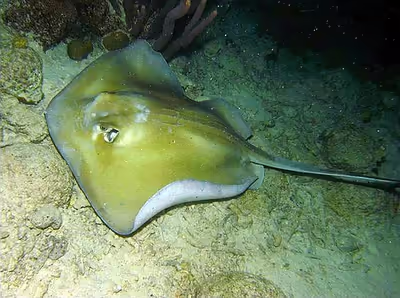
Whiptail rays are commonly found in shallow tropical water, but they may also be found in temperate regions. Having flat bodies, they are demersal, meaning they live at the bottom of a body of water. These rays specifically live sometimes buried in sand or mud or even near coral reefs on continental shelves, or the shelf created when part of a continent is under water. Whiptail rays typically inhabit shallow coastlines of 100 to 200 meters down, but some go as far as 600 meters. To avoid being preyed upon, these rays usually stay buried with just their eyes protruding. These rays are preyed on by multiple shark species, specifically hammerhead sharks.
Some species of whiptail rays live in mangrove swamps, while others reside in the open ocean. Not all species of Whiptail rays live in salt water, however. The subfamily Potamotrygoninae lives solely in freshwater, often buried in sand or mud in backwaters or shallow rivers. This specific species only resides in West Africa and the Atlantic drainages of South America.
Diet
The diet of Whiptail rays generally includes mollusks, crustaceans, jellyfish, and bony fish. They extract food by digging in the sand. In areas such as Stingray City in Grand Cayman and Hamelyn Bay in Western Australia, some rays accept scraps from tourists. Rays may also gather at fisherman's fish cleaning stations. Their electroreceptive abilities allow the rays to detect weak electric fields from prey. This ability allows rays to identify the relative area of prey from a distance.
Human use
Species' flesh may be used for human consumption in areas like South-West Asia where it's salted and dried. Skin may also be used for leather products like wallets and shoes. Species may be found in aquarium exhibits or used for ecotourism.
Conservation
Many whiptail ray species face decreasing populations, with a large number marked from threatened to endangered. The Smalltooth Stingray, Starrynose Cowtail Ray, Pakistan Whipray, Shorttail Whipray, Smooth Stingray, Colares Stingray, Wingfin Stingray, and Thorny Whipray are marked as critically endangered. Threats to stingrays include bycatch as product of overfishing, water contamination, loss of habitat, tourism, and climate change causing increased water temperatures. Note that some of these species listed below may be repeats under alternative names.