


Related on Lably
Through Fresh water, Habitat and Africa
The oldest fossil member of this family is Triassonepa from the Late Triassic-aged Cow Branch Formation of Virginia and North Carolina, United States.
Morphology
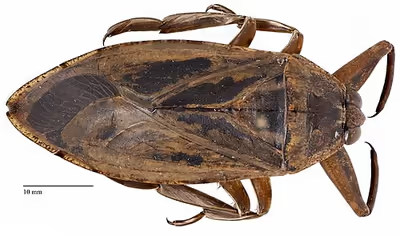
Belostomatids have a flattened, obovoid to ovoid-elongate body, and usually the legs are flattened. The head features two large compound eyes, but lacks ocelli, contrasting with many hemipterans. Short antennae are tucked in grooves behind the eyes. A short breathing tube can be retracted into its abdomen. Adults cannot breathe under water, so must periodically place the breathing tube at the surface for air (similar to a snorkel).
Their hind tarsi have two apical claws. The frontal legs are modified into raptorial appendages that they use to grab their prey, except in the African Limnogeton, which has "normal" forelegs and is a specialized snail-eater. Once caught, the prey are stabbed with their proboscis and a powerful proteolytic saliva is injected, allowing the Belostomatid to suck out the liquefied remains. Wing pads can be seen from the dorsal view. While the members of the subfamily Lethocerinae can disperse by flying, other species, including Abedus herberti, have a greatly reduced flight apparatus and are flightless. Giant Water Bugs exhibit muscle regression as they develop from nymphs to adults, adapting their musculature for a more energy-efficient predatory lifestyle, which may influence their hunting strategies and ecological interactions.
Sign in to keep reading
3 more chapters are free with a Lably account.
Subfamilies and genera
BioLib lists three extant subfamilies and a number of fossil taxa:
Belostomatinae
Auth. Leach, 1815
- Abedus Stål, 1862
- Appasus Amyot & Serville, 1843
- Belostoma Latreille, 1807
- Diplonychus Laporte de Castelnau, 1833 (synonym Sphaerodema Laporte, 1833)
- Hydrocyrius Spinola, 1850 (synonym Poissonia Brown, 1948)
- Limnogeton Mayr, 1853
- Weberiella De Carlo, 1966
- Fossil genera
Horvathiniinae
Auth. Lauck & Menke, 1961; South America
- Horvathinia Montandon, 1911
Lethocerinae
Auth. Lauck & Menke, 1961
- Benacus Stål, 1861
- Lethocerus Mayr, 1853 (includes Kirkaldyia Montandon, 1909)
Fossil taxa
subfamily Stygeonepinae Popov, 1971 †
- Aenictobelostoma Polhemus, 2000 †
- Belostomates Schöberlin, 1888 †
- Lethopterus Popov, 1989 †
- Manocerus Zhang, 1989 †
- Scarabaeides Germar, 1839 †
- Triassonepa Criscione & Grimaldi, 2017 †
Habits
Feeding and defense
Belostomatids are aggressive predators that stalk, capture, and feed on fish, amphibians, as well as aquatic invertebrates such as snails and crustaceans. The largest species have also been found to capture and feed on baby turtles and water snakes. They often lie motionless at the bottom of a body of water, attached to various objects, where they wait for prey to come near. They then strike, injecting a venomous digestive saliva with their rostrum. Although their bite is excruciatingly painful, it is of no medical significance. Occasionally, when encountered by a larger animal or a human, they have been known to "play dead" and most species can emit a fluid from their anus. Due to this, they are assumed dead by humans only to later "come alive" with painful results.
Breeding
Belostomatids show paternal care and these aspects have been studied extensively, among others involving the North American Belostoma flumineum and the East Asian Lethocerus (Kirkaldyia) deyrollei. In species of the subfamily Belostomatinae, the eggs are typically laid on the male's wings and carried until they hatch. The male cannot mate during this period. The males invest considerable time and energy in reproduction and females take the role of actively finding males to mate. This role reversal matches the predictions of R. L. Trivers' parental investment theory. In the subfamily Lethocerinae, the eggs are laid on emergent vegetation and guarded by the male.
In Asian cuisine
Belostomatids can be found for sale in markets mainly in Southeast Asia involving the species Lethocerus indicus. In Southeast Asia they are often collected for this purpose using large floating traps on ponds, set with black lights to attract the bugs. Adults fly at night, like many aquatic insects, and are attracted to lights during the breeding season.