


Related on Lably
Through India, Assam and Indian subcontinent
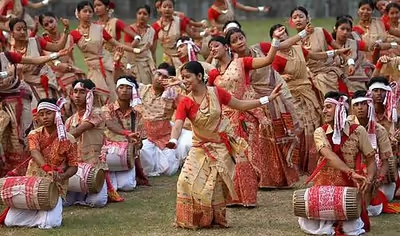
The Rongali Bihu is the most important of them all, coincides with the Assamese New Year and as well as with other regions of Indian subcontinent, East Asia and South-East Asia, which follow the Hindu calendar and Buddhist calendar. The other two Bihu festivals every year are unique to Assamese people. Like some other Indian festivals, Bihu is associated with agriculture, and rice in particular. Bohag Bihu is a sowing festival, Kati Bihu is associated with crop protection and worship of plants and crops and is an animistic form of the festival, while Bhogali Bihu is a harvest festival. Assamese celebrate the Rongali Bihu with feasts, music and dancing. Some hang brass, copper or silver pots on poles in front of their house, while children wear flower garlands then greet the new year as they pass through the rural streets.
The three Bihu are Assamese festivals elders in family, fertility and mother goddess, but the celebrations and rituals reflect influences from Sino-Tibetan and Southeast Asia cultures. In contemporary times, the Bihus are celebrated by all Assamese people irrespective of religion, caste or creed. It is also celebrated overseas by the Assamese diaspora community living worldwide.
The term Bihu is also used to imply Bihu dance otherwise called Bihu Naas and Bihu folk songs also called Bihu Geet.
History
Indigenous origin
Etymology and regional traditions
The word Bihu is believed to have been originally derived from the Deori (a Boro-Garo language) word Bisu which means "excessive joy". A Chutia folk explanation also associates Bisu with the cultivation of ahu rice. According to Mahanta (2018), ahu paddy, in ancient times, occupied an important place in Chutia agriculture, and cultivators guarding the crop from wild animals during the day and night passed the time through singing, dancing and other forms of merriment. The annual rejoicing associated with the luxuriant growth of the ahu crop came, in this tradition, to be known as Bisu.
The original form of Bihu continues among the Chutias, Sonowal Kacharis and Deoris. These groups, known as Sadiyal Kacharis, were associated with the historical Kingdom of Sadiya. The other branches of Bodo-Kacharis, which include Boros, Dimasas, Rabhas, Tiwas, etc., have also been celebrating Bihu since ancient times. The Boros call it Baisagu, while the Dimasas, Tiwa and Rabha call it Bushu or Bushu Dima,Pisu, Dumsi respectively. Noting its regional prevalence, Haliram Dhekial Phukan, a pioneering Assamese scholar, historian, and judicial officer in early colonial Assam, wrote,”Bihu Kamrupe nai, Saumare adhik”, meaning Bihu is not found in Kamrup; it is more prevalent in Upper Assam.
Early historical references
The first reference of Bihu can be found in the copperplate inscription of the Chutia king Lakshminarayan. The inscription was found in Ghilamara region of Lakhimpur district in the year 1935 and it was issued in the year 1401 A.D. It states that the king Lakshminarayan had donated land grants to Brahmins to the west of Subansiri river on the auspicious occasion of Bihu. It reads,
“Etasmay Shashana prada Lakshminarayana Nripa
Utrijya Bisuye Punya Ravidev Dvijanme”
— Copper plate, Ghilamara (1401)
This means that on the pious occasion of Bihu, a Brahmin named Dvija Ravidev was granted land by the king. This indicates that Bihu played an important role in the social life of people of Assam at that period.
Yet another reference to Bihu can be found in the Deodhai Buranji which mentions that the capital of the Chutia kingdom, Sadiya, was suddenly attacked by the Ahom forces on the first day of Bihu/Bisu in 1524 (first Wednesday of Bohag/Vaisakha), when the people were busy celebrating Bihu. The Ahom general Phrasenmung Borgohain, upon the advice of a Chutia general (who sided with the enemies), played the Bihu Dhul (on Ujha Bisu day, i.e. 7th Bohag/Vaisakha) to trick the Chutias, which ultimately led to their defeat.
Religious traditions and myths
According to a tradition recorded in the Deo Buranji, Kechai-khati or Kolimoti, the goddess associated with Sadiya, the capital of the Chutia kingdom, was regarded as the originator of Bihu. Late historian Hem Buragohain states that the bloodthirsty Kolimoti—described in the tradition as Shiva's sister—was believed to have initiated Bihu. In Deori religious tradition, Gira-Girasi, also called Burha-Burhi, are regarded as the senior ancestral deities; Baliya Baba (Pisa Dema) and Kechai-khati (Pisasi Dema) are described as their son and daughter respectively.
In local folklore, it is said that Bordoisila (Bardai Sikhla in Bodo) (meaning north-westerly winds in Assamese) was the daughter of God Earth who married a bridegroom of some distant land. Bordoisila visits her mother's home once a year during springtime, which indicates the beginning of Bihu and leaves after a few days, which indicates the end of Bihu. Assam experience strong gale (wind) at that period, which marks the beginning of Bihu and another strong gale after her departure, which is devastating. The word Bordoisila is derived from the Bodo word Bordaisikhla, which means "girl of storm" (Sikhla meaning girl and Bardai meaning storm). There is even a dance with the same name performed among Boro people during Baisagu, which points to the origin of Bihu in the Bodo-Kachari groups.
Chotor and Bohag Bihu cycle
As per traditions, Bohag Bihu celebrations formerly began during the month of Chot. The period preceding the principal Bohag festivities was known as Rati Bihu or Chotor Bihu, during which young men and women performed at night beneath large trees and at sacred places like the grounds of the Than (temple). It is believed that Bihu was brought down at night from the Tameswari shrine to a large tree, where young men and women perform beneath mango or aahat trees. Chot Bihu is also associated with the youthful aspect of the goddess Kolimati; the flowering of the tarua kadam is regarded as a sign of her attaining youth and heralding the beginning of the festival. Local Chutia forms of Chotor Rati Bihu are still recorded in places such as Barhola and Basa Daiyang in the Jorhat-Golaghat region, where young men and women traditionally perform at night beneath large mango or aahat trees. The repertoire includes jura naam and songs of love and separation, while competitions between pepa players are also recorded. A comparable Rati Bisu tradition is also preserved among the Deoris. The Deoris are recorded as celebrating a "night Bisu", with young people gathering during Phagun and Chaitra for communal Bisu rehearsals; during Bohagiyo Bisu, singing and dancing also continue through the night.
The last day of Chaitra or the first Tuesday of Bohag was when the Rati Bihu ended. This was known as the Uruka (derived from the Deori-Chutia Urukuwa meaning to end). The temple dancers Deodhani danced the entire night and were believed to be possessed by the goddess Kechai-khati (kolimoti), signalling that she had descended upon earth from heaven (Bihu nomai ona). This belief of the goddess arriving during the Bihu season each year can still be found in Bihu songs as,
"Kolimoti e bai ghuri Bohagoloi
Ahibi ne nai?
Ami thakim ami thakim
Baatoloi sai."
The day after Uruka, i.e. the first Wednesday, was celebrated as Goru Bihu. This tradition of cattle rites is the same as that followed by the Boros in Bwisagu, indicating the common roots of both the festivals. During the night of Goru Bihu, people danced Bihu in separate groups in the Thans where animal sacrifice took place. After the sacrifices to the goddess, the young folk visited the households of the village, which was the start of Husori. This old tradition of starting Husori from the temple is still followed by the Deoris, some Sonowals, Chutias and Morans as well as the people of Sadiya. In other communities, the temple has been replaced by the Namghar.
Some old Assamese Bihu folklore still hints at this tradition:
“Hasoti e chot Bisoti e chot.
Budhe Goru Bihu Mangale Uruka.
Bihu goi asili kot.”
“Boge dhari khale luitor hihu,
Mangal bare Uruka Budh bare Goru Bihu
Tar pasor dina Manisor Bihu.”
“Husori e chot asili kot.
Sadiyar ahotor tolot,
Husori e chot asili kot.
Ami je ulomu jot Dubori nogoje tot.”
“Kundilor agolit ukhokoi Himolu.
Tate loi kuruwai bah.
Sadiyar rajate sari haal goxani
Taloi namaskar koru.
Hunare jakhala Rupor hetamari
Ahe sari haali nami.”
The festivities of Bohag Bihu continued for a week and ended with the rite by which the goddess was bid farewell. In this rite, a boat was first prepared out of a banana stem and decorated with flowers and offerings. Then, it was carried to the banks of the river where a duck/chicken was put inside the boat and allowed to float as a symbol of sacrifice. After performing the rite, the people returned to their homes, singing along the way with the beats of the Dhul and the tunes of the Pepa.
This tradition of floating the boat can be heard in Bihu songs as:
"Loh lohori, pranor bhai,
Phulat bhor di nao meli jai.
Sohora lipiri hudhe aathu karhi,
Phulat bhor di nao meli jai.Ki khai bulali, daate sorilore,
Phulat bhor di nao meli jai.Sadiyar rajote holeng hate powa,
Phulat bhor di nao meli jai...
Rupar nao ekhoni, sonor bothadali,
Phulat bhor di nao meli jai.
Bhatiloi bhotiyai jai sorilore,
Phulat bhor di nao meli jai."
Hurai Rangali and Husori Tradition
A ritual tradition associates the ceremonial commencement of Bohag Bihu with the sacred saals of Sadiya, where a form known as Hurai Rangali is performed on the first Wednesday of Bohag. Hurai is explained as the ceremonial bringing down of Bihu from heaven to earth through the saal by the singing of religious songs. At the beginning of the performance, prayers are offered at the Kesaikhati and the other saals, and Ai Kolimati, regarded in the tradition as the goddess associated with Bihu, is believed to bring Bihu down to earth. The opening song of the Hurai asks where Bihu had been and answers that it was beneath the aahat tree at Sadiya.
Another related tradition associates this temple-centred Bihu observance with the development of Husori. Mahanta (2018) records that in the Chutia kingdom, young men and women first performed Bihu before the Tamreswari Temple and thereafter carried the performance into the villages. Following the decline of the kingdom, the initial performance shifted to local thaans and subsequently to Namghars, from where Husori parties proceeded from house to house. Another account similarly records that after ritual observances and sacrifices at the than, the young people proceeded to the households of the village to begin Husori; variants of the practice of commencing Husori from a sacred place are recorded among the Chutias, Deoris, Sonowal Kacharis, Morans and in the Sadiya region.
A separate folktale, Deolara Manikonwar, provides another traditional explanation of courtyard Bihu and Husori. In the story, a king of the Kundil region, traditionally associated with the Chutia state, receives the divinely born Manikonwar, who learns and composes songs and dances and performs them in the courtyards of farming households. He blesses the inhabitants and is said to have brought happiness to them; the narrative explicitly associates these performances with the beginning of courtyard Bihu and the practice of singing Husori at night.
Phaat Bihu and development of modern dance
The Hurai Rangali tradition also survives outside Sadiya. At Harhi Devalaya, it is performed on the seventh day of Bohag, and the tradition associates the shrine with the transfer of the worship of Kecaikhati from Sadiya following the Ahom conquest of the Chutia kingdom in 1524. Upen Rabha Hakacham similarly traces the Faat Bihu tradition of Dhakuakhana to people displaced from Sadiya who eventually settled at Harhi and established a shrine there. The word Phaat as per traditions has different explanations. One tradition associates the name with the word Phaat ("separation"), denoting the migration and dispersal of communities from Sadiya and the transplantation of their Bihu tradition to Dhakuakhana. Another tradition records that the Bihu celebrations drew such a large crowd that the ground was said to develop Phaat ("cracks"), and that this was why it came to be called "Phaat Bihu".
Phaat Bihu has been associated by some writers with the development of the modern form of Bihu dance. It is also traditionally held that performers of Phaat Bihu were invited to perform at the royal establishment during the reign of the Ahom king Rudra Singha. Later, in the 19th century, this form of Bihu is said to have spread among other communities in the Dhakuakhana region and to have been performed at Mahghuli Sapori by Chutias, Sonowals, Deoris, Ahoms, Misings and others.
Stage performances
By the 19th and 20th centuries, Western-style stages had been constructed in various parts of Assam, and the practice of presenting cultural programmes before public audiences had also become established. In 1929, Bihu was performed on a stage for the first time at Betioni in Golaghat. In 1941, through the efforts of Maheswar Neog and others, a staged Bihu performance was organised in Sivasagar. In 1951, a Bihu sammilan was organised in Guwahati under the patronage of Radha Govinda Baruah. Thereafter, staged Bihu gained popularity throughout Assam. In staged Bihu, greater emphasis is placed on competitions than on the traditional performance itself, and the programmes are primarily intended to entertain an audience. Consequently, this form of Bihu is performed according to prescribed rules, conventions and a formalised structure. This transformed Bihu dance and music into a performing art. With the growing popularity of staged Bihu, the traditional and spontaneous gos-tolor Bihu—Bihu performed beneath trees—has become nearly extinct.
Indo-Aryan contribution
The Indo-Aryans, upon their arrival in Assam, helped in gradually sanskritisation of the native Bihu/Bisu to bring it to the present form. Being the pioneers of Astronomy, they further associated the term Bisu with the Visuvan day for the coincidence of the Bohag Bihu with other springtime festivals observed elsewhere in India on this day and adopted the festival of the natives.
Ahom contribution
Ahoms used to celebrate their own spring festival Chyeng-Ken (similar to the Thai word Songkran which is derived from the Sanskrit word for new year saṅkrānt (संक्रान्ति)); the rituals of Chyeng-Ken are described in Khyek-Lai-Bet manuscript. But later on they adopted Bihu as their spring festival. It is believed that Ahom King Rudra Singha gave patronage to Bihu and was also the first one to celebrate Bihu in the courtyard of Rang Ghar. This policy was also believed to be later followed by his successors. But this view has been refuted by many authors. According to Padmeswar Gogoi, there is not a single mention of Bihu being performed in Rang ghar in the Buranjis. The Satsari Buranji states that on the first floor of the Rangghar, the places of the kings were pre-defined. But, if one looks from the position of the king's chair, it is impossible to view the ground where the Bihu dance was supposed to be performed. He also added that the Rang ghar was mainly used for organising buffalo and cock fights or wrestling, and several positions were newly opened for these games. But, on the other hand, no such post was created for Bihu. These facts indicate that Bihu didn't receive much attention from the Ahom kings and remained a festival of the native people back then.
Sign in to keep reading
4 more chapters are free with a Lably account.
The three Bihu Festivals
Bohag Bihu
Bohag Bihu (mid-April, also called Rongali Bihu), the most popular Bihu celebrates the onset of the Assamese New Year (around 14–15 April) and the coming of Spring. It's a time of merriment and feasting and continues, in general, for seven days. The farmers prepare the fields for cultivation of paddy and there is a feeling of joy around. The women make pitha, laroos (traditional food made of rice, coconut) various drinks by local tribes such as Suje by Deoris, Saj by Chutias, Nam-Lao by Tai-Ahom, Aapong by Mising tribe and Jolpan which gives the real essence of the season.
The first day of the bihu is called goru (goru means cow in Assamese language) bihu, where the cows are washed and worshipped, which falls on the last day of the previous year, usually on 14 April. This is followed by manuh (manuh means man kind in Assamese) bihu on 15 April, the New Year Day. This is the day of getting cleaned up, wearing new cloths and celebrating and getting ready for the new year with fresh vigor. The third day is Gosai (Gods) bihu; statues of Gods, worshiped in all households are cleaned and worshiped asking for a smooth new year.
The folk songs associated with the Bohag Bihu are called Bihu geets or Bihu songs. The form of celebration and rites vary among different demographic groups.
The Seven days
Bohag Bihu or Rongali Bihu festival continues for seven days and called as Haat Bihu. The seven days are known as Chot Bihu, Goru Bihu, Manuh Bihu, Kutum Bihu, Senehi Bihu, Mela Bihu and Chera Bihu.
Goru Bihu: The goru bihu or cattle worship rites are observed on the last day of the year. The cattle are washed, smeared with ground turmeric and other pastes, struck with sprigs of dighalati and makhiyati and endeared to be healthy and productive (lao kha, bengena kha, bosore bosore barhi ja / maar xoru, baper xoru, toi hobi bor bor goru—eat gourd, eat brinjal, grow from year to year / your mother is small, your father is small, but you be a large one). The old cattle ropes are cast away through the legs and new ropes are tied to them, and they are allowed to roam anywhere they wished for the entire day.
Manuh Bihu: The New Year Day, the day after the goru bihu, is called the manuh bihu. Elders are shown respect, with gifts of bihuwan (a gamosa), a hachoti (kerchief), a cheleng etc., and their blessings are sought. Children are given new clothes, and Husori singing begins on this day, and people visit their relatives and friends.
Husori: Village elders move from household to household, singing carols in the style of bihu geets, called husoris.
It possibly derives from the Dimasa Kachari word formation ha (land) and char (move over): hachari. Villages could have more than one Husori band, and they would visit households in a village non-contiguous to itself, first singing carols at the Naamghar. The husari singers then visit individual households, by first announcing their arrival at the gate (podulimukh) with drum beats. The singers are traditionally welcomed into the courtyard where they sing the husori songs and perform a ring dance. At the end of the performance they are thanked with an offering dakshina of paan (betel leaf) tamul (areka nut) in a xorai (brass dish with stand), whereupon the singers bless the household for the coming year. If there is a bereavement in the family, or the family does not invite the husori singers due to an illness, the husori band offers blessings from podulimukh and moves on. Generally, the singers are all male.
Faat Bihu: This is a very old form of Bihu, characterized by spontaneity, popular in the Lakhimpur area of Assam.
Mukoli Bihu: Young unmarried men and women attired in traditional golden silk muga dance the bihu and sing bihu songs in the open fields. The songs have themes of romance and sexual love, requited or unrequited. Sometimes the songs describe tragic events too, but are treated very lightly. The dance celebrates female sexuality.
Jeng Bihu: This is Bihu dance and song performed and watched only by women. The name "jeng" comes from the fact that in earlier days women in the villages used to surround the place of their performance with sticks dug into the ground called jeng in Assamese. It is also called gos tolor bihu (Bihu beneath the tree).
Baisago: The Bodo-Kachari people celebrate for seven days—the first day for cattle (Magou), the second day for man (Mansoi) and ancestor worship, feasting, singing and merriment. Songs follow the same themes as the Bihu songs.
Bihutoli Bihu: The rural festival made its transition to urban life when it was first time brought to the stage in Lataxil field in Guwahati by the Guwahati Bihu Sanmilani in 1962, promoted by leading citizens like Radha Govinda Baruah and others. Bihu to a great extent has been popularized by the Bihu 'Samrat'( king ), of Assam, Khagen Mahanta. Unlike the rural version, the dancers danced on a makeshift elevated stage in an open area that came to be known as a Bihutoli.
Many such Bihutolis have sprouted since then in Guwahati and other urban areas. The performances are not confined to the Bihu dance form but may incorporate all forms of theatrical performances to keep the audience enthralled well into the early hours. Performances could include standup comedy, to concerts by solo singers. The stage form of Bihu has become so popular, that organizers have begun extending the celebrations to bohagi bidai, or farewell to the Bohag month, which is similar performances held a month later.
Saat Bihu: Rongali Bihu also called saat Bihu (seven Bihus). It celebrates seven days, it's called so. On the other hand, Rangali Bihu is constitute of seven different types of Bihu -Goru Bihu (Cow Bihu), Manuh Bihu, Xat Bihu, Senehi Bihu, Maiki Bihu, Rongali Bihu, and Sera Bihu. Actually, the first day to pay respect to cows and other days for social activities.
Kati Bihu
Kongali Bihu (mid-October, also called Kati-Bihu) has a different flavor as there is less merriment and the atmosphere has a sense of constraining and solemnity. During this time of the year, the paddy in the fields are in the growing stage and the granaries of the farmers are almost empty. On this day, earthen lamps (saki) are lit at the foot of the household tulsi plant, the granary, the garden (bari) and the paddy fields. In ancient times, earthen lamps were lit all around the paddy fields to attract the insects, thus acting as a natural insecticide. To protect the maturing paddy, cultivators whirl a piece of bamboo and recite rowa-khowa chants and spells to ward off pests and the evil eye. During the evening, cattle are fed specially made rice items called pitha. Kati Bihu is known as Kati Gasa by the Bodo people and Gathi Sainjora by the Dimasa people. The Bodo people light lamps at the foot of the siju (Euphorbia neriifolia) tree. This Bihu is also associated with the lighting of akaxi gonga or akaxbonti, lamps at the tip of a tall bamboo pole, to show the souls of the dead the way to heaven, a practice that is common to many communities in India, as well as Asia and Europe. Kati bihu is generally celebrated around 19 October, as it is almost mid-October.
Magh Bihu
Bhogali Bihu (mid-January, also called Magh Bihu) comes from the word Bhog that is eating and enjoyment. It is a harvest festival and marks the end of harvesting season. Since the granaries are full, there is a lot of feasting and eating during this period. On the eve of the day called uruka, i.e., the last day of pausa, menfolk, more particularly young men go to the field, preferably near a river, build a makeshift cottage called Bhelaghar with the hay of the harvest fields and the bonfire or Meji, the most important thing for the night. During the night, they prepare food and there is community feasting everywhere. There is also the exchange of sweets and greetings at this time. The entire night (called Uruka) is spent around a Meji with people singing bihu songs, beating Dhol, a typical kind of drums or playing games. Boys roam about in the dark stealing firewood and vegetables for fun. The next morning they take a bath and burn the main Meji. People gather around the Meji and throw Pithas (rice cakes) and betel nuts to it while burning it at the same time. They offer their prayers to the god of Fire and mark the end of the harvesting year. Thereafter they come back home carrying pieces of half burnt firewood for being thrown among fruit trees for favorable results. All the trees in the compound are tied to bamboo strips or paddy stems. Different types of sports like Buffalo-fight, Egg-fight, Cock-fight, Nightingale-fight etc. are held throughout the day. There are other conventional festivals observed by various ethnic-cultural groups. Me-dam-me-phi, Ali-aye-ligang, Porag, Garja, Hapsa Hatarnai, Kherai are few among them. The koch celebrates this bihu as pushna.
Instruments used in Bihu
Traditional music is an important part of Bohag or Rongali Bihu, particularly during Bihu dance and Husori performances. The music combines drums, wind instruments, cymbals and bamboo instruments, with the dhol, pepa and gogona being especially characteristic of Bihu performances.
- Dhol – a double-sided drum that provides the principal rhythmic accompaniment to Bihu songs and dances. It is generally played with a stick on one side and the hand on the other.
- Pepa – a wind instrument traditionally made from a buffalo horn fitted with a bamboo reed or pipe. Its distinctive high-pitched sound is closely associated with Bihu music.
- Toka – a bamboo percussion instrument or clapper used to keep time during Bihu songs and dances.
- Xutuli – a small wind instrument traditionally made from baked clay and sounded by blowing through an opening. Its notes resemble bird calls and it is particularly associated with Bihu performances.
- Gogona – a bamboo jaw harp or vibrating reed instrument. It is held near the mouth and sounded by striking its flexible end while using the mouth as a resonating chamber. The lahori gogona is especially associated with female Bihu dancers.
- Baanhi – the Assamese bamboo flute, used to provide melodic accompaniment to Bihu songs and dances.
- Taal – a pair of metal cymbals struck together to maintain and accentuate the rhythm of the music.
Bihu elsewhere
Bihu is also celebrated by Assamese communities outside Assam and among the Assamese diaspora. Such celebrations, particularly those of Rongali Bihu, commonly include Bihu dance, husori, traditional music, cultural programmes and community gatherings.
In the United Kingdom, the London Bihu Committee (LBC) was formally established in 1987 and organises Rongali Bihu celebrations for the Assamese community in Britain, generally around the traditional mid-April period. Organised Bihu celebrations have similarly been reported among Assamese communities in the United States and the United Arab Emirates.
Related festivals
The Bohag Bihu (Rongali Bihu) festive day is celebrated elsewhere but called by other name. Some examples of related festivals in Asia include: Indian subcontinent:
- Sinhalese New Year in Sri Lanka.
East Asia: